Key Highlights
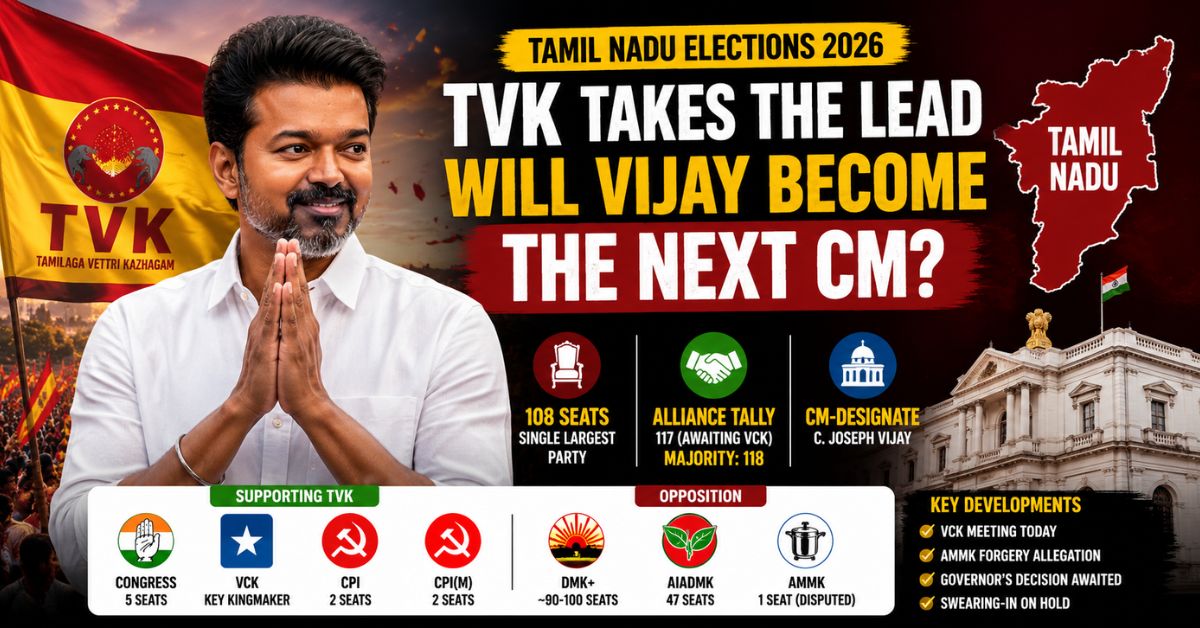
- TVK emerged as the single largest party in the 2026 Tamil Nadu Assembly Elections with 108 seats, placing Vijay at the center of government formation talks.
- Vijay remains CM-designate as the TVK-led alliance is currently short of the 118-seat majority mark required in the 234-member Assembly.
- Congress broke its long-standing alliance with DMK and extended conditional support to tvk congress alliance, reshaping Tamil Nadu’s political landscape.
- VCK has emerged as the key kingmaker, with its support expected to push the TVK alliance beyond the majority threshold.
- Legal complaints, coalition bargaining, Governor scrutiny, and opposition resistance have delayed the swearing-in process in Tamil Nadu.
Tamil Nadu is witnessing one of the most dramatic political transitions in its modern history. The 2026 Assembly Election has broken the long-standing dominance of the DMK and AIADMK, opening the door for actor-turned-politician C. Joseph Vijay and his party Tamilaga Vettri Kazhagam (TVK) to emerge as the central force in state politics, as detailed in our election analysis 2026.
For the first time in nearly six decades, a government outside the traditional Dravidian power structure appears close to taking office. Yet the path to power remains uncertain. Coalition negotiations, legal complaints, ideological conditions, and pressure on the Governor have turned Chennai into the center of a rapidly shifting political battle.
As of May 9, 2026, Vijay remains the Chief Minister-designate, but the final swearing-in still depends on whether the TVK-led alliance can formally cross the 118-seat majority mark in the 234-member Tamil Nadu Assembly.
TVK Emerges as the Single Largest Party in Tamil Nadu
The biggest political story of the 2026 election has been the rise of TVK from a newly launched political movement into the single largest party in the state, highlighted by the TVK Murughan R.S. win.
TVK secured 108 seats in the Assembly, though the effective strength is currently treated as 107 because Vijay must vacate one of the two constituencies he won. Even then, the result has fundamentally changed Tamil Nadu politics.
The outcome signals a clear shift among urban youth voters, first-time voters, sections of women voters, and anti-incumbency groups that were looking for an alternative to both the DMK and AIADMK, as seen in the Vijaysaravanan Thanjavur victory.
The election result also established Vijay as more than a celebrity entrant, making the Tiruchirappalli West result 2026 a significant point of interest in Tamil Nadu politics. His campaign strategy focused heavily on governance reform, anti-corruption messaging, welfare continuity, and a promise to create what TVK repeatedly described as a “new political culture” in Tamil Nadu.
That message appears to have connected strongly across western districts, parts of northern Tamil Nadu, and urban centers like Chennai, Coimbatore, and Madurai.
Why Vijay Has Not Yet Taken Oath as Chief Minister
Despite emerging as the single largest party, Vijay has not yet been invited to form the government because TVK remains short of the majority mark.
The current Assembly requires 118 MLAs for a simple majority. TVK’s confirmed tally, along with declared alliance support, currently stands at 117.
The Governor, Rajendra Arlekar, has reportedly insisted on physical proof of majority support before formally inviting Vijay to take oath as Chief Minister.
This has created a constitutional and political confrontation.
Several legal experts and former law ministers have argued that the Governor should first invite the single largest party to form the government and allow a floor test later inside the Assembly. A writ petition has reportedly already been filed in the Supreme Court seeking intervention on this issue.
The delay has increased political tension because the tenure of the current Assembly effectively ends on May 10, creating fears of constitutional uncertainty if a government is not sworn in quickly.
Congress Breaks Alliance With DMK to Support TVK
Perhaps the most shocking development after the election has been the Congress party’s decision to break away from the DMK alliance and extend support to TVK.
The Congress won five seats and has offered conditional support to Vijay’s coalition. The move ended nearly two decades of political cooperation between Congress and the DMK in Tamil Nadu.
This decision has reportedly triggered serious internal friction between the DMK leadership and the national Congress leadership.
According to political observers, Congress calculated that supporting Vijay would keep the party politically relevant in a changing Tamil Nadu landscape where younger voters increasingly favor fresh leadership over traditional alliance politics.
However, Congress support came with conditions.
The party reportedly insisted that any TVK-led government must maintain a secular platform and avoid any direct or indirect understanding with the BJP. This condition has become one of the defining ideological foundations of the emerging coalition.
VCK Holds the Key to Government Formation
VCK Backs TVK as Vijay Moves Closer to Forming Tamil Nadu Government
VCK has officially extended support to Vijay-led TVK, pushing the alliance beyond the majority mark in Tamil Nadu. The latest political developments have strengthened Vijay’s position to become the next Chief Minister.
At the center of the current deadlock is Viduthalai Chiruthaigal Katchi, commonly known as VCK.
The party, led by Thol. Thirumavalavan, currently holds the deciding votes that could push the TVK alliance beyond the majority mark.
VCK is expected to contribute two MLAs. If the party formally submits its support letter to the Governor, the TVK coalition tally would rise to 119, comfortably crossing the majority requirement.
That is why all political attention in Tamil Nadu today is focused on the VCK leadership meeting taking place in Chennai.
The negotiations are not merely symbolic. Reports suggest VCK is seeking meaningful power-sharing arrangements rather than outside support.
Discussions reportedly include demands for cabinet representation, stronger Scheduled Caste welfare measures, and even the possibility of a Deputy Chief Minister position.
This marks a major change in Tamil Nadu coalition culture.
Traditionally, both DMK and AIADMK dominated alliances without giving significant power-sharing roles to smaller partners. The TVK era appears to be forcing a different model where allies demand direct participation in governance.
CPI and CPI(M) Extend Support to TVK
The Left parties have also become important players in the ongoing government formation process.
Communist Party of India and Communist Party of India (Marxist), which hold two seats each, initially appeared uncertain about supporting TVK.
However, both parties later extended support to the Vijay-led front, taking the confirmed alliance tally to 117.
The Left parties have also openly criticized the Governor’s handling of the situation. Leaders from both CPI and CPI(M) warned that delaying the swearing-in of a popularly elected government could create a constitutional crisis.
They argued that democratic convention requires giving the single largest party the first opportunity to prove majority support on the Assembly floor.
DMK Faces a New Political Reality
For the Dravida Munnetra Kazhagam and Chief Minister M.K. Stalin, the election has become a moment of deep political reassessment.
The DMK alliance secured around 73 seats, while the DMK itself won 59. Although the party remains the principal opposition force, the loss of Congress support has weakened its immediate post-election strategy.
DMK leaders reportedly described Congress’s decision to back TVK as a “backstab” and accused the national leadership of sacrificing ideological consistency for political survival.
The party is now trying to hold together its remaining alliance structure, especially among minority-based and Left-oriented parties.
The Indian Union Muslim League has already denied speculation that it may support TVK, publicly reaffirming support for the DMK bloc.
Even so, the broader political reality is difficult for the DMK leadership. For the first time in years, the party is confronting the possibility that Tamil Nadu’s political center may permanently shift toward a new force.
AIADMK Reduced to Third Position
The election has also produced a major setback for the All India Anna Dravida Munnetra Kazhagam.
The AIADMK secured 47 seats and has officially fallen behind both TVK and the DMK alliance in the Assembly hierarchy.
Rumors briefly circulated about possible backchannel talks between AIADMK and TVK, particularly among anti-DMK strategists seeking a broader front. However, no formal support has emerged.
AIADMK leaders have instead prepared to function from the opposition benches, while attempting to prevent further erosion of their voter base toward TVK.
For many analysts, the 2026 election marks the deepest structural crisis AIADMK has faced since the death of J. Jayalalithaa.
The AMMK Forgery Allegation Adds Legal Drama
The political battle has also entered legal territory.
T.T.V. Dhinakaran filed a police complaint alleging that TVK submitted a forged support letter from AMMK MLA S. Kamaraj to the Governor.
According to Dhinakaran, the support letter was unauthorized and invalid.
TVK responded aggressively by releasing a video that allegedly shows the MLA voluntarily signing the support document.
This public dispute has intensified scrutiny around every single vote required for government formation. Since the coalition remains numerically fragile, even one disputed MLA has become politically significant.
The controversy has reportedly contributed to the Governor delaying a final decision regarding the invitation to form government.
Rahul Gandhi Cancels Chennai Visit
Another major development came when Rahul Gandhi reportedly cancelled his scheduled visit to Chennai.
He was expected to attend the possible swearing-in ceremony at the Jawaharlal Nehru Indoor Stadium. His cancellation is being interpreted as a signal that the Congress leadership does not yet believe the numbers are fully secure.
Preparations at the venue, however, continue.
Security arrangements remain active, and TVK supporters have gathered in large numbers across Chennai anticipating a last-minute breakthrough in negotiations.
VCK Social Media Controversy Deepens Speculation
Adding to the uncertainty, the official VCK account on X was suddenly suspended after a post appeared to indicate support for the TVK coalition.
The suspension triggered intense speculation online.
Some political observers claimed it could have been the result of internal disagreement within the party, while others suspected a coordinated cyberattack targeting the sensitive coalition talks.
Although VCK leaders later attempted to downplay the incident, the episode reflected the highly volatile environment surrounding the current negotiations.
A Historic Political Transition in Tamil Nadu
Regardless of the final swearing-in timeline, the 2026 election has already changed Tamil Nadu politics permanently.
The rise of Vijay and TVK has disrupted the DMK-AIADMK binary that dominated the state for generations. The election has also shown that celebrity politics in Tamil Nadu can evolve beyond campaign symbolism into actual governance power.
More importantly, the current negotiations reveal a new coalition era where smaller parties are no longer willing to remain silent alliance partners.
As of now, the entire political future of Tamil Nadu depends on a few crucial developments expected over the next several hours.
If VCK formally joins the alliance, Vijay is likely to become the next Chief Minister of Tamil Nadu and lead the state’s first non-Dravidian-led government in nearly 60 years.
Until then, the state remains in suspense, waiting for the final numbers that could reshape Tamil Nadu politics for the next decade.