Assembly Election Results 2026 Reshape Political Landscape Across India
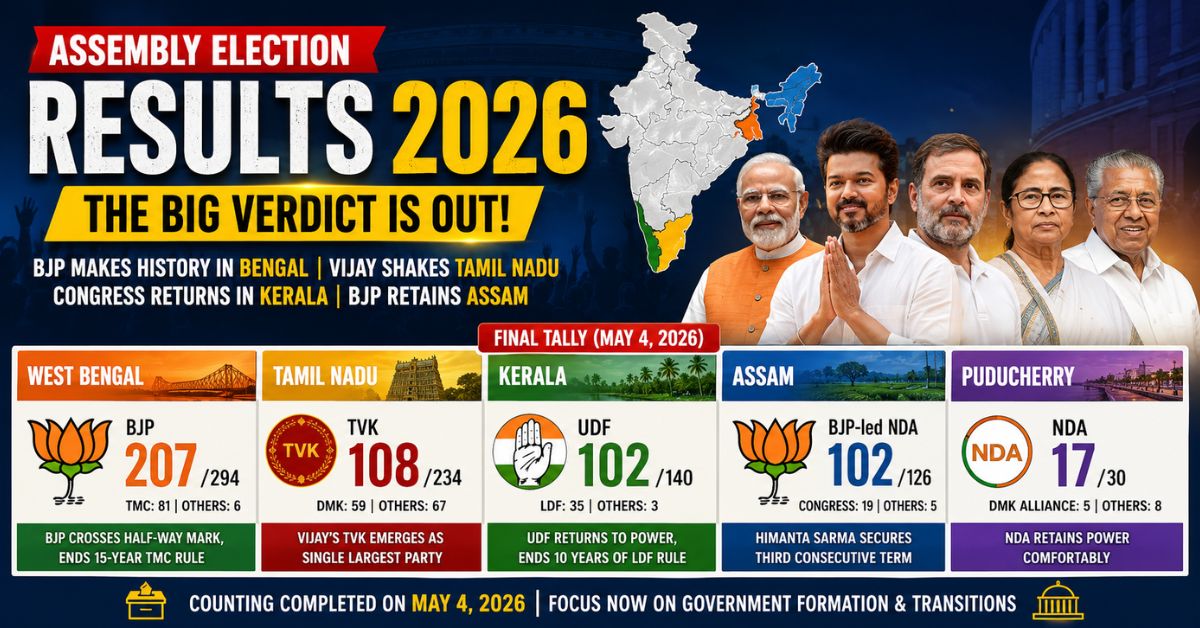
- BJP scripted a historic victory in West Bengal by winning 207 seats and ending Mamata Banerjee’s 15-year rule in the state.
- Actor Vijay’s TVK emerged as the single largest party in Tamil Nadu with 108 seats and is currently working to complete coalition talks for government formation.
- The Congress-led UDF returned to power in Kerala with a landslide 102-seat victory, ending a decade of LDF rule under Pinarayi Vijayan.
- Himanta Biswa Sarma secured a third consecutive term for the BJP-led NDA in Assam with a commanding performance across the state.
- Post-result developments including coalition negotiations, leadership transitions, and post-poll violence have become the immediate focus after the counting concluded on May 4, 2026.
The 2026 Assembly Election Results have redrawn India’s political map in one of the most dramatic state election cycles in recent years. From the BJP’s historic breakthrough in West Bengal to actor Vijay’s political rise in Tamil Nadu, the results have produced major shifts that are likely to influence national politics ahead of the 2029 Lok Sabha elections.
The elections were held across West Bengal, Tamil Nadu, Kerala election schedule, Assam, and Puducherry, covering a total of 824 assembly seats. Counting took place on May 4, 2026, with the Election Commission overseeing one of the largest state-level electoral exercises in the country.
What makes these Assembly Election Results especially important is the scale of anti-incumbency seen in several states, the emergence of new political forces, and the collapse of long-standing political assumptions. Two chief ministers lost power, regional strongholds changed hands, and several national parties now face difficult questions about their future strategies.
Final Assembly Election Results 2026
| State | Total Seats | Majority Mark | Winning Alliance/Party | Seats Won | Runner-Up |
|---|---|---|---|---|---|
| West Bengal | 294 | 148 | BJP | 207 | TMC – 81 |
| Tamil Nadu | 234 | 118 | TVK | 108 | DMK – 59 |
| Kerala | 140 | 71 | UDF | 102 | LDF – 35 |
| Assam | 126 | 64 | BJP-led NDA | 102 | Congress – 19 |
| Puducherry | 30 | 16 | NDA | 17 | DMK Alliance – 5 |
West Bengal Witnesses Historic BJP Victory
The biggest headline of the 2026 Assembly Election Results came from West Bengal. The BJP crossed the majority mark comfortably by winning 207 seats, ending Mamata Banerjee’s 15-year rule in the state.
For years, Bengal had remained politically difficult terrain for the BJP despite its rise in national politics. The 2026 result changes that completely. The party not only formed a majority government but also expanded deep into districts that had traditionally voted for the Trinamool Congress.
The most symbolic moment came from Bhabanipur, where Suvendu Adhikari defeated Mamata Banerjee by more than 15,000 votes. That contest quickly became the defining image of the election cycle.
Political analysts believe several factors contributed to the BJP surge. These included anti-incumbency, allegations of corruption, local organizational expansion, and voter fatigue after years of TMC dominance. The campaign also saw heavy polarization and extremely high voter mobilization.
West Bengal recorded nearly 93 percent voter turnout, one of the highest in the state’s electoral history. The Election Commission deployed more than 2.5 lakh central security personnel during and after polling due to fears of violence.
The aftermath of the Bengal result has also remained tense. Reports of post-poll clashes emerged from Kolkata, Birbhum, and North 24 Parganas. Multiple incidents of vandalism and political violence were reported after the declaration of results. The Election Commission later ordered strict action against those involved.
The BJP leadership has now appointed Amit Shah as central observer for the selection of the next chief minister. The decision highlights how seriously the party views its first full-scale victory in Bengal.
Tamil Nadu Election Results Deliver the “Vijay Factor”
If Bengal represented a political breakthrough, Tamil Nadu represented a political earthquake.
Tamilaga Vettri Kazhagam, led by actor Vijay, emerged as the single largest party with 108 seats in its very first assembly election. The result disrupted decades of domination by the DMK and AIADMK.
Although TVK fell short of the majority mark of 118 seats, Vijay quickly began negotiations with smaller parties and independents. Congress, which won 5 seats, extended support but reportedly placed conditions regarding any future alliance with the BJP or NDA partners.
The rise of Vijay is now being described as one of the fastest political transformations in modern Tamil Nadu politics. His campaign combined massive youth outreach, digital engagement, fan-club networks, and anti-establishment messaging.
According to several political reports, TVK’s social media operation played a major role in shaping public opinion during the campaign. Instead of relying mainly on traditional rallies, the party built a highly controlled digital image around Vijay as a clean and modern political alternative.
The defeat of the DMK was particularly damaging because Chief Minister MK Stalin also lost his own constituency in Kolathur. That outcome further strengthened the perception that Tamil Nadu voters were seeking generational change.
Industry circles are now closely watching Vijay’s next moves because Tamil Nadu remains India’s largest manufacturing and electronics hub. Companies linked to automotive production, semiconductors, electronics, and mobile phone manufacturing are expected to monitor the stability of the incoming coalition carefully.
At present, the swearing-in ceremony has reportedly been delayed slightly while coalition talks continue. Still, Vijay is expected to become the next chief minister once alliance negotiations are completed.
Kerala Returns to Political Alternation
Kerala once again followed its long-standing pattern of changing governments every election cycle.
The Congress-led United Democratic Front won 102 seats, comfortably defeating the Left Democratic Front, which managed only 35 seats. The result ended ten years of LDF rule under Pinarayi Vijayan.
The scale of the defeat has national implications because Kerala was the last major state governed by the Left. The result now leaves communist parties without power in any Indian state for the first time in decades.
Political observers noted that the UDF campaign focused heavily on unemployment, rising prices, governance fatigue, and local dissatisfaction with the state administration. Congress also benefited from improved coordination with allies such as the Indian Union Muslim League, which won 22 seats.
Following the results, Pinarayi Vijayan formally resigned as chief minister. Meetings are currently taking place within the UDF to finalize the next chief ministerial candidate.
The BJP also improved its presence in Kerala by winning three seats, including Nemom and Kazhakuttam. While still far from becoming a major force in the state, the result indicates gradual organizational growth.
Assam Gives BJP a Third Consecutive Term
In Assam, Himanta Biswa Sarma strengthened his position further by leading the BJP-led NDA to a third consecutive term in office.
The NDA won 102 seats in total, while the Congress struggled to cross 20 seats. The result was seen as a major endorsement of Sarma’s leadership style and organizational control over the state’s political machinery.
The BJP performed strongly across urban constituencies as well as several rural belts where anti-incumbency was expected to affect the ruling alliance. Instead, the party managed to maintain its support base through welfare schemes, identity politics, and organizational consolidation.
One of the notable moments of the election was the defeat of several high-profile Congress figures. The party now faces questions about leadership, strategy, and regional relevance in the Northeast.
J.P. Nadda has been appointed as observer for the formal government formation process, although Sarma’s continuation as chief minister is already considered certain.
Puducherry Stays with NDA
Puducherry produced a more stable result compared to the larger states.
The NDA secured 17 seats in the 30-member assembly, allowing the alliance to comfortably retain power in the Union Territory. The All India NR Congress emerged as the largest partner within the alliance by winning 12 seats.
The DMK alliance failed to gain enough momentum despite hopes of benefiting from anti-incumbency.
Attention has now shifted toward power-sharing discussions inside the NDA, especially regarding ministerial distribution and administrative control.
Why the 2026 Assembly Election Results Matter Nationally
These Assembly Election Results are likely to affect national politics far beyond the five states involved.
For the BJP, the Bengal victory represents a psychological and strategic breakthrough in eastern India. For Congress, Kerala provides temporary relief after disappointing performances elsewhere. Regional parties, meanwhile, now face growing challenges from both national parties and emerging local movements.
Tamil Nadu may become the most closely watched state over the next three years because Vijay’s rise could inspire similar celebrity-led political experiments in other parts of the country.
The results also reveal how rapidly voter behavior is changing. Traditional caste equations, historical loyalties, and legacy party structures are no longer guaranteeing electoral success.
Digital campaigning, leadership image, local governance issues, and youth mobilization played a major role in shaping the 2026 verdict.
As government formation continues in Tamil Nadu and leadership transitions unfold in Bengal and Kerala, the political effects of these Assembly Election Results are only beginning to emerge.
For now, one conclusion is clear. The 2026 elections have reshaped India’s regional political balance in ways few expected before counting day.