


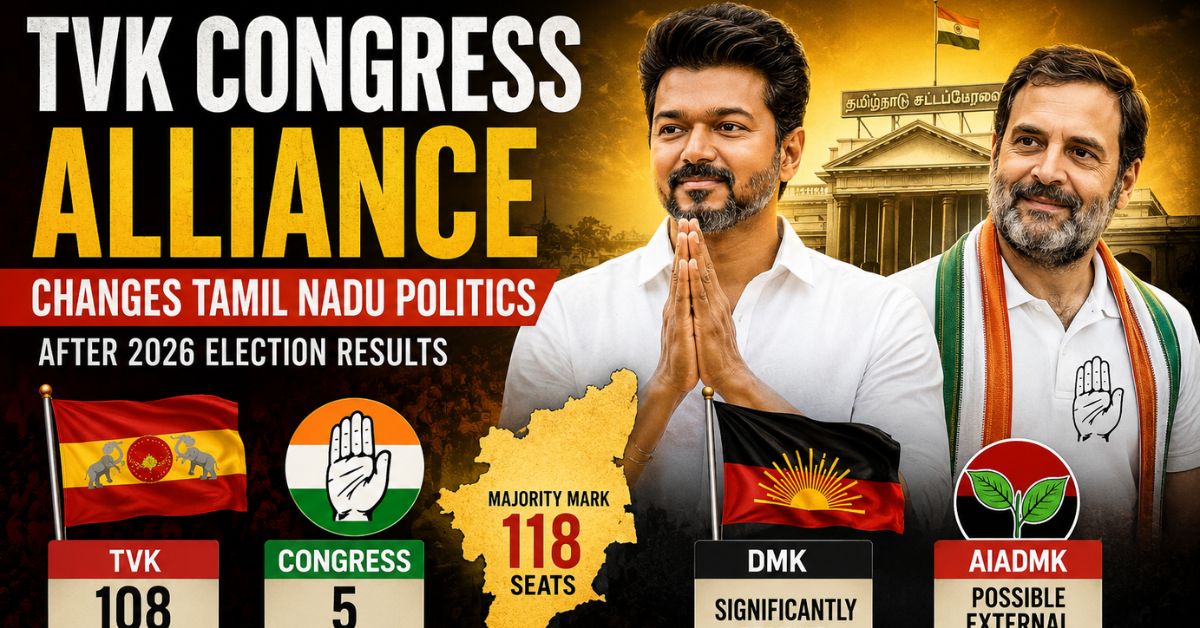
TVK Congress Alliance Reshapes Tamil Nadu Politics After 2026 Election Results
- Congress has officially ended its long-standing alliance with DMK to support Vijay’s TVK in forming the Tamil Nadu government.
- TVK emerged as the single largest party with 108 seats, while Congress added 5 seats, taking the alliance tally to 113.
- The Congress support comes with a strict condition that TVK must avoid any alliance or support arrangement involving BJP.
- Reports suggest Congress may receive two cabinet ministries in the proposed TVK-led government.
- TVK is continuing talks with smaller parties and independents to secure the remaining numbers needed for majority.
Tamil Nadu politics has entered a completely new phase after the dramatic rise of C. Joseph Vijay and his party, Tamilaga Vettri Kazhagam. The biggest development after the 2026 Assembly election results is the formal decision of the Indian National Congress to support TVK and walk away from its long-standing alliance with the Dravida Munnetra Kazhagam.
The TVK Congress alliance has now become the center of political discussion across Tamil Nadu and national politics. For the first time in decades, the state appears ready to move beyond the traditional DMK versus AIADMK contest that shaped Tamil Nadu elections for generations.
The 2026 Tamil Nadu Assembly election produced a fractured mandate, but it also delivered a clear political message. Voters wanted change, and TVK emerged as the biggest symbol of that shift.
TVK Emerges as the Single Largest Party
The 234-member Tamil Nadu Assembly requires 118 seats for a majority. TVK won 108 seats in its first major Assembly election contest, making it the single largest party in the state. Congress secured 5 seats, taking the alliance tally to 113, still short of the majority mark.
The election result itself was historic because it broke the long-standing dominance of DMK and AIADMK in Tamil Nadu politics. Analysts are already calling it one of the biggest political realignments in the state since 1967.
TVK’s rise was not seen as only a celebrity-driven campaign. Reports suggest the party built a disciplined political structure through years of groundwork, digital outreach, and youth mobilization.
Many young voters, first-time voters, and urban middle-class families appeared drawn to Vijay’s message of political change, clean governance, and economic growth. His popularity from cinema helped, but political observers believe the anti-incumbency mood against both DMK and AIADMK also played a major role.
Why Congress Left the DMK Alliance
One of the most surprising developments after the election was Congress deciding to end its partnership with DMK.
The Congress-DMK alliance had remained largely intact since 2004 and played a major role in both state and national elections. However, the poor election performance of the alliance and the sudden rise of TVK forced Congress leadership to rethink its political future in Tamil Nadu.
According to reports, Congress leaders described their support to TVK as “conditional support” aimed at forming a secular government in Tamil Nadu. The party clearly stated that TVK should not align with BJP or BJP-backed forces.
Senior Congress leaders also reportedly secured assurances about cabinet representation in the proposed government. Multiple reports indicate that Congress may receive two ministerial positions if the TVK-led government is formed successfully.
This power-sharing arrangement is significant because Congress had long expressed dissatisfaction over limited influence in the previous DMK-led alliance structure.
The move also signals that Congress sees TVK as a long-term political investment rather than only a temporary post-election arrangement.
The “No BJP” Condition in the TVK Congress Alliance
The strongest condition attached to the TVK Congress alliance is the “anti-communal” clause.
Congress leaders have publicly stated that TVK must avoid seeking support from BJP or BJP-aligned factions. This condition has become central to the negotiations because Tamil Nadu politics traditionally remains resistant to BJP expansion compared to several northern states.
Congress believes maintaining a secular image is essential for both parties if they want to expand the alliance before the 2029 Lok Sabha elections.
Political observers say this condition may complicate TVK’s efforts to secure additional support because some AIADMK factions remain connected to BJP at the national level.
Still, TVK appears focused on building a broader regional coalition rather than moving closer to BJP.
DMK Calls Congress “Backstabbers”
The collapse of the DMK-Congress alliance has triggered a sharp political reaction.
DMK leaders openly criticized Congress after reports confirmed the support arrangement with TVK. Some DMK spokespersons described Congress as “backstabbers” for abandoning the alliance immediately after election results were declared.
For DMK, the political damage is serious. The party not only lost power but also lost a national ally that had remained with it for nearly two decades.
The defeat is expected to trigger major internal discussions inside DMK regarding leadership strategy, alliance management, and voter dissatisfaction.
Several political analysts believe DMK underestimated the emotional and political appeal of Vijay among younger voters and urban constituencies.
TVK Still Needs More Numbers
Even after Congress support, TVK remains short of the majority mark.
The alliance currently stands at 113 seats, which means Vijay still requires support from at least five more MLAs to comfortably form the government.
Reports suggest TVK has started discussions with smaller parties, independents, and regional outfits. Some reports also mention informal communication with sections of AIADMK.
However, AIADMK publicly denied any formal alliance discussions in some media interactions, showing that negotiations remain fluid and politically sensitive.
TVK is also expected to seek support from Left parties, VCK, PMK, and independent MLAs to cross the majority line safely.
This political uncertainty has delayed the final government formation process. Reports indicate the Governor is still assessing whether TVK can demonstrate stable numbers before inviting the party to form the government officially.
Seat Position and Government Formation Status
| Party | Seats Won (2026) | Role in Political Scenario |
|---|---|---|
| TVK | 108 | Single Largest Party |
| Congress | 5 | Alliance Partner |
| DMK | Significantly Reduced | Main Opposition |
| AIADMK | Variable | Possible External Support |
Vijay’s Transition From Actor to Chief Ministerial Candidate
The rise of Vijay from cinema superstar to chief ministerial contender has become one of the biggest political stories in India.
His transformation from actor to politician gained momentum after he officially launched TVK and announced his full-time entry into politics. Within a short period, the party managed to build strong grassroots networks across Tamil Nadu.
Political experts say Vijay successfully combined celebrity appeal with organizational discipline. His campaign relied heavily on social media outreach, carefully managed public appearances, and strong engagement with youth voters.
The TVK campaign also focused on welfare politics, employment generation, industrial growth, education, and corruption-free governance.
This messaging helped TVK position itself as a fresh alternative between the established DMK and AIADMK structures.
Business Community Watching the TVK Congress Alliance Closely
Tamil Nadu remains one of India’s largest industrial and manufacturing states. Global companies including Apple suppliers, Hyundai, Samsung, and major automobile manufacturers have large investments in the state.
Because of this, investors and industry leaders are closely monitoring the TVK Congress alliance and the possible new government.
Business groups remain hopeful but cautious because many TVK candidates are first-time legislators with limited governance experience.
At the same time, Vijay has promised economic continuity, investment growth, AI development, electric vehicle expansion, and semiconductor manufacturing initiatives.
If TVK successfully forms the government, maintaining investor confidence will become one of its first major tests.
The 2029 Lok Sabha Strategy Has Already Started
Congress leaders have made it clear that this alliance is not only about government formation in 2026.
The party reportedly views TVK as a long-term partner for local body elections and the 2029 Lok Sabha elections. This indicates that both parties are trying to build a broader anti-BJP and anti-DMK political platform in Tamil Nadu.
For Congress, aligning with a rising regional force may help rebuild its declining influence in Tamil Nadu.
For TVK, Congress provides national-level political connections, parliamentary experience, and organizational support beyond state politics.
If the partnership survives the initial government formation stage, it could become one of the most important regional-national political alliances in South India.
A Historic Turning Point in Tamil Nadu Politics
The TVK Congress alliance has changed the direction of Tamil Nadu politics within days of the election results.
The fall of the DMK-Congress partnership, the rise of Vijay’s TVK, and the uncertainty surrounding coalition numbers have created one of the most unpredictable political moments in the state’s modern history.
Tamil Nadu voters now appear ready for a new political structure where cinema influence, youth mobilization, social media strategy, and coalition politics all play a major role together.
Whether the TVK Congress alliance becomes a stable long-term partnership or only a temporary arrangement will depend on the next few weeks of negotiations and government formation.
For now, one thing is clear. Tamil Nadu politics has entered a completely new era.