


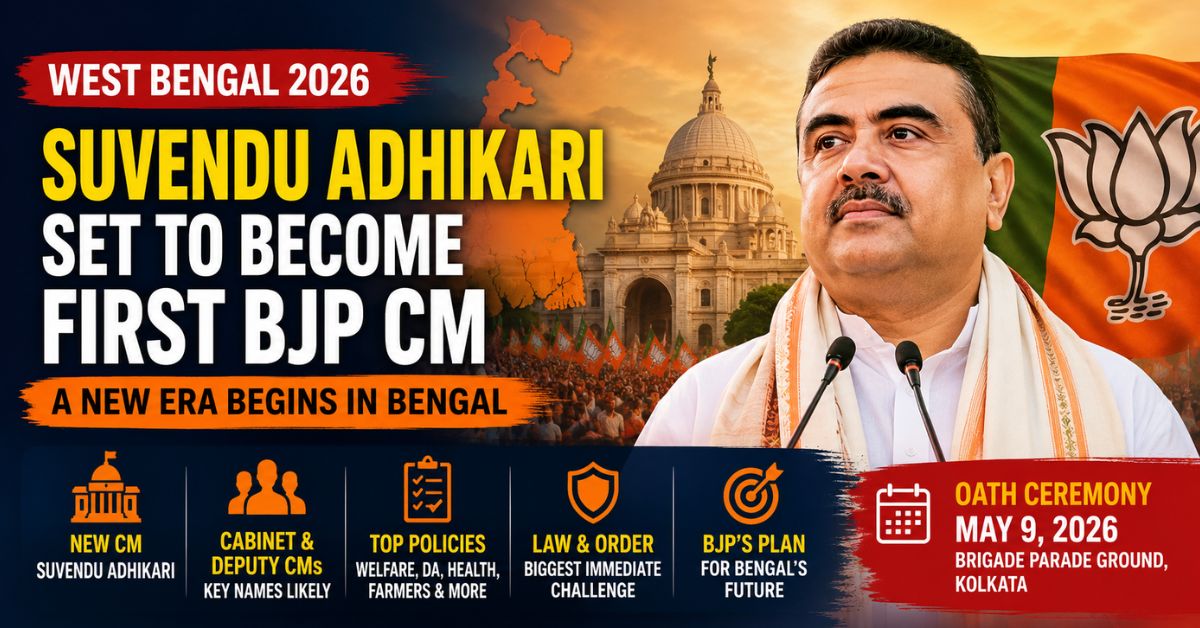
West Bengal’s Political Shift: Suvendu Adhikari Set To Become First BJP Chief Minister
- Suvendu Adhikari has been elected as BJP legislature party leader and will take oath as West Bengal Chief Minister on May 9, 2026.
- The BJP is forming its first-ever government in West Bengal after defeating the TMC in the 2026 Assembly Elections.
- The new government is expected to announce welfare schemes, Ayushman Bharat rollout, 7th Pay Commission benefits, and farmer support measures.
- Two Deputy Chief Ministers may be appointed to balance representation from South Bengal and North Bengal.
- The incoming administration faces immediate pressure over law and order, post-poll violence, and delivery of major campaign promises.
West Bengal is entering one of the biggest political transitions in its modern history. After nearly 15 years of Trinamool Congress rule under Mamata Banerjee, the Bharatiya Janata Party has emerged victorious in the 2026 Assembly Elections and is now preparing to form its first-ever government in the state.
At the center of this political shift is Suvendu Adhikari, who was formally elected as the leader of the BJP legislature party on May 8, 2026. The decision clears the way for him to become the next Chief Minister of West Bengal during the oath-taking ceremony scheduled for May 9 at Kolkata’s Brigade Parade Ground.
The Rise of Suvendu Adhikari in Bengal Politics
The political journey of Suvendu Adhikari has become one of the defining stories of Bengal politics over the last decade. Once considered a trusted lieutenant of Mamata Banerjee inside the Trinamool Congress, Adhikari later shifted to the BJP and became the party’s strongest face in Bengal.
His latest victory has further strengthened his image as the BJP’s “giant slayer.” In the 2026 Assembly Elections, Adhikari defeated Mamata Banerjee in the Bhabanipur constituency by more than 15,000 votes.
Political observers see this win as more than a constituency battle. Bhabanipur had long been associated with Mamata Banerjee’s political identity. The BJP’s victory there became a symbolic moment in the state election.
Adhikari was unanimously chosen as BJP legislature party leader during a meeting attended by Union Home Minister Amit Shah in Kolkata.
The swearing-in ceremony has been deliberately scheduled on Rabindra Jayanti, the birth anniversary of Rabindranath Tagore, adding cultural symbolism to the beginning of the new administration.
BJP’s Historic Victory in West Bengal Elections 2026
The 2026 Assembly Election result has dramatically altered Bengal’s political map. BJP crossed the majority mark comfortably and secured more than 200 seats, while the Trinamool Congress was reduced to roughly 80 seats.
This outcome is significant because West Bengal had remained one of the few major states where the BJP had failed to establish a government despite years of organizational expansion.
The BJP’s campaign focused heavily on law and order, corruption allegations, welfare restructuring, women’s safety, and financial support schemes. The party also positioned the election as a referendum on governance after years of TMC rule.
Several northern districts and urban belts witnessed major swings in favor of BJP candidates. Analysts have pointed to anti-incumbency, organizational growth, and aggressive booth-level campaigning as major reasons behind the outcome.
The election also recorded very high voter participation. Reports suggest turnout crossed 92 percent, making it one of the highest participation rates in Bengal’s electoral history.
Mamata Banerjee and the End of the TMC Government
For Mamata Banerjee, the election result represents the biggest setback of her political career. Since coming to power in 2011 and ending the Left Front’s long rule, she had remained the central political figure in Bengal.
Following the election results, Banerjee initially refused to resign and alleged conspiracy and electoral manipulation.
However, the constitutional process moved ahead rapidly. Governor R. N. Ravi officially dissolved the outgoing legislative assembly on May 7, legally ending the TMC government’s tenure and clearing the path for government formation by the BJP.
Despite the defeat, Trinamool Congress leaders have indicated that the party will continue as the principal opposition force in the state assembly.
Political analysts believe the next few months will determine whether the TMC can reorganize itself after the loss or whether Bengal politics is entering a longer BJP-dominated phase.
West Bengal Cabinet and Deputy Chief Ministers
Although the final cabinet list is expected during the swearing-in ceremony, several names are already being discussed inside political circles.
The BJP is reportedly considering a two-Deputy Chief Minister model to balance regional representation and caste demographics within the state.
Among the strongest names being discussed is Agnimitra Paul, who is seen as a prominent face from South Bengal and an important woman leader within the state BJP unit.
From North Bengal, leaders such as Nisith Pramanik and Deepak Barman are reportedly under consideration.
Senior BJP leaders including Dilip Ghosh and Locket Chatterjee are also expected to receive important responsibilities in the administration.
The BJP leadership appears focused on combining experienced leaders with younger faces in order to create a cabinet that can manage both governance and political messaging.
Top Policies Expected From the New West Bengal Government
The BJP’s “Sankalpa Patra” played a major role during the election campaign. The incoming administration is now under pressure to begin implementation quickly.
Annapurna Financial Scheme
One of the first expected announcements is the rollout of the “Annapurna” welfare program for women.
The BJP has promised to increase monthly financial assistance for women to ₹3,000. The scheme is expected to either replace or significantly expand the existing Lakshmir Bhandar structure introduced during the TMC government.
This promise became one of the BJP’s strongest campaign points in rural Bengal and among women voters.
7th Pay Commission and DA Dues
Another major decision expected in the first cabinet meeting is the implementation of the 7th Pay Commission for state government employees.
The issue of Dearness Allowance arrears had remained politically sensitive under the previous government. BJP leaders repeatedly raised the issue during the campaign and promised quick resolution after coming to power.
If implemented rapidly, the move could help the new administration build goodwill among government staff and pensioners.
Ayushman Bharat in West Bengal
Healthcare integration is also expected to become a major early policy move.
West Bengal had previously stayed outside the Ayushman Bharat scheme. The new government is expected to formally join the central health insurance program, which provides medical coverage of up to ₹5 lakh per family.
The BJP argued during the election campaign that Bengal residents were missing the benefits available in many other states.
White Paper on State Finances and Corruption
Suvendu Adhikari has repeatedly spoken about releasing a “White Paper” on the state’s finances after assuming office.
The proposed document is expected to examine alleged corruption, financial liabilities, recruitment controversies, and accusations involving syndicate and “cut money” systems under the previous administration.
This is likely to become one of the BJP government’s central political and administrative themes in the early months.
PM-Kisan Expansion and Farmer Support
Agriculture remains politically important across Bengal’s rural districts.
The BJP government is expected to fully integrate the state with the PM-Kisan scheme while also adding a state-level top-up. Combined assistance could reportedly reach ₹9,000 annually for eligible farmers.
The administration is also expected to push for better procurement systems and higher MSP support for paddy farmers.
Law and Order Challenges After the Election
Even before the swearing-in ceremony, the state has witnessed serious political tension and violence.
The killing of Chandranath Rath, a close aide of Suvendu Adhikari, intensified the already tense political atmosphere. BJP leaders described the incident as politically motivated, while investigations remain ongoing.
Reports of clashes and arrests in several districts have raised concerns regarding post-poll violence. Security deployment has been increased in sensitive areas ahead of the oath-taking ceremony.
Adhikari has publicly appealed for peace and restraint among party workers.
The incoming administration will likely face immediate scrutiny over its ability to restore stability while avoiding escalation.
BJP’s Long-Term Strategy in West Bengal
The BJP’s Bengal victory is being viewed nationally as a major political breakthrough.
For years, West Bengal remained one of the few large states outside BJP control. The 2026 result changes that equation and significantly expands the party’s influence in eastern India.
Prime Minister Narendra Modi, Amit Shah, and several NDA Chief Ministers are expected to attend the swearing-in ceremony in Kolkata, highlighting the national importance attached to the victory.
The BJP is also expected to move carefully on cultural and ideological issues. Discussions have already begun regarding the formation of a committee to study the implementation of the Uniform Civil Code in West Bengal.
At the same time, the party will attempt to balance ideological commitments with welfare politics and governance delivery.
What Comes Next for West Bengal
The next 30 to 100 days may define the long-term success of the new government.
The BJP must now shift from campaign mode to governance. Delivering on welfare promises, controlling political violence, managing bureaucracy, and maintaining social balance will become immediate priorities.
For Suvendu Adhikari personally, this transition carries enormous expectations. His political rise has been rapid and dramatic, but governing West Bengal presents a different challenge entirely.
The state remains politically charged, socially diverse, and economically complex. Expectations among BJP supporters are extremely high, while opposition resistance is likely to remain strong.
Still, one thing is already clear. The 2026 West Bengal Assembly Election has fundamentally changed the political direction of the state, and Suvendu Adhikari is now preparing to lead that transformation as Bengal’s first BJP Chief Minister.