


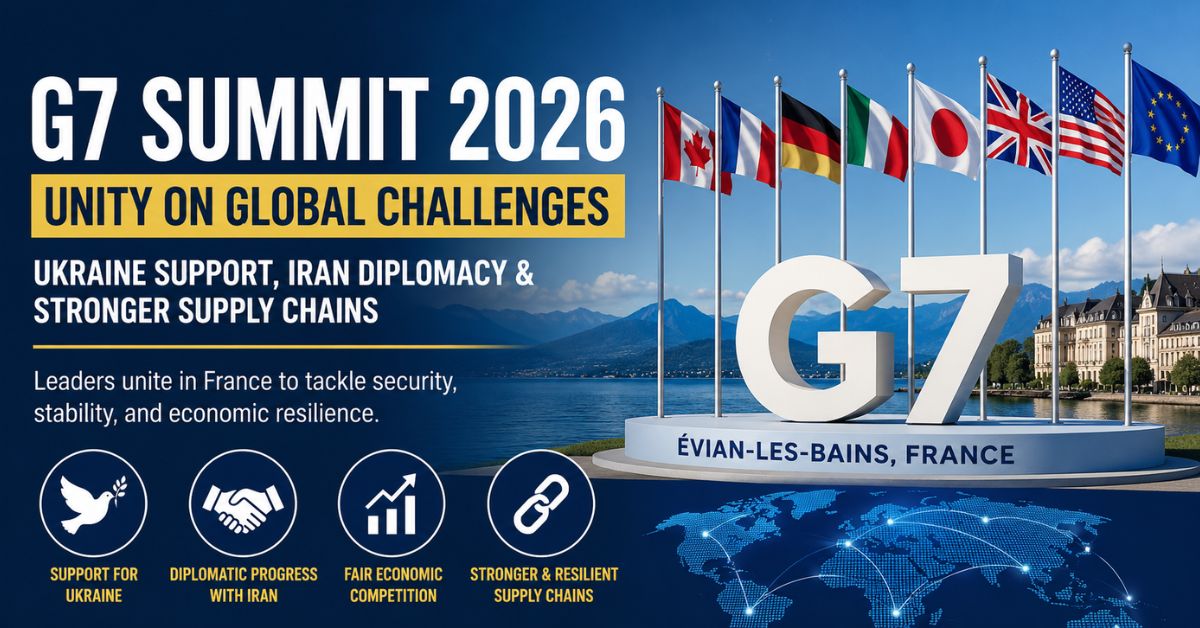
G7 Summit Ends With United Stance on Ukraine, Iran and Supply Chains: Key Highlights
- Leaders at the 2026 G7 Summit in Évian-les-Bains, France, concluded the gathering with a stronger-than-expected display of unity on major global issues.
- The G7 reaffirmed continued support for Ukraine and emphasized the importance of strengthening Kyiv’s defensive capabilities.
- Leaders welcomed diplomatic progress involving Iran and highlighted the need to maintain security in key shipping routes such as the Strait of Hormuz.
- Economic competition with China, including concerns about industrial overcapacity and market imbalances, remained a major topic of discussion.
- The summit placed significant focus on securing critical mineral supply chains and reducing dependence on a limited number of suppliers.
- Indian Prime Minister Narendra Modi participated as an invited leader and held discussions focused on maritime security, trade, and global economic cooperation.
ÉVIAN-LES-BAINS, France — Leaders of the world’s leading industrial democracies concluded the 2026 G7 Summit in France with a stronger-than-expected display of unity on several major global issues, including support for Ukraine, regional stability in the Middle East, and efforts to strengthen critical supply chains.
Held in the lakeside town of Évian-les-Bains from June 15 to June 17, the summit brought together leaders from the Group of Seven nations at a time of rising geopolitical tensions, economic uncertainty, and growing concerns about global trade and security. While disagreements had emerged before the gathering, particularly over foreign policy and economic priorities, the summit ultimately produced a common message on some of the world’s most pressing challenges.
The discussions focused on continued support for Ukraine, diplomatic efforts involving Iran, concerns about China’s economic practices, and the need to reduce vulnerabilities in global supply chains. The summit also featured extensive bilateral meetings, including talks involving Indian Prime Minister Narendra Modi, who attended as a guest leader.
Key G7 Summit Events and Outcomes
| Event | Date |
|---|---|
| G7 Summit Opens in Évian-les-Bains, France | June 15, 2026 |
| Ukraine Support Discussions Intensify | June 15–17, 2026 |
| Iran Diplomacy and Maritime Security Talks | June 15–17, 2026 |
| Final Summit Conclusions Announced | June 17, 2026 |
Ukraine Remains a Central Focus
Support for Ukraine remained one of the most important topics throughout the summit.
Since Russia’s invasion of Ukraine began more than four years ago, Western nations have continued to provide military, financial, and humanitarian support to Kyiv. Questions had emerged before the summit about whether the G7 would be able to maintain a united position given political differences among member countries.
However, leaders ultimately reaffirmed their commitment to supporting Ukraine. The final discussions highlighted the need to continue helping Ukraine strengthen its defenses while increasing pressure on Russia.
European leaders also sought closer coordination with the United States on future assistance. Discussions reportedly included the delivery of additional air defense systems and other military capabilities designed to help Ukraine protect its infrastructure and population from ongoing attacks.
For many European governments, maintaining support for Ukraine remains essential not only for regional security but also for preserving the international rules-based order that has shaped global relations for decades.
The unified message from the summit was seen as an important signal to both Kyiv and Moscow that major Western economies remain committed to supporting Ukraine despite the long duration of the conflict.
G7 Welcomes Diplomatic Progress With Iran
Another significant topic was the situation in the Middle East.
Leaders welcomed recent diplomatic progress involving Iran and expressed hope that negotiations could help reduce tensions across the region. The issue has gained greater urgency due to concerns about regional security, energy supplies, and the safety of international shipping routes.
The Strait of Hormuz received particular attention during discussions. The narrow waterway is one of the world’s most important energy transit routes, with a large share of global oil shipments passing through it every day.
Any disruption in the strait can have immediate effects on energy prices and international trade. As a result, G7 leaders emphasized the importance of maintaining freedom of navigation and protecting commercial shipping.
The focus on Iran reflected broader concerns about stability in West Asia, where conflicts and political tensions continue to affect regional and global markets.
Many countries attending the summit stressed that diplomatic solutions remain the preferred path for preventing further escalation and ensuring long-term stability.
Growing Concerns About China’s Economic Practices
Economic competition with China was another major issue discussed during the summit.
Several G7 leaders raised concerns about what they describe as industrial overcapacity in certain sectors of the Chinese economy. The term refers to a situation where production levels significantly exceed market demand, leading to lower prices and increased pressure on competitors around the world.
Officials from several countries argue that large state support programs and subsidies have contributed to these imbalances in sectors such as electric vehicles, batteries, solar technology, and other strategic industries.
French President Emmanuel Macron and other leaders emphasized the need for fair competition and more balanced global trade conditions.
While the summit did not signal an immediate escalation in economic measures, leaders discussed ways to coordinate their responses to what they view as unfair market practices and economic pressure.
At the same time, G7 governments continue to balance competition with cooperation. China remains one of the world’s largest economies and a critical trading partner for many countries, making complete economic separation unrealistic.
Instead, leaders focused on reducing vulnerabilities while maintaining economic engagement where possible.
Supply Chain Security Becomes a Strategic Priority
The summit also highlighted the growing importance of supply chain resilience.
The COVID-19 pandemic, geopolitical tensions, and recent trade disruptions have exposed weaknesses in global supply networks. As a result, governments have increasingly focused on securing access to critical materials and strategic industries.
One area receiving particular attention was critical minerals.
These materials, including lithium, cobalt, nickel, and rare earth elements, are essential for technologies such as electric vehicles, renewable energy systems, smartphones, advanced electronics, and defense equipment.
Many countries currently depend heavily on a small number of suppliers for these resources. This concentration creates risks if political tensions, trade restrictions, or disruptions affect supply.
G7 leaders discussed efforts to diversify sourcing, support new mining and processing projects, and develop more transparent and sustainable supply chains.
The goal is not only to improve economic security but also to ensure that the transition to cleaner energy technologies is not interrupted by shortages of key materials.
Analysts view critical minerals as one of the most important strategic issues likely to shape global competition over the coming decade.
Development and Financing Challenges Remain on the Agenda
Another area of discussion involved the financial challenges facing developing countries.
Many low-income and middle-income nations continue to struggle with rising debt burdens, higher borrowing costs, and limited access to investment.
Although no major new development framework was formally announced, leaders discussed the need for more effective financing solutions and greater international cooperation.
Debt restructuring remains a particularly important issue. Several countries have faced difficulties meeting repayment obligations while also funding essential public services and infrastructure projects.
International institutions and G20 members have been working to improve debt resolution mechanisms, though progress has often been slow.
G7 leaders signaled support for continued efforts to increase transparency and improve access to financing for countries facing economic pressure.
The discussions reflected a broader recognition that global economic stability depends not only on the performance of major economies but also on the ability of developing nations to achieve sustainable growth.
India’s Role Draws Attention
India’s participation as an invited country attracted significant attention during the summit.
Prime Minister Narendra Modi held several meetings with world leaders on the sidelines, reinforcing India’s growing importance in global economic and geopolitical discussions.
India has increasingly positioned itself as a key voice for developing economies while also expanding partnerships with major Western nations.
During summit-related discussions, Modi highlighted concerns about maritime security and the protection of international trade routes.
These issues have become increasingly important as geopolitical tensions affect shipping lanes that connect Asia, Europe, and the Middle East.
India’s role in global supply chains, technology development, and economic growth has also made it an important partner for many G7 countries seeking to diversify trade relationships and strengthen economic resilience.
As the world’s most populous nation and one of the fastest-growing major economies, India’s influence in international decision-making continues to expand.
A Summit Focused on Practical Challenges
The 2026 G7 Summit may ultimately be remembered less for dramatic announcements and more for its emphasis on practical cooperation.
Leaders faced a world marked by ongoing wars, regional instability, economic competition, and concerns about supply chain security. Rather than pursuing sweeping new initiatives, much of the summit focused on strengthening coordination among major economies and addressing immediate challenges.
The gathering demonstrated that despite political differences, G7 nations continue to find common ground on key security and economic issues.
The strong support for Ukraine, backing for diplomatic efforts involving Iran, attention to supply chain resilience, and discussions about economic competition all reflected a shared concern about maintaining stability in an increasingly complex global environment.
As governments prepare for the next phase of geopolitical and economic challenges, the outcomes from Évian-les-Bains suggest that cooperation among major democracies remains a central part of their strategy for managing an uncertain world.