


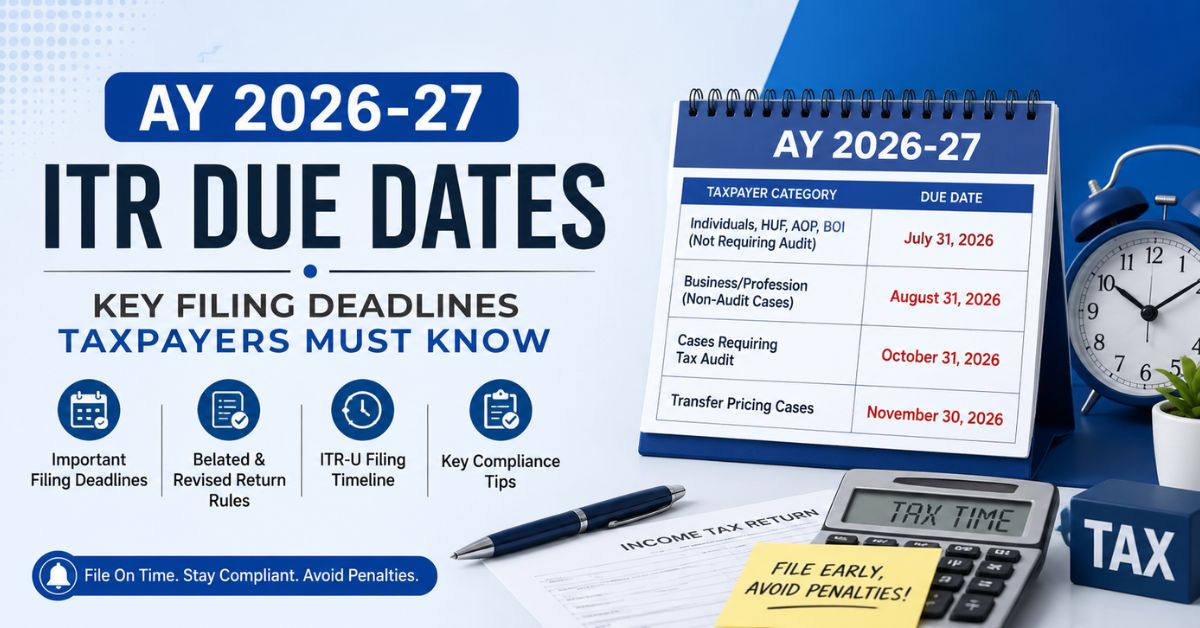
Key Highlights of AY 2026-27 ITR Due Dates
- Individuals, HUFs, AOPs, and BOIs not requiring audit must generally file their Income Tax Returns by July 31, 2026.
- Business and professional taxpayers not requiring audit have time until August 31, 2026 to file their returns.
- Taxpayers covered under tax audit provisions must file returns by October 31, 2026, while transfer pricing cases have a November 30, 2026 deadline.
- Belated returns can generally be filed until December 31, 2026, subject to applicable late fees and interest.
- Taxpayers should verify Form 26AS, AIS, and TIS before filing and choose the correct ITR form to avoid processing issues.
Taxpayers preparing to file their Income Tax Returns (ITRs) for Assessment Year (AY) 2026-27 should take note of the important filing deadlines announced by the Income Tax Department. The deadlines apply to income earned during the Financial Year (FY) 2025-26 and vary depending on the category of taxpayer and whether an audit requirement applies.
Missing the applicable deadline can lead to late filing fees, interest charges, and additional compliance requirements. Tax experts therefore advise taxpayers to begin preparing their returns well before the due date and verify all tax-related information in advance.
For AY 2026-27, individual taxpayers who are not subject to audit requirements will generally need to file their returns by July 31, 2026. Businesses, professionals, and taxpayers covered under audit provisions have separate deadlines extending into October and November 2026.
Key ITR Filing Deadlines for AY 2026-27
The Income Tax Department has prescribed different due dates based on the taxpayer category.
| Taxpayer Category | Due Date |
|---|---|
| Individuals, HUFs, AOPs, BOIs not requiring audit | July 31, 2026 |
| Business and professional taxpayers not requiring audit | August 31, 2026 |
| Taxpayers requiring tax audit | October 31, 2026 |
| Transfer pricing cases | November 30, 2026 |
These deadlines are crucial because filing returns on time helps taxpayers avoid penalties and ensures faster processing of refunds.
Who Needs to File by July 31, 2026?
The July 31 deadline primarily applies to salaried individuals, pensioners, and other taxpayers whose accounts are not required to be audited under tax laws.
Most taxpayers filing forms such as ITR-1 and ITR-2 fall under this category. These forms are commonly used by salaried employees, individuals with income from house property, and taxpayers earning income from sources such as interest.
For many taxpayers, filing before the deadline also reduces the chances of facing technical issues due to heavy traffic on the tax portal during the final days of the filing season.
August 31 Deadline for Non-Audit Business and Professional Taxpayers
Business owners and professionals who do not fall under audit requirements generally have an extended deadline until August 31, 2026.
This category often includes small businesses, consultants, freelancers, and professionals filing returns through forms such as ITR-3 or ITR-4, depending on their eligibility.
The additional time allows taxpayers to complete bookkeeping, reconcile income records, and ensure that all business-related information has been accurately reported.
October 31 Deadline for Audit Cases
Taxpayers whose accounts are required to be audited under income tax provisions must file their returns by October 31, 2026.
Tax audits involve a detailed examination of financial records by a qualified professional. Since audited financial statements and audit reports need to be completed before filing the return, these taxpayers are given a longer compliance timeline.
Returns filed by audited businesses typically use forms such as ITR-3, ITR-5, ITR-6, or ITR-7, depending on the nature of the entity.
Experts note that taxpayers covered under audit requirements should begin preparations well in advance because delays in completing audit procedures can affect return filing timelines.
November 30 Deadline for Transfer Pricing Cases
The final major filing deadline for AY 2026-27 is November 30, 2026, which applies to transfer pricing cases.
Transfer pricing provisions generally apply to certain international and specified domestic transactions involving related parties. Since these cases require additional documentation and reporting requirements, taxpayers are allowed additional time to complete compliance obligations.
Large companies and multinational businesses are among the entities most commonly affected by transfer pricing regulations.
What Happens If You Miss the Original Due Date?
Missing the original due date does not necessarily prevent a taxpayer from filing a return. However, delayed filing may result in financial consequences and compliance complications.
The Income Tax Department allows taxpayers to submit a belated return if they fail to meet the original deadline.
For AY 2026-27, a belated return can generally be filed up to December 31, 2026.
Taxpayers who choose this route may be required to pay a late filing fee and interest on unpaid tax liabilities. The exact amount depends on the taxpayer’s circumstances, income level, and tax payable.
In addition to monetary costs, late filing may also affect certain tax benefits available under the law.
Revised Return Facility Available for Error Correction
Filing a return on time does not always mean the return is error-free.
Taxpayers sometimes discover mistakes after submission. These mistakes may include incorrect income reporting, missing deductions, omitted bank interest, or errors in personal details.
To address such situations, the Income Tax Department allows taxpayers to file a revised return.
A revised return enables taxpayers to correct genuine mistakes and submit updated information without waiting for a tax notice. Tax professionals often recommend reviewing the filed return carefully after submission to identify any possible discrepancies.
The revised return facility plays an important role in helping taxpayers maintain accurate records and reduce the likelihood of future disputes.
ITR-U Option for Missed Filings
Taxpayers who miss both the original and belated filing deadlines may still have another option available through the Updated Return mechanism, commonly known as ITR-U.
The updated return framework was introduced to encourage voluntary compliance and provide taxpayers with an opportunity to correct omissions.
For AY 2026-27, eligible taxpayers can file an updated return until March 31, 2031, subject to applicable conditions, additional tax, and interest payments.
However, filing an updated return generally involves higher compliance costs compared to filing within the regular deadlines. Tax professionals therefore advise taxpayers not to rely on this option unless absolutely necessary.
Also Read
Choosing the wrong ITR form can result in a defective return notice and delays in processing. Learn the key differences between ITR-1, ITR-2, ITR-3, and ITR-4, understand eligibility rules, and find out which form matches your income profile for AY 2026-27.
Why Form 26AS, AIS, and TIS Should Be Checked Before Filing
One of the most common reasons for tax notices is a mismatch between the information reported by the taxpayer and the data available with the Income Tax Department.
Before filing a return, taxpayers should carefully review three important documents:
Form 26AS: Contains details of tax deducted at source (TDS), tax collected at source (TCS), advance tax payments, and certain high-value transactions.
Annual Information Statement (AIS): Provides a broader view of financial transactions reported to the tax department, including interest income, securities transactions, and other financial activities.
Taxpayer Information Summary (TIS): Offers a summarized version of information available in the AIS and helps taxpayers understand the figures that may be considered while filing returns.
Cross-checking these records before filing can help taxpayers identify discrepancies early and reduce the possibility of receiving mismatch notices later.
Choosing the Correct ITR Form Is Equally Important
Tax experts frequently warn that selecting the wrong ITR form can create significant complications.
Different forms are designed for different categories of taxpayers and income types. Filing through an incorrect form may result in the return being treated as defective.
A defective return can delay processing and may require the taxpayer to take corrective action within a specified time period.
Taxpayers should therefore verify their eligibility carefully before selecting a return form.
Why Early Filing Can Be Beneficial
Although many taxpayers wait until the final weeks before the deadline, early filing offers several advantages.
First, taxpayers receive more time to review information and correct errors. Second, early filing generally helps in faster processing of refunds. Third, taxpayers can avoid last-minute website slowdowns and technical difficulties that often occur near major filing deadlines.
Early filing also provides peace of mind by ensuring that compliance obligations are completed well before the deadline.
AY 2026-27 Continues Under the Income-tax Act, 1961
An important point for taxpayers is that filings for AY 2026-27 continue to be governed by the provisions of the Income-tax Act, 1961.
This remains relevant even though the new Income Tax Act, 2025 came into effect from April 1, 2026.
The reason is that AY 2026-27 relates to income earned during FY 2025-26, which falls under the framework of the earlier law. As a result, taxpayers filing returns for this assessment year will continue to follow the provisions applicable under the Income-tax Act, 1961.
Bottom Line
The Income Tax Department’s filing calendar for AY 2026-27 provides different deadlines based on taxpayer categories, with July 31, 2026 serving as the key date for most individual taxpayers. Businesses, audited entities, and transfer pricing cases have extended deadlines through August, October, and November.
Taxpayers who miss the original due dates still have options through belated returns, revised returns, and updated returns, although these routes may involve additional costs or compliance requirements. Reviewing Form 26AS, AIS, and TIS, choosing the correct ITR form, and filing well before the deadline can help taxpayers avoid errors and ensure a smoother return filing process.