


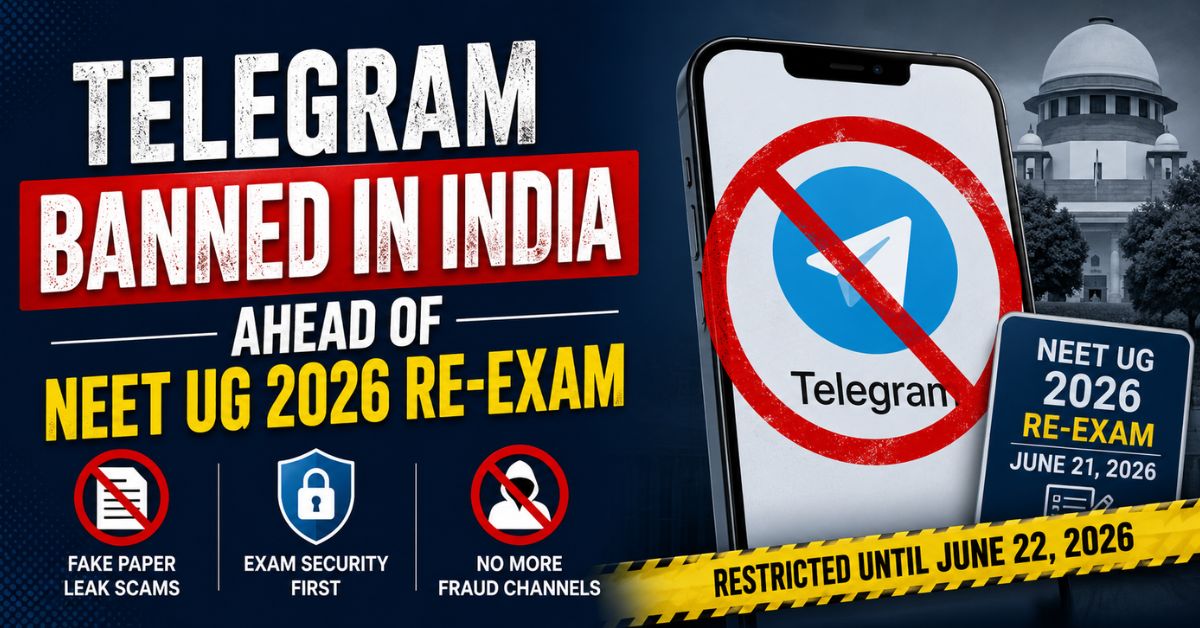
Telegram Banned in India Ahead of NEET UG 2026 Re-Exam: Key Highlights
- The Indian government has temporarily restricted Telegram ahead of the NEET UG 2026 re-examination scheduled for June 21.
- The move aims to stop the spread of fake question papers, misinformation, and exam-related scams targeting students.
- Authorities identified several Telegram channels allegedly claiming to sell leaked NEET papers for large sums of money.
- The National Testing Agency (NTA) has stated that no genuine question papers have been leaked.
- The restriction is expected to remain in place until June 22, 2026, while additional controls on message editing have also been reported.
- Students have been advised to rely only on official NTA announcements and report suspicious activities to cybercrime authorities.
The Indian government has temporarily restricted Telegram across the country ahead of the NEET UG 2026 re-examination scheduled for June 21. The decision comes amid growing concerns about fake question paper leaks, online scams, and misinformation being circulated through Telegram channels.
According to reports, the Ministry of Electronics and Information Technology (MeitY) acted after concerns were raised by the National Testing Agency (NTA), cybercrime units, and other authorities monitoring exam-related activities online.
Officials say the restriction is intended to protect students and maintain the integrity of the examination process after the controversy surrounding the cancellation of the original NEET UG 2026 examination.
Why Has Telegram Been Restricted in India?
The government’s action is linked to the rise of Telegram channels that were allegedly claiming to provide leaked NEET UG 2026 question papers.
Investigators found several channels operating under names such as “PAPER LEAKED NEET” and “Private Mafia.” These channels reportedly attracted students by promising access to examination papers before the exam in exchange for substantial payments.
Authorities discovered that many of these claims were fraudulent. Students were allegedly being asked to pay thousands or even lakhs of rupees for fake papers and fabricated information.
Officials believe these activities created confusion, panic, and unnecessary stress among candidates preparing for one of India’s most competitive entrance examinations.
NEET UG 2026 Re-Exam Background
The NEET UG 2026 re-examination was announced after the original examination conducted on May 3 was cancelled due to allegations of paper leaks and concerns about the fairness of the examination process.
The controversy generated widespread discussion across the country, leading to demands for a fresh examination under stricter security arrangements.
Following investigations and consultations, authorities decided to conduct a re-examination on June 21, 2026, to ensure a fair opportunity for affected candidates.
| Event | Date |
|---|---|
| Original NEET UG 2026 Exam | May 3, 2026 |
| Exam Cancellation | Following Leak Controversy |
| NEET UG 2026 Re-Exam | June 21, 2026 |
| Telegram Restriction Expected Until | June 22, 2026 |
NTA Says No Genuine Question Papers Have Leaked
The National Testing Agency has repeatedly assured students that the examination chain remains secure and that no genuine NEET UG 2026 question papers are available outside official custody.
Officials have warned candidates against trusting individuals or groups claiming to possess leaked papers.
According to the agency, many fraudsters take advantage of student anxiety during examination periods by spreading misleading information and making false promises.
The NTA has advised students to follow only official notifications and announcements issued through recognized government channels.
How Telegram Channels Were Allegedly Targeting Students
Investigators found several methods being used by scammers to attract candidates.
- Claiming access to genuine examination papers before the test.
- Demanding large payments for supposed leaked papers.
- Sharing fake screenshots and fabricated testimonials.
- Creating private groups accessible only after payment.
- Using fear and urgency to pressure students into making quick decisions.
Authorities say many students and parents became victims of these schemes because of uncertainty surrounding the re-examination.
Why Authorities Considered Telegram a Major Concern
Telegram allows users to create large public and private channels capable of reaching thousands of people quickly. While the platform is widely used for education, communication, and information sharing, authorities say some individuals misused these features to spread misinformation.
Officials reportedly found that scam channels could easily reappear under different names even after enforcement action was taken against them.
This made individual channel removals less effective and contributed to the decision to introduce broader temporary restrictions.
Restriction Expected to Continue Until June 22
Reports indicate that Telegram access restrictions are expected to remain in place until June 22, one day after the NEET UG 2026 re-examination.
The timing is intended to prevent the circulation of fake question papers, fabricated screenshots, and misleading claims before and during the examination period.
Officials believe the temporary measure will help reduce opportunities for fraud networks to target students.
Reported Controls on Message Editing
Reports have also suggested that Telegram has been asked to limit or disable certain message-editing features for an extended period.
Authorities are concerned that some individuals could edit older messages after the examination and falsely claim that they predicted or leaked actual questions beforehand.
Such tactics can be used to create credibility for fraudulent channels and attract future victims.
While reports mention restrictions on message editing, complete implementation details have not been fully clarified through public official announcements.
Government’s Message to Students
Government agencies have urged students to remain focused on their preparation and ignore rumors circulating on social media platforms.
Officials stress that anyone claiming to sell genuine NEET question papers should be treated with caution.
Students are encouraged to verify information only through official NTA communications and trusted government sources.
- Do not purchase alleged leaked question papers.
- Do not share personal information with unknown groups.
- Verify updates through official NTA announcements.
- Report suspicious channels and messages immediately.
- Focus on preparation rather than online rumors.
Enhanced Security Measures for NEET UG 2026 Re-Exam
The NEET UG 2026 re-examination is expected to be conducted under enhanced security arrangements.
Authorities have reportedly strengthened coordination between examination officials, law enforcement agencies, and cybercrime teams.
Online monitoring efforts have also been expanded to identify fake leak claims and other suspicious activities that could disrupt the examination process.
The objective is to ensure a fair and transparent examination for all candidates.
How Students Can Report Fraud
Authorities have encouraged candidates and parents to report suspicious activities related to the examination.
Anyone who encounters fake paper leak claims, scam channels, or fraudulent messages can file complaints through official cybercrime channels.
| Reporting Option | Details |
|---|---|
| National Cybercrime Helpline | 1930 |
| Online Complaint Portal | Official National Cybercrime Reporting Portal |
| Evidence to Preserve | Screenshots, payment records, messages, and links |
Officials say prompt reporting can help investigators identify fraud networks and prevent additional students from becoming victims.
Impact on Telegram Users Across India
The temporary restriction affects many users who rely on Telegram for communication, educational discussions, and study groups.
However, authorities maintain that the measure is necessary due to the exceptional circumstances surrounding the NEET UG 2026 re-examination.
While some users have expressed concerns about the disruption, officials argue that protecting students and preserving examination integrity remain the highest priorities.
What Happens Next?
As the NEET UG 2026 re-examination approaches, authorities continue to monitor online platforms for misinformation and fraudulent activity.
The government has emphasized that no genuine question papers have been leaked and that students should ignore any claims suggesting otherwise.
For candidates, the focus now remains on preparation, following official instructions, and avoiding individuals or groups promising access to examination materials.
With stronger security measures, increased cyber monitoring, and temporary restrictions on platforms linked to misinformation campaigns, authorities hope to ensure a fair examination process for the lakhs of students appearing for NEET UG 2026.