What You Need to Know
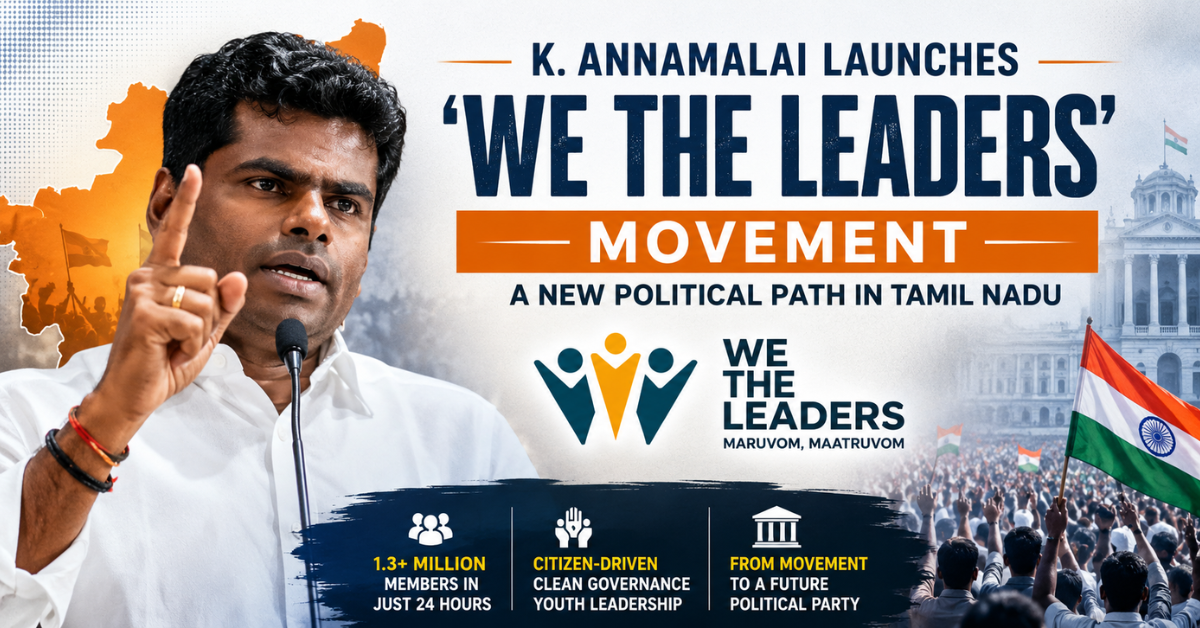
- K. Annamalai has launched a new political movement called “We the Leaders” after resigning from the BJP.
- The movement is built around citizen participation, clean governance, and grassroots leadership.
- Annamalai says the initiative will eventually evolve into a formal political party.
- More than 1.3 million people reportedly registered with the movement within 24 hours of its launch.
- The development could influence Tamil Nadu‘s political landscape ahead of future Assembly elections.
Former Tamil Nadu BJP president K. Annamalai has formally launched a new political movement called “We the Leaders,” marking a significant new chapter in his political journey after resigning from the Bharatiya Janata Party (BJP). The initiative, unveiled through its official platform and public outreach campaign, is being presented as a grassroots movement focused on citizen participation, clean governance, and leadership development.
The launch comes at a time when Tamil Nadu politics continues to be dominated by established regional parties, while voters increasingly discuss issues such as governance, employment, education, and political accountability, particularly in light of recent Vijay anti-corruption measures. Through the new movement, Annamalai is seeking to create what he describes as an alternative political culture that moves beyond traditional party structures and personality-driven politics.
Within hours of its launch, the movement drew considerable public attention, with reports indicating that more than 1.3 million people registered as members or volunteers through its online platform. The response has immediately placed the initiative among the most closely watched political developments in the state, especially as the DMK exit poll 2026 indicates a close contest ahead.
A New Beginning After Leaving the BJP
The launch of the new movement comes days after Annamalai resigns from BJP, a decision that ended his high-profile tenure as one of the party’s most visible faces in Tamil Nadu. A former Indian Police Service (IPS) officer, he joined politics in 2020 and quickly became a prominent leader within the BJP’s state unit.
During his time in the party, Annamalai built a reputation as an outspoken critic of the ruling DMK government and frequently positioned himself as a challenger to the state’s traditional political establishment. His campaigns and public engagements helped increase the BJP’s visibility in Tamil Nadu, even though the party remained a relatively smaller electoral force compared to the DMK and AIADMK.
His decision to leave the BJP and establish an independent movement therefore represents a major political shift. Rather than immediately launching a new political party, Annamalai has chosen to begin with a civic and leadership-oriented platform that he says will gradually expand into a larger political organization.
The Idea Behind ‘We the Leaders’
At the center of the movement is the concept of what Annamalai calls “Common Man Politics.” According to the movement’s public messaging, the focus is on empowering ordinary citizens to participate in governance and public life rather than relying on a small group of political elites.
The movement’s slogan, “Maruvom, Maatruvom,” meaning “Let’s change, let’s bring change,” reflects its emphasis on both personal and social transformation.
Annamalai has repeatedly argued that politics should not revolve around individuals, personality cults, or unquestioning loyalty to leaders. Instead, he has said that public movements should be built around ideas, values, and active citizen participation.
This approach attempts to address a concern often raised in discussions about Indian politics, namely that political organizations can become heavily dependent on a few dominant figures. By promoting a decentralized structure, the movement aims to encourage leadership development at multiple levels.
Supporters of the initiative view this as an effort to create a more participatory political culture. Critics, however, note that translating such ideals into a functioning political organization will be a significant challenge.
Focus on Grassroots Development
One of the key themes of the movement is grassroots engagement. Rather than concentrating solely on elections, the initiative intends to work on community development and public participation.
The movement’s stated priorities include education, healthcare, skill development, environmental sustainability, and youth empowerment. These areas have been identified as long-term foundations for social and economic progress.
Annamalai has also spoken about the importance of creating informed and responsible citizens who can contribute to public decision-making. The movement’s framework seeks to encourage local problem-solving and community leadership instead of relying entirely on political representatives.
This strategy reflects a broader trend seen in several civic movements across India, where organizations attempt to build influence through social engagement before entering electoral politics.
Whether the movement can maintain public enthusiasm over a long period will depend largely on its ability to convert online support into sustained grassroots activity.
The ‘Conscious Constituency’ Concept
A major component of the movement is what Annamalai calls the “Conscious Constituency” model.
According to the framework outlined by the movement, the objective is to create communities that are informed, engaged, and focused on measurable development outcomes. The concept combines citizen participation with data-driven decision-making and local accountability.
Under this approach, issues such as education quality, healthcare access, employment opportunities, and environmental sustainability would receive continuous attention rather than becoming topics discussed only during election campaigns.
The model seeks to encourage voters to evaluate governance based on performance and outcomes instead of political rhetoric alone.
- Education and learning opportunities
- Healthcare accessibility
- Skill development and employment
- Youth leadership programs
- Environmental sustainability
- Community participation in governance
Supporters believe such an approach could improve civic awareness and encourage greater public involvement in policy discussions. However, implementing these ideas across a large and diverse state such as Tamil Nadu would require significant organizational capacity and resources.
Preparing for Electoral Politics
Although “We the Leaders” is currently being presented as a movement and public platform, Annamalai has made it clear that electoral politics remains part of the long-term plan.
He has publicly stated that the initiative will eventually evolve into a political party built on what he describes as the principles of clean governance and ethical leadership.
According to Annamalai, the process will not be rushed. Instead, he intends to establish strong organizational foundations before entering major electoral contests.
This gradual approach differs from many political launches where leaders immediately announce party structures and election strategies. By focusing first on movement-building, Annamalai appears to be attempting to create a broader support base before transitioning into formal politics.
The strategy suggests a long-term vision rather than a short-term electoral campaign.
Leadership Training and Political Ethics
As part of the movement’s future plans, Annamalai has announced efforts to develop leadership training initiatives aimed at preparing future political candidates.
The broader objective is to identify and mentor individuals interested in public service before they enter active politics. The emphasis on ethics and governance reflects one of the central themes of the movement.
Political observers note that leadership development remains a relatively underexplored area in Indian politics, where many candidates enter public life through family connections, party structures, or local influence networks.
By promoting structured training and mentorship, the movement hopes to create a pipeline of future leaders who share its governance principles.
Whether such programs can attract large numbers of participants remains to be seen, but the initiative highlights the movement’s attempt to differentiate itself from conventional political organizations.
Strong Initial Public Response
The launch generated significant attention across social media platforms and political circles.
Reports indicate that more than 1.3 million people registered with the movement within the first 24 hours of its launch. The numbers were widely discussed online and quickly became one of the most talked-about political developments in Tamil Nadu.
Annamalai responded to the surge by thanking supporters and volunteers while describing the response as a sign that many citizens are looking for new political alternatives.
He also emphasized that the movement should not be viewed as a personal project centered around him. Instead, he framed it as a collective effort involving citizens who want to contribute to public life.
While membership figures demonstrate considerable interest, political analysts caution that digital registrations do not automatically translate into active participation or electoral support. Sustaining engagement over the coming months will be an important test for the organization.
What It Means for Tamil Nadu Politics
Tamil Nadu has long been characterized by the dominance of major regional parties, particularly the DMK and AIADMK. Attempts by new political formations to establish themselves have often faced significant challenges due to strong party networks and voter loyalties.
Annamalai’s new movement enters this landscape with both opportunities and obstacles.
On one hand, his public profile, administrative background, and active supporter base provide a foundation for building a new organization. The initial response also suggests that there is public curiosity about alternative political platforms.
On the other hand, converting a movement into a successful political party requires extensive organizational structures, local leadership networks, financial resources, and sustained public trust.
Political success in Tamil Nadu has historically depended not only on ideas and messaging but also on strong grassroots mobilization and long-term voter engagement.
The Road Ahead for We the Leaders
The launch of “We the Leaders” represents one of the most significant political developments in Tamil Nadu in recent years. By stepping away from a national political party and launching an independent movement, Annamalai has taken a path that carries both substantial risks and opportunities.
The movement’s emphasis on citizen participation, leadership development, and clean governance has resonated with many supporters during its initial days. The strong registration numbers suggest that a section of the public is willing to explore new political alternatives.
However, the true measure of success will not be determined by launch-day enthusiasm alone. The coming months will reveal whether the movement can build a durable grassroots network, maintain public engagement, and eventually transform itself into a credible political force.
For now, “We the Leaders” has succeeded in attracting attention and sparking discussion across Tamil Nadu. Whether it can reshape the state’s political landscape remains one of the key questions that will be closely watched in the years leading up to the next Assembly election.