Key Developments in Tamil Nadu‘s TASMAC Reform Drive
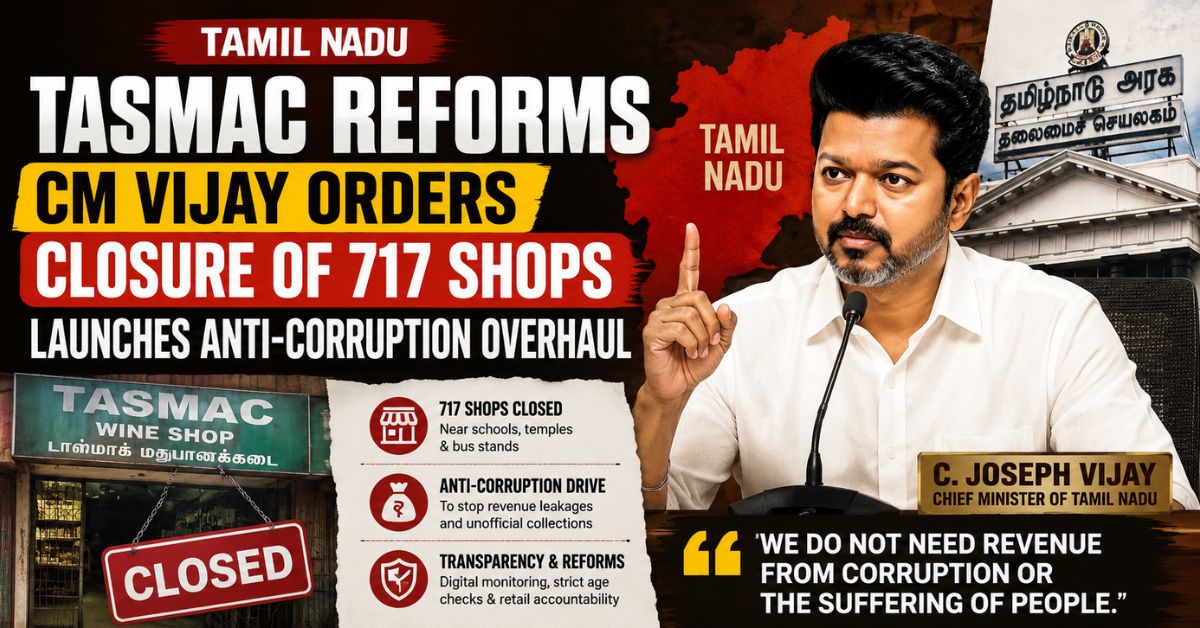
- Chief Minister C. Joseph Vijay has launched a major overhaul of TASMAC as one of the first major initiatives of his government.
- The administration has ordered the closure of 717 liquor shops located near schools, places of worship, and transport hubs.
- The government says it aims to eliminate alleged revenue leakages and improve transparency across the liquor distribution system.
- Officials have been tasked with strengthening monitoring, digital oversight, and regulatory compliance throughout TASMAC operations.
- The reforms are being positioned as part of TVK’s broader agenda focused on accountability, governance, and public welfare.
Tamil Nadu Chief Minister C. Joseph Vijay has launched a major restructuring of the state’s liquor distribution system, making it one of the first major governance initiatives of the new government. In a move that combines anti-corruption measures with public welfare objectives, the administration has ordered the closure of 717 TASMAC outlets and announced a broader effort to improve transparency within the state-run liquor network.
The decisions were taken during the government’s early policy review meetings and are being presented as part of the ruling Tamilaga Vettri Kazhagam’s commitment to administrative reform, accountability, and social welfare.
The measures come at a time when TASMAC, the Tamil Nadu State Marketing Corporation, remains one of the state’s largest sources of revenue while also being a frequent subject of public debate over alcohol consumption, corruption allegations, and the social impact of liquor sales.
Government Targets Alleged Revenue Leakages
According to officials who briefed the administration, the government believes that significant amounts of money may have been lost through informal cash collection practices operating within parts of the TASMAC network.
The administration has indicated that it intends to eliminate all unofficial financial arrangements connected to procurement, distribution, and retail operations. Officials say the objective is to ensure that every rupee generated through liquor sales is properly accounted for and reaches the state treasury.
While allegations regarding the scale of these leakages have become a major political issue, the government’s immediate focus appears to be on tightening oversight and strengthening accountability mechanisms throughout the system.
The anti-corruption campaign forms part of a broader governance agenda that Vijay and his party promoted during the election campaign, especially in light of the recent DMK exit poll 2026. Since taking office, the Chief Minister has repeatedly emphasized the need for transparent administration and stronger action against corruption in government-linked operations.
Political observers note that TASMAC represents a particularly significant area for reform because of the large volume of cash transactions handled through its extensive retail network across Tamil Nadu.
Closure of 717 TASMAC Shops
One of the most visible decisions announced by the government is the closure of 717 TASMAC outlets located near schools, places of worship, and transport hubs.
The move fulfills a key promise made by Tamilaga Vettri Kazhagam during the election campaign, when the party pledged to reduce the social impact of alcohol availability in sensitive public areas.
According to official information released by the government, the closures are spread across multiple regions of the state.
| Region | Number of Shops Closed |
|---|---|
| Madurai | 290 |
| Coimbatore | 179 |
| Tiruchi | 84 |
| Chennai | 82 |
| Salem | 82 |
The closures represent a substantial reduction in the state’s liquor retail footprint. Officials say the affected outlets were identified based on their proximity to institutions and locations considered socially sensitive.
Supporters of the move argue that reducing the presence of liquor shops near schools and religious sites could help address long-standing public concerns raised by residents, community groups, and local organizations.
Critics, however, have questioned the potential impact on state revenues and whether customers may simply shift their purchases to nearby outlets rather than reducing alcohol consumption.
Balancing Revenue and Social Welfare
The TASMAC network has historically generated significant revenue for the Tamil Nadu government. As a result, any reduction in the number of outlets naturally raises questions about the financial impact on the state.
The Vijay administration has sought to frame the decision as one that prioritizes public welfare over revenue considerations.
Government representatives have argued that policy decisions should not be based solely on income generation and that social concerns must also play a role in determining how liquor sales are regulated.
This approach marks an important political message from the new administration. Rather than focusing exclusively on revenue preservation, the government appears to be positioning itself as willing to accept financial costs if reforms are considered beneficial to the public.
The debate reflects a broader challenge faced by many state governments in India. While liquor sales provide an important source of revenue, governments must also address concerns about public health, addiction, law and order, and the impact of alcohol consumption on families and communities.
Push for Greater Transparency
Beyond shop closures, the government has instructed the Prohibition and Excise Department to strengthen monitoring and oversight mechanisms throughout the TASMAC system.
Officials have been tasked with examining ways to improve transparency in both wholesale and retail operations.
The administration’s stated goal is to reduce opportunities for corruption and ensure that transactions can be tracked more effectively.
Technology is expected to play a central role in these efforts. Government departments are reviewing measures that could reduce dependence on cash transactions and improve record-keeping across the supply chain.
Experts note that greater digitization can help reduce opportunities for financial irregularities while making it easier for authorities to monitor sales, inventory movement, and revenue collection.
The focus on transparency reflects a wider trend among state governments seeking to modernize administrative systems through digital monitoring and data-driven oversight.
Focus on Retail-Level Accountability
Another area receiving attention is retail-level compliance.
For years, complaints from customers have periodically surfaced regarding overcharging at liquor outlets and the lack of consistent enforcement of pricing rules.
The government has signaled that stricter monitoring of retail practices will form part of its reform agenda.
Officials say the objective is to ensure that customers are charged only the approved price and that all sales are conducted in accordance with regulations.
The administration is also examining ways to strengthen enforcement mechanisms and improve accountability among personnel operating within the network.
While detailed implementation plans are still being developed, the government’s broader message is that retail operations must function within a clearly defined regulatory framework.
Age Verification and Regulatory Controls
The administration has also emphasized the importance of preventing underage access to alcohol.
Officials are reviewing measures that could strengthen age verification procedures at liquor outlets and improve compliance with existing legal requirements.
Tamil Nadu law permits alcohol purchases only by individuals above the prescribed age limit, and the government has indicated that enforcement of these rules will receive greater attention.
Public health experts have frequently argued that stricter age verification can help reduce underage drinking and improve compliance with alcohol regulations.
Any new enforcement measures introduced by the government are expected to form part of a broader strategy aimed at balancing revenue considerations with public welfare objectives.
High Court Observation Adds Support
The government’s decision to close hundreds of TASMAC outlets has also received attention in legal circles.
The Madras High Court reportedly described the closures as a positive step, providing additional support for the administration’s approach.
Judicial observations carry significance because liquor policy often becomes the subject of legal challenges involving licensing, zoning regulations, and public interest concerns.
The court’s remarks are likely to strengthen the government’s position as it moves forward with implementing the closures and defending the policy against possible objections.
Legal experts note that support from the judiciary can provide greater stability for major policy decisions, particularly those involving public welfare considerations.
What the Reforms Mean for Tamil Nadu
The TASMAC reforms are widely being viewed as an early indicator of how the Vijay administration intends to govern.
Throughout the election campaign, Tamilaga Vettri Kazhagam positioned itself as a party focused on transparency, accountability, and administrative reform. The decisions announced so far suggest that the government intends to translate those campaign promises into concrete policy actions.
Political analysts say the anti-corruption drive carries importance beyond the liquor sector itself. By targeting one of the state’s most visible and revenue-rich public enterprises, the government is sending a message that scrutiny and accountability will extend across major departments.
Officials have also hinted that similar reviews could eventually be conducted in other sectors where large-scale government revenue collection takes place.
Whether the reforms achieve their intended objectives will depend largely on implementation, enforcement, and the government’s ability to sustain oversight over time.
For now, however, the closure of 717 liquor outlets and the launch of a transparency-focused review of TASMAC represent one of the most significant policy initiatives undertaken by the new administration since taking office.
As the reforms move from announcement to execution, businesses, consumers, government officials, and political observers across Tamil Nadu will be watching closely to see whether the changes deliver measurable improvements in transparency, accountability, and public welfare.