Key Highlights
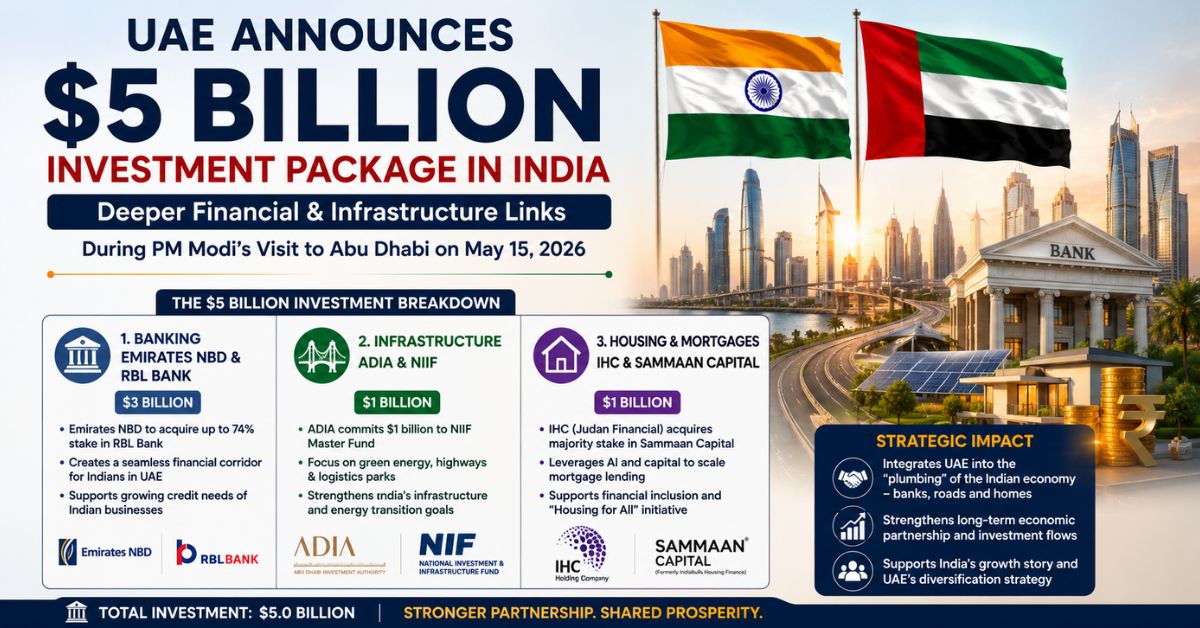
- The UAE discussed and advanced investment commitments worth around $5 billion during PM Modi’s Abu Dhabi visit.
- Emirates NBD moved forward with its proposed majority stake acquisition in RBL Bank.
- ADIA reaffirmed infrastructure investment plans linked to India’s NIIF platform.
- IHC-linked entities explored expanded investments in housing finance and mortgage lending.
- The deals reflect deeper India-UAE cooperation in banking, infrastructure, and financial services.
Prime Minister Narendra Modi’s visit to Abu Dhabi on May 15 saw the United Arab Emirates deepen its investment engagement with India through a series of major financial and infrastructure-linked commitments valued at around $5 billion.
The agreements and investment discussions covered banking, infrastructure, housing finance, and logistics, reflecting the growing economic partnership between the two countries at a time when the UAE India energy security is being prioritized beyond the traditional energy sector.
Officials and industry analysts said the package signals the UAE’s intention to strengthen its role in India’s financial and infrastructure growth story while also creating stronger economic links between the Gulf and South Asia.
Emirates NBD Expands Into India’s Banking Sector
The largest component of the investment activity involved UAE banking major Emirates NBD and India’s RBL Bank. Emirates NBD received regulatory approvals connected to its proposed acquisition of a majority stake in the private sector lender, a transaction estimated to be worth nearly $3 billion.
The deal marks one of the biggest recent Gulf-backed investments in India’s banking sector. Analysts say the move could help Emirates NBD expand its presence in one of the world’s fastest-growing banking markets while also improving financial connectivity between India and the UAE.
The bank is expected to focus on retail banking, remittance services, and corporate financing linked to India-UAE trade flows. Millions of Indian workers live in the Gulf region, making cross-border banking and remittance systems an important part of the broader economic relationship.
The timing of the approvals close to Modi’s visit was widely viewed as a sign of strong political coordination between the two governments, although officials did not publicly link the regulatory process directly to the minority rights discussion during the diplomatic meetings.
ADIA Reaffirms Infrastructure Investment Plans
Infrastructure investment formed another major pillar of the discussions. The Abu Dhabi Investment Authority, commonly known as ADIA, reaffirmed its commitment to infrastructure investment in India through the National Investment and Infrastructure Fund, or NIIF.
People familiar with the discussions said fresh investments worth around $1 billion are expected to support long-term projects linked to transport, logistics, renewable energy, and industrial infrastructure.
India has been seeking large-scale foreign capital to support the National Infrastructure Pipeline, a multi-year program focused on roads, ports, energy systems, logistics parks, and urban development projects.
ADIA has already emerged as one of the largest overseas institutional investors in Indian infrastructure assets over the past several years. Analysts believe the latest discussions reinforce the UAE sovereign fund’s position as a long-term strategic investor in India’s modernization plans.
IHC Eyes Growth in Housing Finance
Another important development involved UAE-based conglomerate International Holding Company, or IHC, which has shown increasing interest in India’s financial services and consumer sectors.
People aware of the discussions said IHC-linked entities are exploring expanded investments in Sammaan Capital, formerly known as Indiabulls Housing Finance. The broader focus is expected to include mortgage lending and housing finance aimed at India’s growing middle-income population.
The investment discussions are seen as part of a wider trend in which Gulf investors are moving into sectors connected to consumer growth, financial inclusion, and urban development in India.
India’s housing finance market has expanded steadily over the past decade, particularly in smaller cities where demand for affordable housing and retail credit continues to rise. Analysts say foreign investors are increasingly viewing the sector as a long-term growth opportunity because of India’s urban expansion and rising household incomes.
A Deeper Economic Partnership
Beyond individual deals, the broader significance of the investment package lies in the deeper integration of UAE capital into India’s economic infrastructure.
Unlike earlier phases of India-Gulf economic relations, which focused mainly on oil imports and remittances, the latest investments are spread across banking systems, infrastructure financing, logistics networks, and consumer finance.
Economic experts say this reflects a strategic shift in the India-UAE relationship, where both countries are trying to build stronger institutional and financial links that can support trade, investment, and supply chain cooperation over the long term.
The investment announcements also come at a time when global investors are increasingly looking toward India as a major destination for infrastructure and manufacturing growth. India remains one of the world’s fastest-growing major economies, while the UAE has continued to position itself as a global investment and logistics hub connecting Asia, Africa, and Europe.
Officials from both countries have repeatedly emphasized that economic cooperation is becoming one of the central pillars of the broader Comprehensive Strategic Partnership between India and the UAE.
Long-Term Focus on Growth Sectors
As bilateral trade and investment ties continue to expand, analysts believe future cooperation is likely to move further into sectors such as digital infrastructure, clean energy, logistics technology, and advanced financial services.
For India, the UAE investments provide long-term foreign capital for critical sectors of the economy. For the UAE, the growing partnership offers access to one of the world’s largest consumer and infrastructure markets as Gulf economies diversify their international investment portfolios beyond hydrocarbons.


Interesting to see such a big investment push. Any thoughts on how it might affect the wedding industry there?