India-Netherlands Partnership: Key Highlights
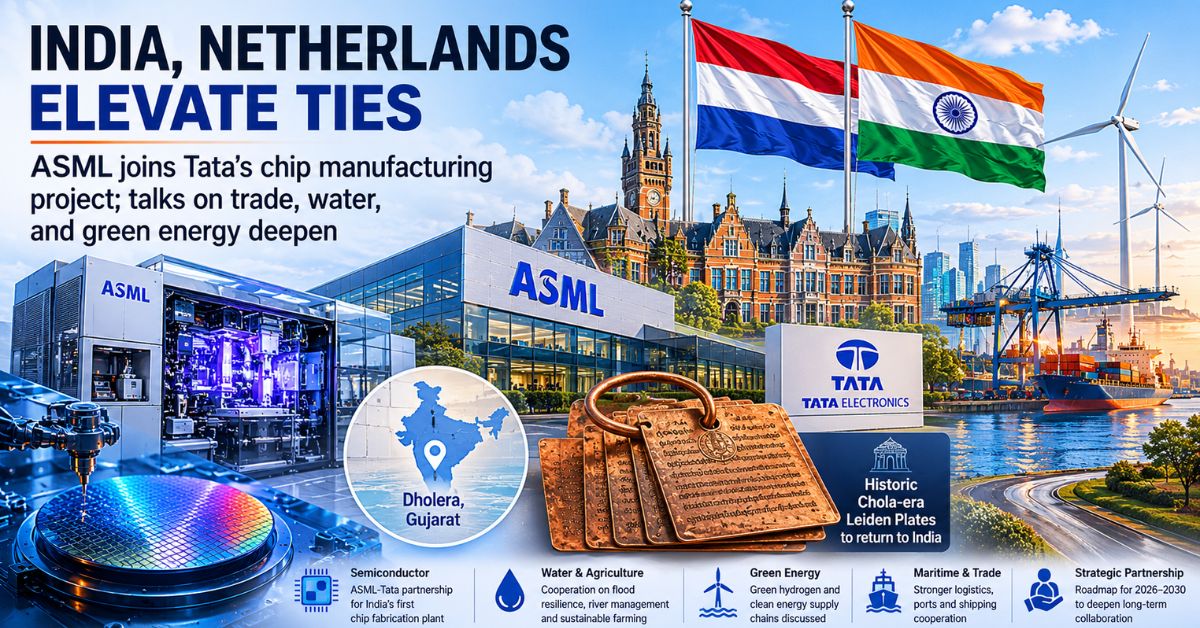
- India and the Netherlands elevated bilateral ties to a Strategic Partnership during PM Narendra Modi’s May 2026 visit.
- ASML and Tata Electronics signed a semiconductor agreement linked to India’s Dholera chip fabrication plant.
- The partnership expands cooperation in water management, green energy, maritime logistics, and technology.
- The Netherlands agreed to return the historic Chola-era Leiden Plates to India.
- Both nations discussed long-term cooperation in clean energy supply chains and advanced manufacturing.
Prime Minister Narendra Modi’s visit to the Netherlands in May 2026 marked a major step forward in relations between the two countries, with both sides agreeing to elevate their ties to a “Strategic Partnership” and deepen cooperation in semiconductors, trade, water management, and advanced technology sectors.
The two-day visit to The Hague was centered around technology and economic cooperation, including discussions on a virtual trade corridor 2024, but it also carried diplomatic and cultural significance. The most important outcome was a semiconductor agreement between Dutch chip equipment maker ASML and Tata Electronics for India’s first large-scale semiconductor fabrication plant in Dholera, Gujarat.
ASML-Tata Deal Becomes Centerpiece of Visit
The agreement is being viewed as an important moment in India’s effort to build a domestic semiconductor manufacturing industry. India has long been active in chip design and software services, but it has depended heavily on imports for advanced semiconductor manufacturing.
ASML plays a critical role in the global chip industry because it produces some of the world’s most advanced lithography machines used to manufacture semiconductors. Industry experts have described the partnership as strategically important for India’s long-term electronics and technology ambitions.
According to reports, ASML will provide advanced lithography systems and technical support for Tata Electronics’ semiconductor fabrication project in Dholera. The facility is expected to become one of India’s first major front-end chip manufacturing plants and is being developed as part of the government’s India Semiconductor Mission.
The semiconductor deal comes at a time when countries across the world are trying to diversify technology supply chains and reduce dependence on a small number of manufacturing hubs, much like India’s recent advancements in its nuclear phase. India has been positioning itself as an alternative destination for electronics manufacturing and high-technology investment.
Strategic Partnership Expands Beyond Technology
During the visit, India and the Netherlands also adopted a broader framework to guide cooperation between 2026 and 2030. While the full roadmap has not yet been made public, official statements and media reports indicate that both countries plan to work more closely in areas such as green energy, digital technology, maritime logistics, and innovation.
One important area of discussion was green hydrogen, alongside the minority rights discussion that took place during the visit. The Netherlands, home to Europe’s largest port in Rotterdam, is trying to strengthen clean energy supply chains as Europe shifts away from fossil fuels. India, which is investing heavily in renewable energy production, sees green hydrogen exports as a future economic opportunity.
Water Management and Maritime Cooperation
The two countries also expanded discussions under their long-running cooperation framework on water, agriculture, and health sectors, often referred to as the “WAH” partnership.
Dutch expertise in flood management and urban water systems has been important for India over the past decade, especially as Indian cities face increasing pressure from extreme rainfall, rising populations, and poor drainage infrastructure. Officials discussed new cooperation in river management, flood resilience, and sustainable agriculture practices.
Maritime cooperation also featured prominently during the visit. The Netherlands is one of Europe’s largest logistics and shipping hubs, while India is trying to modernize ports, shipyards, and cargo infrastructure as part of its broader trade expansion plans.
Return of Chola-Era Leiden Plates Adds Cultural Dimension
Beyond trade and technology, the visit also included a cultural and historical dimension. Reports from the Netherlands said the Dutch side agreed to return the historic Chola-era Leiden Plates, also known as the Anaimangalam Copper Plates, to India.
The copper plates are believed to date back to the 11th century during the reign of Rajendra Chola I. Inscribed in Tamil and Sanskrit, they document land grants and provide important details about the Chola dynasty, one of India’s most influential maritime empires.
The plates had remained in the Netherlands for centuries and were held at Leiden University. Their return has been seen in India as an important cultural gesture and a sign of growing trust between the two countries.
Trade and Investment Ties Continue to Grow
Modi also attended meetings with Dutch business leaders during the visit, including executives from major multinational companies operating in technology, energy, healthcare, and consumer goods sectors. During the discussions, he highlighted India’s manufacturing push, digital economy growth, and expanding infrastructure market.
Trade ties between India and the Netherlands have grown steadily in recent years. The Netherlands is among the largest foreign investors in India and also serves as an important gateway for Indian exports into Europe.
The visit reflected the changing nature of India’s partnerships with European countries. While earlier cooperation was often limited to trade and development projects, recent engagements have focused more on strategic technologies, supply chain security, clean energy, and advanced manufacturing.
Why the Semiconductor Partnership Matters
For India, the semiconductor partnership with ASML may ultimately become the defining outcome of the visit. Building a domestic chip manufacturing ecosystem remains one of the country’s most ambitious industrial goals, and access to advanced manufacturing technology is considered essential for achieving that objective.
The Netherlands, though smaller in size compared to many major economies, holds significant influence in critical technology sectors. By strengthening ties with Dutch industry and institutions, India is seeking to position itself more deeply within global technology and manufacturing networks.