Key Developments
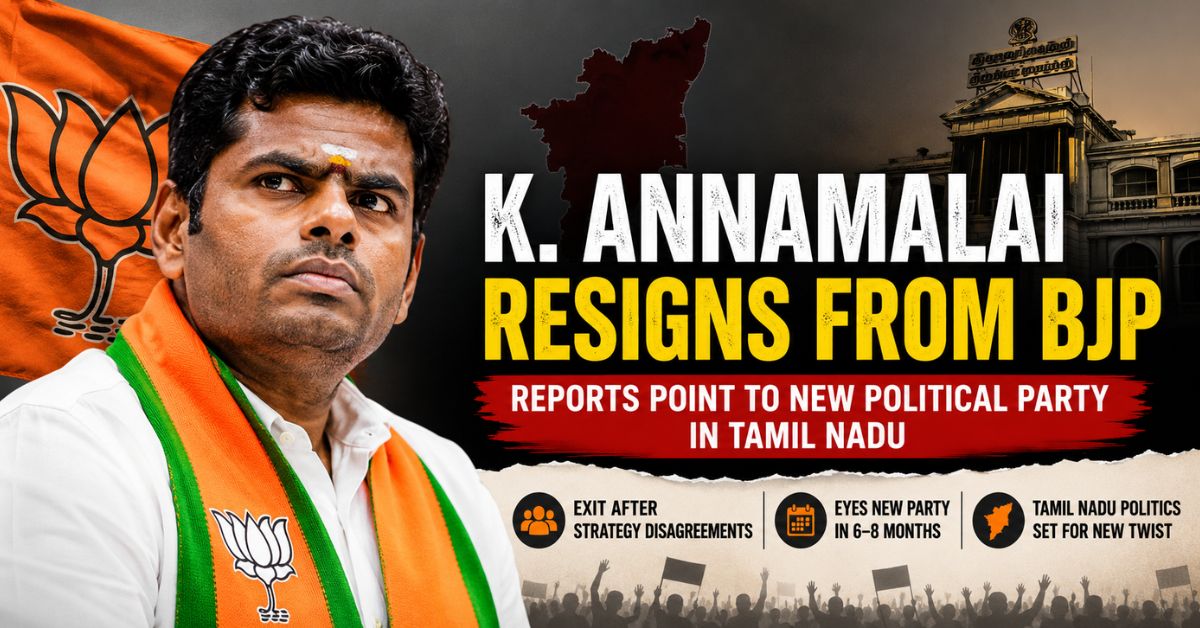
- K. Annamalai has reportedly resigned from the BJP after months of disagreements over the party’s strategy in Tamil Nadu.
- The former Tamil Nadu BJP chief is said to have opposed the party’s renewed alliance with the AIADMK.
- His influence within the state unit appeared to decline after he was replaced by Nainar Nagendran before the 2026 Assembly election.
- Reports suggest Annamalai may launch a new regional political platform focused on young and educated voters.
- The development could reshape opposition politics in Tamil Nadu as new political forces compete for space.
Former Tamil Nadu BJP president K. Annamalai has reportedly resigned from the Bharatiya Janata Party (BJP), bringing an end to one of the party’s most prominent political chapters in the state. The resignation, submitted to BJP National President Nitin Nabin in New Delhi on June 2, has triggered fresh discussions about the future of the BJP in Tamil Nadu and the next political move of one of its most recognizable leaders.
The former Indian Police Service (IPS) officer rose quickly within the BJP after joining the party in 2020. Over the next few years, he became the public face of the BJP’s efforts to expand its presence in Tamil Nadu, a state where regional parties have traditionally dominated politics.
His departure comes amid reports of long-running differences with the party’s central leadership over alliances, organizational priorities, and the BJP’s long-term strategy in Tamil Nadu.
K. Annamalai Submits Resignation to BJP Leadership
According to multiple reports, Annamalai formally submitted his resignation to BJP National President Nitin Nabin in New Delhi on June 2. While the BJP has not publicly disclosed detailed reasons behind the move, political sources suggest that differences over the party’s direction in Tamil Nadu had been building for several months.
Annamalai’s resignation marks a significant moment for the BJP in the state. Since becoming state president, he had emerged as one of the party’s most visible campaigners and played a major role in increasing the BJP’s public presence.
His speeches, outreach programs, and state-wide campaigns helped him develop a strong personal profile that often extended beyond the BJP’s traditional voter base.
Rise of a Former IPS Officer in Tamil Nadu Politics
Annamalai entered politics after resigning from the Indian Police Service. His administrative background and direct style of communication quickly attracted public attention.
After joining the BJP, he contested the 2021 Tamil Nadu Assembly election and soon became one of the party’s most important leaders in the state.
As state president, he focused heavily on grassroots expansion. He frequently traveled across districts, interacted with local workers, and organized public outreach campaigns designed to strengthen the BJP’s organizational structure.
Many political observers credited him with energizing party workers and attracting younger supporters who were looking for alternatives to traditional political parties.
His leadership style often emphasized accountability, governance reforms, and anti-corruption messaging, helping him build a distinct political identity.
Differences Over Tamil Nadu Strategy
Reports indicate that the main source of disagreement between Annamalai and the BJP’s national leadership involved the party’s electoral strategy in Tamil Nadu.
The BJP leadership chose to revive its alliance with the AIADMK ahead of the 2026 Tamil Nadu Assembly election. However, Annamalai reportedly favored a different approach, as indicated by the DMK exit poll 2026.
According to political sources and media reports, he believed that the BJP should focus on building an independent political base rather than depending on alliances with larger regional parties.
His argument was centered on long-term growth, similar to the support seen for the Vijay TVK government support. Supporters of his approach believed that creating a strong grassroots network would allow the BJP to emerge as a major force in Tamil Nadu over time.
The central leadership, on the other hand, appeared to support a broader alliance strategy that could improve the party’s immediate electoral prospects.
This difference in thinking reportedly became more visible as preparations for the Assembly election progressed.
Leadership Changes Ahead of the 2026 Election
Questions about Annamalai’s future within the BJP began to grow when he was replaced as Tamil Nadu BJP president by Nainar Nagendran.
The leadership change came at a politically sensitive period as parties were preparing for the 2026 Assembly election.
Reports also suggested that Annamalai was not given a central role in several important election-related committees and strategic decisions.
Although he remained one of the BJP’s most recognized leaders in the state, many observers viewed these developments as signs that the party leadership was moving in a different direction.
The changes fueled speculation about whether Annamalai would continue to play a major role in the BJP after the election.
Election Results Renewed Political Debate
The 2026 Tamil Nadu Assembly election significantly changed the state’s political landscape.
The election results sparked fresh discussions about the effectiveness of various political strategies being pursued by parties across the state.
At the same time, actor-turned-politician Vijay and his party, Tamilaga Vettri Kazhagam (TVK), emerged as one of the most talked-about developments of the election.
The rise of TVK demonstrated that voters were willing to consider newer political alternatives under certain circumstances.
Supporters of Annamalai argued that the changing political environment reinforced his belief that independent political identities could gain support among voters looking for alternatives.
Others maintained that alliances remain essential in Tamil Nadu’s highly competitive political environment, where regional parties continue to dominate elections.
The debate reflected a broader question facing the BJP in the state: whether to prioritize long-term organizational growth or coalition-based electoral gains.
Reports Suggest a New Political Movement
Attention has now shifted to Annamalai’s future plans.
Multiple reports indicate that he may be preparing to launch a new regional political platform within the next several months.
While no formal announcement has been made, sources quoted in media reports suggest that discussions regarding a new political movement are already underway.
The proposed platform is expected to combine regional identity with a broader national outlook. Reports suggest it may seek to attract voters who do not fully identify with either the established Dravidian parties or the BJP.
Details regarding the movement’s organizational structure, leadership team, and policy agenda remain unclear.
Until an official announcement is made, many aspects of the proposed political project remain speculative.
Focus on Young and Educated Voters
One of the most closely watched aspects of any future political movement led by Annamalai will be its target voter base.
Throughout his political career, he has attracted support from young professionals, entrepreneurs, students, and first-time voters.
His emphasis on governance, administrative efficiency, transparency, and public accountability helped him connect with sections of the electorate seeking a different style of politics.
Political analysts believe that any new party launched by Annamalai would likely attempt to expand this support base while also reaching voters dissatisfied with existing political choices.
The growing presence of younger voters in Tamil Nadu’s political landscape could make this demographic an important battleground in future elections.
Challenges Facing a New Regional Party
Despite his popularity, creating a successful political party would present significant challenges.
Tamil Nadu has a long history of strong regional political movements supported by extensive organizational networks and loyal voter bases.
Both the DMK and AIADMK possess decades of political experience and deep grassroots structures across the state.
The rise of TVK has also increased competition among emerging political forces seeking to attract voters looking for alternatives.
Any new political organization would need to establish district-level leadership, build local networks, develop policy positions, and sustain momentum over several years.
Political experts frequently note that individual popularity can help launch a movement, but long-term success often depends on organizational strength and consistent voter engagement.
What Annamalai’s Exit Means for Tamil Nadu Politics
Annamalai’s resignation arrives at a time when Tamil Nadu politics is undergoing notable changes.
Regional parties continue to dominate the state’s political landscape, but the emergence of new political players has created a more competitive environment than in previous years.
For the BJP, the departure represents the loss of a leader who helped increase the party’s visibility and expand its outreach efforts in Tamil Nadu.
For Annamalai, the resignation opens a new chapter that could significantly shape his future role in public life.
Whether he launches a political party, begins a social movement, or chooses another path, his next steps will be closely watched by political observers, party workers, and voters across the state.
As Tamil Nadu’s political landscape continues to evolve, the consequences of Annamalai’s departure are likely to remain a subject of debate well beyond the immediate political cycle.