Public Sector Banks FY26 Performance at a Glance
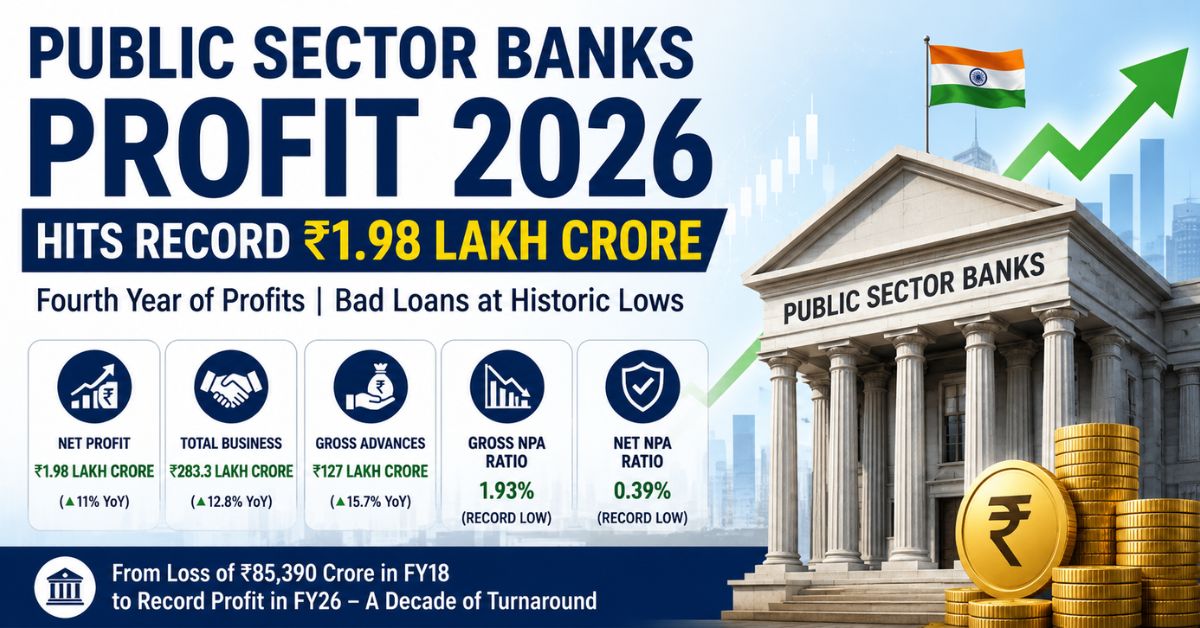
- Public Sector Banks reported a record combined net profit of ₹1.98 lakh crore in FY2025-26, the highest ever recorded by the sector.
- Gross Non-Performing Assets (GNPA) fell to a historic low of 1.93%, while Net NPA declined to 0.39%.
- Total business reached ₹283.3 lakh crore, supported by strong growth in retail, MSME, and agricultural lending.
- Operating profit rose to ₹3.21 lakh crore, reflecting better asset quality, recoveries, and operational efficiency.
- The achievement marks the fourth consecutive year of profitability and a major turnaround from the losses reported in FY18.
India’s Public Sector Banks (PSBs) have reported their strongest financial performance ever, with combined net profits rising to a record ₹1.98 lakh crore during the financial year 2025-26 (FY26). The achievement marks the fourth consecutive year of profitability for state-owned banks and highlights a remarkable turnaround from the banking crisis that affected the sector less than a decade ago, similar to the successes seen in the Saari Guarantiyan budget.
According to data released by the Department of Financial Services under the Ministry of Finance, the sector’s net profit increased by about 11% compared to the previous financial year. At the same time, bad loans declined to their lowest levels on record, while lending activity remained strong across retail, agriculture, and MSME segments.
The latest figures suggest that India’s public sector banking system has completed one of the most significant recovery stories in the country’s financial history. From reporting massive losses and struggling with high levels of non-performing assets during the late 2010s, PSBs have now emerged as profitable institutions with stronger balance sheets and improved financial health.
Public Sector Banks Report Record Profit in FY26
Public Sector Banks collectively earned a net profit of ₹1.98 lakh crore during FY26. This is the highest annual profit ever recorded by the sector and follows steady improvement over the past several years.
The strong earnings were supported by rising loan growth, lower credit costs, improved recoveries, and better asset quality. Operating profit, which measures earnings before provisions and taxes, reached ₹3.21 lakh crore during the year.
The sector’s total business, which includes deposits and advances, expanded to ₹283.3 lakh crore. Deposits stood at ₹156.3 lakh crore, while gross advances increased to ₹127 lakh crore.
These figures indicate that Public Sector Banks continued to play a major role in supporting economic activity by providing credit to households, businesses, farmers, and small enterprises across the country, ensuring household LPG availability.
| Key Metric | FY26 Performance |
|---|---|
| Net Profit | ₹1.98 lakh crore |
| Operating Profit | ₹3.21 lakh crore |
| Total Business | ₹283.3 lakh crore |
| Deposits | ₹156.3 lakh crore |
| Gross Advances | ₹127 lakh crore |
| Gross NPA Ratio | 1.93% |
| Net NPA Ratio | 0.39% |
| CRAR | 16.6% |
How Public Sector Banks Reached This Milestone
The record profit did not happen overnight, as the RBI ECL rules have played a significant role in transforming lending practices. It is the result of several years of reforms, stricter lending practices, and efforts to clean up bank balance sheets.
During the banking stress period around FY18, many Public Sector Banks were struggling with large volumes of bad loans. Several institutions reported losses as companies failed to repay debts and banks were forced to make large provisions against stressed assets.
The situation gradually improved through a combination of government-led reforms, recapitalization measures, stronger monitoring systems, and recoveries through the Insolvency and Bankruptcy Code (IBC).
Banks also adopted better risk management practices and strengthened their credit assessment processes. These changes helped reduce fresh slippages while improving recoveries from existing stressed accounts under the IBC insolvency law.
As a result, profitability has improved steadily over the last four years, culminating in the record earnings reported in FY26.
Asset Quality Reaches Best Levels in Decades
One of the biggest reasons behind the strong performance was the significant improvement in asset quality.
The Gross Non-Performing Asset (GNPA) ratio declined to 1.93%, the lowest level ever reported by Public Sector Banks. The Net Non-Performing Asset (NNPA) ratio fell further to just 0.39%.
A non-performing asset, commonly known as a bad loan, is a loan on which repayments have stopped for a specified period. Lower NPA levels generally indicate healthier banks and lower financial stress.
The latest numbers represent a dramatic improvement compared to the banking crisis years when gross NPA ratios had climbed into double digits.
The decline in bad loans has reduced the need for heavy provisioning. This has allowed banks to retain a larger share of their earnings, directly supporting profitability.
Financial experts often view asset quality as one of the most important indicators of a bank’s long-term health. The latest figures suggest that Public Sector Banks have made substantial progress in addressing the legacy problems that once weighed heavily on their balance sheets.
Credit Growth Remained Strong Across Key Segments
Another important factor behind the profit growth was strong demand for loans.
Public Sector Banks recorded healthy expansion across major lending categories during FY26.
| Lending Segment | Growth in FY26 |
|---|---|
| MSME | 18.2% |
| Retail | 18.1% |
| Agriculture | 15.5% |
| Overall Advances | 15.7% |
Retail loans grew by 18.1%, reflecting continued demand for home loans, vehicle loans, personal loans, and other consumer credit products.
The MSME segment registered growth of 18.2%, highlighting increased borrowing by small and medium-sized businesses. This segment plays a critical role in employment generation and economic growth.
Agricultural lending also remained strong, with credit growth of 15.5% during the year.
The broad-based nature of this growth is significant because it shows that earnings were supported by multiple sectors of the economy rather than a single lending category.
Technology and Operational Improvements Supported Growth
Technology has become an increasingly important driver of performance for Indian banks.
Over the past several years, Public Sector Banks have invested heavily in digital banking platforms, online services, automation systems, and data analytics tools.
These investments have helped improve operational efficiency while reducing costs.
Customers now perform a large share of transactions through mobile applications, internet banking platforms, and digital payment systems. This has reduced pressure on branch operations and improved service delivery.
Technology has also strengthened fraud monitoring, risk management, and loan assessment processes. Better use of data has helped banks identify risks earlier and make more informed lending decisions.
The result has been improved productivity and stronger financial performance across the sector.
Capital Position Remains Strong
Public Sector Banks also maintained comfortable capital levels during FY26.
The aggregate Capital to Risk Weighted Assets Ratio (CRAR) stood at 16.6%, well above the minimum regulatory requirements.
A strong capital base provides banks with a financial cushion against unexpected losses and supports future lending growth.
Higher capital levels are particularly important during periods of economic uncertainty because they improve the resilience of financial institutions.
The latest figures indicate that most Public Sector Banks are in a stronger position than they were several years ago when capital shortages were a major concern.
SBI Continues to Lead the Sector
Among all Public Sector Banks, the largest contribution to profits continues to come from State Bank of India (SBI).
As the country’s largest lender, SBI accounts for a significant share of the sector’s assets, deposits, advances, and profits.
Other major contributors include Punjab National Bank, Bank of Baroda, Canara Bank, Indian Bank, and Indian Overseas Bank.
Many of these banks reported strong growth in profits and improvements in asset quality during FY26.
The performance of these institutions reflects a broader trend across the Public Sector Banking system rather than gains concentrated in a single bank.
A Remarkable Turnaround From FY18 Losses
The scale of the recovery becomes clearer when viewed against the sector’s performance less than a decade ago.
| Financial Year | Sector Performance |
|---|---|
| FY18 | Loss of ₹85,390 crore |
| FY23 | Profit crossed ₹1 lakh crore |
| FY25 | ₹1.78 lakh crore profit |
| FY26 | ₹1.98 lakh crore profit |
Government reforms, capital support, consolidation of banks, stronger governance standards, and improved risk management all contributed to this turnaround.
The improvement also reflects broader efforts to strengthen the stability of India’s financial system.
What the Record Profit Means for Customers and the Economy
The strong financial performance of Public Sector Banks has implications beyond the banking sector.
Profitable and financially healthy banks are generally better positioned to support economic growth through lending activities. Stronger balance sheets allow banks to extend credit to businesses, support infrastructure projects, finance agricultural activities, and provide loans to households.
Lower bad loan levels also reduce pressure on bank finances, making institutions more stable and resilient.
For customers, healthier banks can mean improved service quality, stronger digital offerings, and greater confidence in the financial system.
The performance is also important for the government because Public Sector Banks continue to play a central role in implementing financial inclusion programs and supporting priority sectors of the economy.
Challenges Remain Despite Strong Results
Despite the strong results, challenges remain.
Banks will need to maintain strict lending standards as credit growth continues. Rapid expansion in lending can sometimes create future asset quality risks if loans are not properly assessed.
Economic slowdowns, global financial uncertainty, interest rate movements, and changes in borrower repayment capacity could also affect future performance.
In addition, maintaining profitability becomes more difficult as banks compete aggressively for deposits and lending opportunities.
Industry observers say the next phase for Public Sector Banks will be sustaining growth while preserving the improvements achieved in asset quality.
Outlook for Public Sector Banks
The FY26 results show that India’s Public Sector Banks are operating from a much stronger position than they were a decade ago. Record profits, historic lows in bad loans, strong credit growth, and healthy capital levels indicate that the sector has successfully moved beyond the challenges that once threatened its stability.
While future economic conditions will influence performance, the latest numbers suggest that Public Sector Banks have built a stronger foundation for long-term growth. The record ₹1.98 lakh crore profit achieved in FY26 not only highlights the sector’s financial strength but also underscores its continuing importance to India’s banking system and broader economy.