


India Pauses WhatsApp Username Feature Rollout: Key Highlights
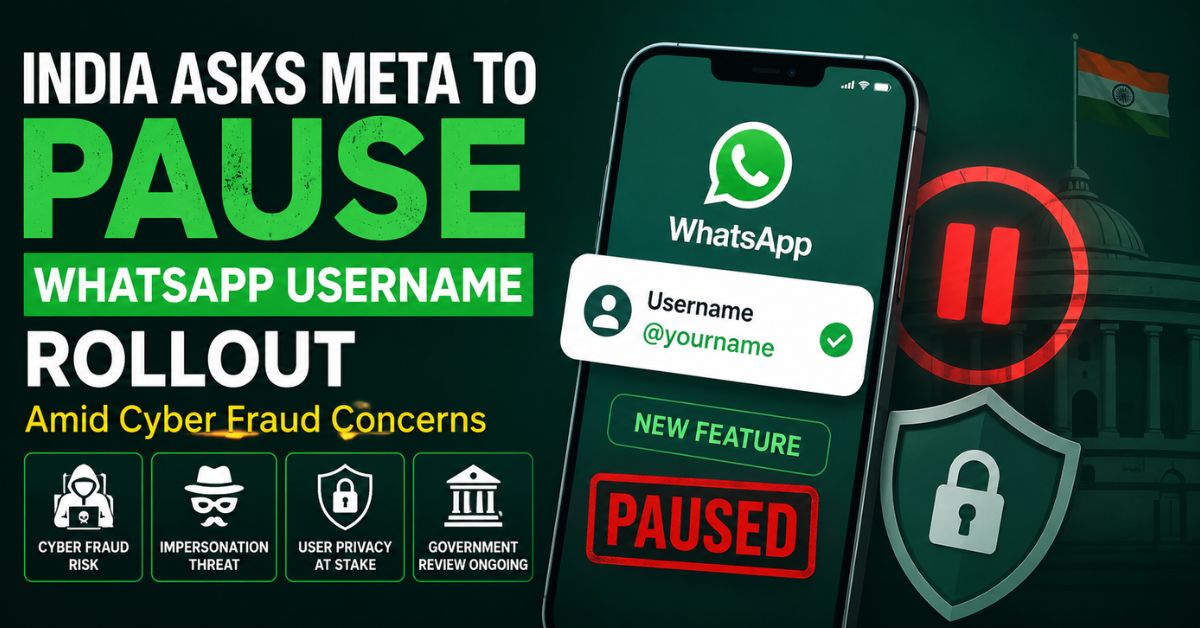
- According to multiple media reports, the Government of India has asked Meta to temporarily pause the rollout of WhatsApp’s proposed username feature.
- Reuters reported that the Ministry of Electronics and Information Technology (MeitY) has sought detailed clarifications before the feature is introduced in India.
- Officials are reportedly concerned that usernames could increase the risks of impersonation, cyber fraud, phishing, and digital arrest scams.
- Meta has stated that the feature is intended to enhance user privacy by allowing people to connect without sharing their phone numbers.
- According to reports, the feature remains under regulatory consultation and has not been permanently banned in India.
- Further discussions between the government and Meta are expected before any rollout proceeds for Indian users.
The Government of India has reportedly asked Meta to temporarily halt the rollout of WhatsApp’s proposed username feature in the country, citing concerns over cyber fraud, impersonation, and challenges for law enforcement investigations. According to multiple media reports, the Ministry of Electronics and Information Technology (MeitY) has issued a formal notice to Meta, seeking detailed clarifications before the feature is introduced to Indian users.
The reported intervention comes just days after WhatsApp announced a new privacy-focused feature that would allow users to communicate using usernames instead of sharing their mobile phone numbers with new contacts. While Meta has described the feature as a step toward improving user privacy, Indian authorities are said to be examining whether it could also create new opportunities for online scams and identity misuse.
What has the Government reportedly asked Meta to do?
According to a Reuters report, which said it reviewed the government’s communication, MeitY has directed Meta not to roll out the username feature in India until consultations with the government are completed. Reuters further reported that the ministry has sought a detailed explanation from the company and asked why regulatory action should not be considered if the concerns remain unresolved.
Several Indian media outlets, including The Indian Express, Moneycontrol, The Times of India, and India Today, have also reported that the government has sought technical documentation explaining how the feature would operate and what safeguards are in place to prevent misuse.
As of the time of writing, MeitY has not publicly released the complete text of the notice.
| Development | Status |
|---|---|
| WhatsApp Announces Username Feature | Announced by Meta |
| Government Notice to Meta | Reportedly Issued by MeitY |
| India Rollout | Reportedly Paused Pending Consultations |
| Final Regulatory Decision | Awaited |
Why is the Government concerned about WhatsApp usernames?
According to reports citing government officials, the primary concern is that usernames could become another avenue for cybercriminals to impersonate trusted individuals or institutions.
Officials are reportedly worried that fraudsters could create usernames resembling government departments, banks, financial institutions, businesses, or public figures. Without strong verification mechanisms, unsuspecting users may find it difficult to distinguish genuine accounts from fraudulent ones.
The concern comes at a time when India has witnessed a sharp rise in cyber-enabled financial crimes, including phishing attacks, investment scams, fake customer support fraud, and so-called “digital arrest” scams.
According to reports by NDTV Profit and The Indian Express, officials believe that a username-based identity system could make these scams more convincing if adequate safeguards are not implemented.
What are “digital arrest” scams?
One of the concerns highlighted in multiple reports relates to the growing number of “digital arrest” scams reported across India.
In such scams, fraudsters allegedly impersonate police officers, officials from central investigative agencies, customs authorities, or financial regulators. Victims are often contacted through messaging platforms or video calls and are falsely informed that they are under investigation. They are then pressured into transferring money under the pretext of verification or legal compliance.
According to reports, government officials fear that easily recognizable usernames resembling official agencies could make such scams even more convincing if users are unable to verify the identity of the sender.
No evidence has been presented publicly suggesting that WhatsApp’s proposed feature itself enables these scams. Rather, officials are reported to be evaluating whether it could become another tool exploited by cybercriminals.
Could usernames affect law enforcement investigations?
Another issue reportedly under discussion is traceability during criminal investigations.
Currently, WhatsApp accounts are linked to verified mobile phone numbers, even though the platform uses end-to-end encryption for messages. According to Reuters and other reports, officials are examining whether hiding phone numbers behind usernames could create additional challenges when identifying individuals involved in cybercrime, particularly in cases involving overseas phone numbers or cross-border fraud.
At present, Meta has not publicly released detailed technical documentation explaining how usernames would function alongside existing account identifiers.
Available information suggests that usernames are intended to serve as a privacy layer for users rather than replace the underlying phone number associated with an account. However, the precise technical architecture has not yet been publicly disclosed.
| Government Concerns | Reported Details |
|---|---|
| Impersonation | Officials reportedly fear fake usernames resembling government agencies, banks and public figures. |
| Cyber Fraud | Authorities are examining whether the feature could be misused for phishing and financial scams. |
| Traceability | Officials are reviewing whether investigations could become more challenging if phone numbers are hidden from users. |
| Regulatory Review | The rollout is reportedly under consultation before any launch in India. |
What has Meta said about the feature?
Meta has maintained that the proposed username feature is designed primarily to improve user privacy.
According to WhatsApp’s public announcements and company statements reported by multiple media outlets, users would be able to connect with new contacts without revealing their phone numbers. Existing contacts who already have a user’s number would continue interacting as they do today.
The company has also indicated that usernames would be optional rather than mandatory.
Reports citing Meta further state that the company plans to introduce safeguards intended to reduce impersonation risks. These reportedly include reserved usernames for certain public figures, government entities, and well-known organizations, along with existing reporting and blocking tools already available on WhatsApp.
According to The Verge and Meta’s developer documentation, the feature is expected to roll out gradually rather than being introduced globally all at once.
Following reports of the Indian government’s notice, WhatsApp also said it would continue engaging with Indian authorities and reiterated that the feature aims to strengthen user privacy while incorporating safety measures.
Has India banned the feature?
Based on the information currently available, there is no indication that India has permanently banned WhatsApp usernames.
According to Reuters, the government’s reported direction is a temporary pause while consultations continue.
No official notification declaring the feature unlawful has been made public, and there is currently no court case or judicial proceeding related to the matter.
Instead, the issue remains part of an ongoing regulatory review between the government and Meta.
What remains unclear?
Despite widespread reporting, several technical aspects of the feature remain undisclosed.
Meta has not publicly explained how usernames will be allocated, whether similar-looking usernames will be restricted, how frequently usernames can be changed, or how historical username records would be maintained.
Likewise, the full questionnaire reportedly sent by MeitY to Meta has not been released publicly.
Until those details are made available, it is difficult to independently assess how the proposed safeguards would operate in practice.
| What Is Confirmed | What Remains Undisclosed |
|---|---|
| Meta has announced the username feature. | Detailed technical architecture of the username system. |
| The Government has reportedly sought clarifications before rollout. | Complete contents of MeitY’s notice to Meta. |
| The feature is intended to improve user privacy. | Username moderation and similarity detection mechanisms. |
| Consultations between Meta and the Government are ongoing. | Timeline for a potential rollout in India. |
What could happen next?
According to Reuters and several Indian news organizations, Meta is expected to provide detailed responses addressing the government’s concerns before any rollout proceeds in India.
The discussions are likely to focus on identity verification, anti-impersonation protections, complaint handling mechanisms, law enforcement cooperation, and compliance with India’s digital regulatory framework.
Depending on the outcome of those consultations, the government could permit the feature with additional safeguards, request modifications before launch, or seek further technical reviews.
For now, Indian users are unlikely to see the username feature until those discussions conclude.
Why this matters for WhatsApp users in India
The reported intervention highlights the continuing challenge of balancing digital privacy with online safety.
On one hand, privacy advocates have welcomed features that reduce the need to share personal phone numbers with strangers. On the other, regulators are increasingly focused on preventing online fraud, impersonation, and financial scams that have affected thousands of users across India.
Whether WhatsApp’s username system ultimately reaches Indian users may depend on Meta’s ability to demonstrate that stronger privacy protections can coexist with effective safeguards against misuse.
As of now, according to Reuters and multiple Indian media reports, the proposed feature remains under regulatory scrutiny, with consultations between Meta and the Government of India expected to determine its future rollout in the country.