


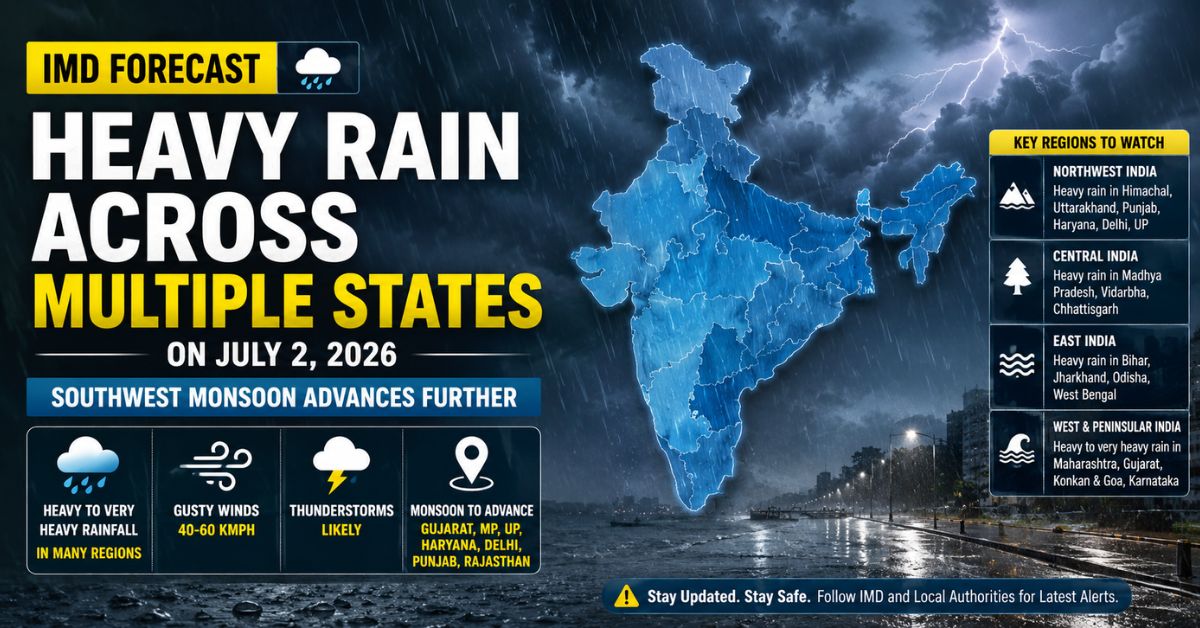
IMD Weather Forecast for July 2, 2026: Key Highlights
- The India Meteorological Department (IMD) has forecast heavy to very heavy rainfall across several parts of India on July 2 as the Southwest Monsoon remains active.
- Conditions are favorable for the monsoon to advance further into parts of Gujarat, Madhya Pradesh, Uttar Pradesh, Haryana, Chandigarh, Delhi, Punjab and Rajasthan over the next two days.
- Heavy rainfall is expected across North, Central, West and East India, with isolated extremely heavy rainfall forecast over parts of Gujarat, Konkan and Madhya Maharashtra.
- Thunderstorms accompanied by lightning and gusty winds of up to 60 kmph are likely in several regions.
- Delhi, Mumbai, Himachal Pradesh, Uttarakhand, Bihar, Jharkhand and several other states are expected to witness active monsoon conditions.
- Residents have been advised to monitor official IMD and local administration advisories due to the possibility of waterlogging, localized flooding and travel disruptions.
The India Meteorological Department (IMD) has forecast another active day for the Southwest Monsoon on July 2, with heavy to very heavy rainfall expected across several parts of northern, central, western and eastern India. The weather agency said conditions remain favorable for the monsoon to advance further into Gujarat, Madhya Pradesh, Uttar Pradesh, Haryana, Chandigarh, Delhi, Punjab and Rajasthan over the next two days.
The latest outlook signals widespread rainfall after a weak June monsoon in many parts of the country. While the active spell is expected to reduce rainfall deficits in several regions, the IMD has also maintained its broader forecast that July rainfall as a whole is likely to remain below normal across the country.
Where will it rain heavily on July 2?
According to the IMD’s latest forecast, widespread rainfall accompanied by thunderstorms and gusty winds is expected across large parts of India.
In northwest India, heavy rainfall is likely over Himachal Pradesh, Uttarakhand, Punjab, Haryana, Delhi, western Uttar Pradesh and eastern Uttar Pradesh, while isolated places could receive very heavy rainfall. Thunderstorms with lightning are also expected to affect several districts during the active monsoon spell.
Across central India, the IMD has forecast heavy rainfall over Madhya Pradesh, Vidarbha and Chhattisgarh, where the strengthening monsoon circulation is expected to remain active through the week.
Eastern India is also likely to experience widespread showers, with Bihar, Jharkhand, Odisha, Gangetic West Bengal and Sub-Himalayan West Bengal and Sikkim expected to receive moderate to heavy rainfall at isolated locations.
Meanwhile, western India remains under one of the strongest monsoon zones. Heavy to very heavy rainfall has been forecast over Konkan and Goa, Gujarat Region, Saurashtra and Kutch, and Madhya Maharashtra, with isolated locations likely to receive extremely heavy rainfall.
| Region | Weather Forecast |
|---|---|
| Northwest India | Heavy rainfall over Himachal Pradesh, Uttarakhand, Punjab, Haryana, Delhi and Uttar Pradesh with isolated very heavy rainfall. |
| Central India | Heavy rainfall expected across Madhya Pradesh, Vidarbha and Chhattisgarh. |
| East India | Moderate to heavy rainfall forecast for Bihar, Jharkhand, Odisha and parts of West Bengal. |
| West India | Heavy to very heavy rainfall over Konkan & Goa, Gujarat, Saurashtra & Kutch and Madhya Maharashtra. |
Mumbai and Maharashtra likely to see another wet day
The IMD expects the active monsoon phase to continue across Maharashtra, including Mumbai, where heavy rainfall may persist through July 2. Authorities have issued district-level alerts for parts of the Mumbai Metropolitan Region as continuous rain could lead to waterlogging in low-lying areas and slow traffic movement during peak hours.
Residents have been advised to monitor local municipal advisories, especially in areas that experience recurring flooding during intense monsoon spells. Transport services are expected to operate normally but could face localized disruptions if rainfall intensifies.
Delhi and North India to get monsoon relief
For Delhi and the National Capital Region, the IMD has forecast thunderstorms, lightning and light to moderate rainfall, with gusty winds reaching 40 to 60 kmph in some areas. The rain is expected to bring relief from recent humid conditions while increasing the possibility of temporary traffic congestion and localized water accumulation.
Neighboring states including Haryana, Punjab, Himachal Pradesh and Uttarakhand are also expected to receive widespread rainfall, with heavier showers likely over the Himalayan foothills. Officials have advised people in landslide-prone and hilly regions to remain alert as persistent rain may affect road connectivity.
Southwest Monsoon continues its advance
The IMD said the Southwest Monsoon has already advanced into additional parts of northwest India and conditions remain favorable for further progress over the next two days.
According to the weather department, the monsoon is expected to spread further into parts of Gujarat, Madhya Pradesh, Uttar Pradesh, Haryana, Chandigarh, Delhi, Punjab and Rajasthan, marking another significant stage in its seasonal advance.
The progress comes after the monsoon experienced a relatively slow phase during June before regaining strength toward the end of the month.
What is causing the widespread rainfall?
Meteorologists attribute the current spell to an active monsoon circulation supported by favorable atmospheric conditions over central and northern India. The strengthening monsoon flow is expected to sustain widespread rainfall across multiple regions during the first week of July.
The IMD has also indicated that a developing low-pressure system could further enhance rainfall activity across parts of northern and central India over the coming days.
Will July receive normal rainfall?
Although rainfall activity is expected to increase during the opening days of July, the IMD’s monthly outlook continues to project below-normal rainfall for July 2026 as a whole.
Officials said the current active spell could narrow the rainfall deficit created during June, but it may not completely offset the shortfall if rainfall weakens later in the month. The forecast remains important for agriculture because July is one of the busiest periods for kharif crop sowing across India.
Travel and public safety advisory
The IMD has advised residents to stay updated through official weather bulletins and district-specific alerts, as rainfall intensity can vary significantly within the same state.
People living in low-lying urban areas should prepare for temporary waterlogging, while those traveling to hilly regions should monitor local administration advisories for possible road closures, landslides or weather-related disruptions. Motorists are advised to drive cautiously during thunderstorms and avoid flooded roads.
Authorities also recommend avoiding shelter under isolated trees during lightning activity and securing loose outdoor objects where strong winds are forecast.
Frequently Asked Questions
Will Delhi receive heavy rain on July 2?
The IMD has forecast thunderstorms, lightning, gusty winds and periods of rainfall for Delhi and the NCR, with heavier showers possible in some areas.
Which states are likely to receive the heaviest rainfall?
Parts of Maharashtra, Gujarat, Konkan and Goa, Madhya Pradesh, Himachal Pradesh, Uttarakhand, Punjab, Haryana, Bihar and Jharkhand are among the regions expected to experience heavy rainfall during the active monsoon spell.
Has the monsoon reached all of northwest India?
Not yet. The IMD says conditions are favorable for the Southwest Monsoon to advance further into additional parts of Gujarat, Madhya Pradesh, Uttar Pradesh, Haryana, Chandigarh, Delhi, Punjab and Rajasthan over the next two days.
Is it true that 19 states are under alert?
Many news reports describe warnings affecting 19 states. However, the IMD does not use that specific figure in its official bulletin. Instead, it issues forecasts and alert levels by state and meteorological subdivision. For accuracy, it is preferable to state that multiple states are under rainfall and thunderstorm alerts rather than citing a nationwide count.