IBC Amendment Bill 2026: Key Developments
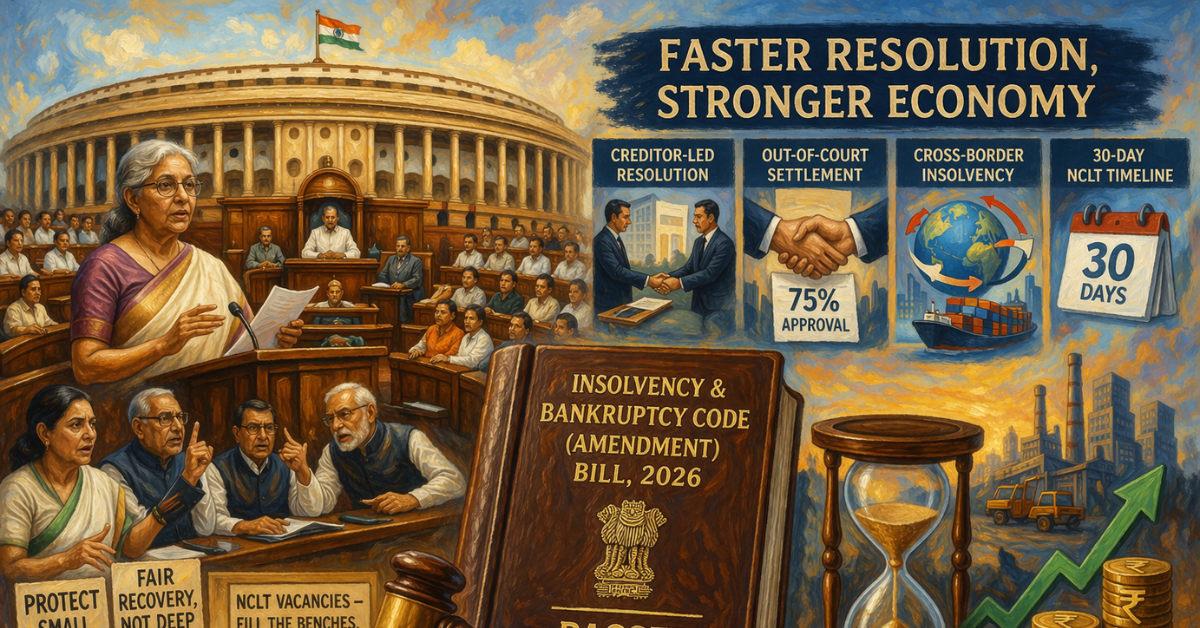
- Parliament passes major overhaul of India’s insolvency framework to speed up debt resolution.
- Introduces creditor-led, pre-packaged insolvency processes to reduce delays.
- Provides legal backing for out-of-court settlements with 75% creditor approval.
- Sets a strict 30-day deadline for NCLT to admit or reject insolvency cases.
- Opposition raises concerns over high haircuts and tribunal capacity constraints.
In a significant legislative move aimed at strengthening India’s credit ecosystem, Parliament has passed the Insolvency and Bankruptcy Code (Amendment) Bill, 2026. The bill, cleared by the Rajya Sabha on April 2, 2026, introduces structural reforms designed to reduce delays in insolvency proceedings and preserve asset value during financial distress.
The amendment builds upon the existing Insolvency and Bankruptcy Code, which has governed corporate insolvency resolution in India since 2016. While the original framework improved recovery mechanisms and credit discipline, persistent delays and procedural bottlenecks have limited its effectiveness in several high-profile cases, similar to issues seen in the medical certification transgender context.
Shift Toward a Creditor-Led Resolution Model
A central feature of the amendment is the transition toward a creditor-driven resolution process. Under the revised framework, financial creditors are empowered to initiate pre-packaged insolvency proceedings across a broader category of companies. This reduces reliance on formal admission procedures and allows restructuring efforts to begin earlier in the distress cycle.
Previously, insolvency cases required admission by the National Company Law Tribunal, a step that often faced delays due to litigation and administrative backlog. By enabling pre-packaged processes, the amendment seeks to bypass prolonged entry barriers and reduce uncertainty for lenders and businesses.
Formal Recognition of Out-of-Court Settlements
For the first time, the law introduces a structured mechanism for out-of-court settlements. These settlements can now receive legal recognition if approved by at least 75 percent of the Committee of Creditors (CoC). This provision aims to bridge informal restructuring arrangements with the formal insolvency framework.
The reform is expected to ease pressure on judicial institutions while offering greater flexibility to creditors in resolving stressed assets. It also allows viable businesses to avoid lengthy court proceedings and continue operations with minimal disruption.
Cross-Border Insolvency Framework Introduced
The amendment lays the foundation for handling cross-border insolvency cases, an area that has remained underdeveloped in India’s legal system. With increasing global exposure of Indian companies, insolvency cases often involve assets and creditors across multiple jurisdictions.
The new provisions align India’s framework with global best practices guided by international standards on cross-border insolvency. This alignment is expected to facilitate cooperation between domestic and foreign courts, improving recovery prospects in multinational insolvency proceedings.
Strict Timelines to Address Procedural Delays
To tackle one of the most persistent issues under the IBC, the amendment mandates that insolvency applications must be admitted or rejected within 30 days by the NCLT. This timeline is intended to eliminate prolonged delays at the entry stage, which have historically stalled resolution processes.
By enforcing strict deadlines, the government aims to ensure that intervention occurs before significant asset value erosion takes place, thereby improving recovery outcomes for creditors.
Government’s Position on the Reform
While piloting the bill, Finance Minister Nirmala Sitharaman emphasized that the amendments are designed to remove procedural inefficiencies and improve resolution efficiency. She stated that the objective is to revive viable businesses quickly while enabling unviable firms to exit in a structured manner, freeing up capital for productive use in the economy.
Opposition Raises Concerns on Recovery and Capacity
Despite broad agreement on the need for reform, opposition members expressed concerns regarding the effectiveness of the proposed changes. Representatives from the Trinamool Congress and the Biju Janata Dal highlighted the issue of steep “haircuts” in past insolvency cases.
They pointed out that creditors have often recovered only a small fraction of their dues, in some cases accepting losses exceeding 90 percent. The absence of a minimum recovery threshold in the amendment, they argued, leaves this issue unresolved.
Another major concern relates to institutional capacity. Opposition leaders noted that vacancies and resource constraints within the NCLT could undermine the effectiveness of stricter timelines. Without strengthening tribunal infrastructure, they cautioned, faster legal provisions may not translate into faster resolutions.
Broader Implications for India’s Credit Ecosystem
The amendment reflects a continued effort to refine India’s insolvency regime in response to operational challenges observed over the past decade. By prioritizing early intervention, creditor control, and procedural efficiency, the reform seeks to improve both recovery rates and investor confidence.
Its long-term impact will depend on implementation, particularly in addressing institutional constraints and ensuring consistent application across cases. As the revised framework begins to take effect, its ability to deliver faster and more predictable outcomes will be closely watched by lenders, businesses, and policymakers alike.