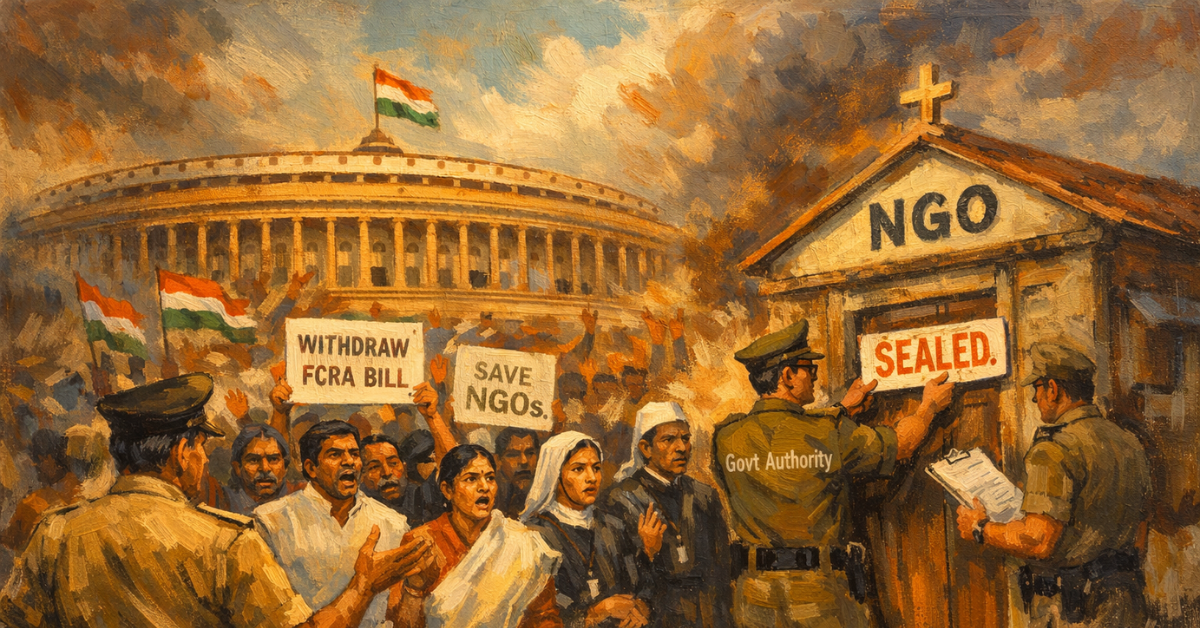
Key Developments
- Centre has put the FCRA Amendment Bill, 2026 on hold after protests.
- Opposition and civil society raised concerns over asset seizure powers.
- Proposed “Designated Authority” became the main point of contention.
- Government defended the bill citing transparency and national security.
- Further stakeholder consultations expected before reintroduction.
The Union Government has put the Foreign Contribution (Regulation) Amendment Bill, 2026 on hold following sustained protests and mounting political pressure, similar to the recent controversies surrounding the Lok Sabha women’s quota. The decision comes after days of disruption in Parliament and demonstrations outside, particularly at the Makar Dwar, where Opposition leaders and civil society groups gathered in large numbers.
Introduced in the Lok Sabha on March 25, the bill sought to expand the government’s powers over organisations receiving foreign funding. Its provisions quickly triggered concern across political and institutional circles, especially with Assembly elections approaching in states such as Kerala, where the issue has drawn strong local reaction.
At the centre of the proposed changes is a restructuring of enforcement under the Foreign Contribution (Regulation) Act. The amendment attempts to address what the government describes as gaps that arise after an organisation’s licence is cancelled, particularly in relation to assets created through foreign contributions, similar to the issues surrounding medical certification transgender.
What the amendment proposes
The bill introduces the concept of a “Designated Authority,” a government-appointed body that would assume control over assets built using foreign funds if an organisation loses its registration. These assets include schools, hospitals, and welfare institutions that often operate in underserved areas.
Under the proposed framework, the authority would have the power to take provisional or permanent control, manage operations, and ensure that these facilities continue to serve public purposes. The government argues that this prevents assets from being abandoned or diverted after regulatory action against an organisation.
Political and institutional concerns
Opposition parties have strongly objected to this provision, arguing that it grants excessive powers to the executive without adequate judicial oversight. Leaders from the Congress, Trinamool Congress, Samajwadi Party, and Nationalist Congress Party have described the move as an attempt to legitimise state takeover of privately managed institutions.
Concerns have been particularly sharp among minority-run organisations. In Kerala, church leaders warned that a large number of educational and healthcare institutions could come under direct or indirect government control. The issue, for them, extends beyond property rights to questions of institutional autonomy.
Several Opposition MPs staged walkouts during the week, stating that the bill could be used to target organisations critical of the government. Civil society groups echoed similar concerns, pointing to the absence of clearly defined safeguards within the proposed framework.
Government’s justification
The Ministry of Home Affairs has defended the bill as a measure aimed at transparency and accountability. Officials argue that assets created using foreign funds are intended for public welfare, and should continue to serve that purpose even if the original organisation is found in violation of the law.
The government has also linked the amendment to national security concerns, stating that foreign funding has, in some cases, been used to influence domestic policy or support activities that run counter to national interests, similar to the issues raised during the discussions on the CAPF Bill 2026. Tighter regulation, it maintains, is necessary to prevent such risks.
Another justification relates to the diversion of funds. The amendment seeks to curb practices where funds are routed through multiple organisations, making it difficult to trace their final use. A central authority, according to the government, would bring administrative clarity and reduce disputes following licence cancellations.
What happens next
With elections approaching in key states, the decision to put the bill on hold reflects a calibrated political response. The government has indicated that it remains committed to the proposed changes, but will undertake further consultations with stakeholders before moving ahead.
The debate around the amendment continues to reflect broader tensions between regulatory oversight and institutional autonomy. Its eventual form, if reintroduced, is likely to depend on how these competing concerns are addressed in the next round of discussions.