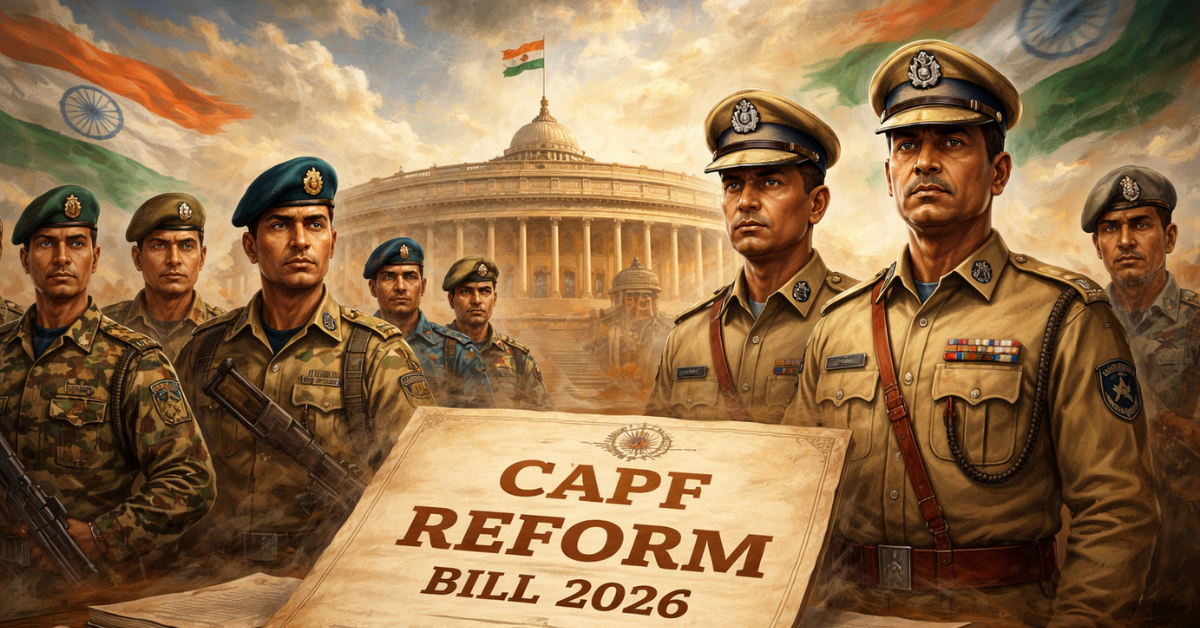
CAPF Reform Bill 2026: Structure, Controversy, and Political Divide
- Parliament passes Central Armed Police Forces Bill on April 1 (Rajya Sabha) and April 3 (Lok Sabha)
- Creates a unified administrative framework for BSF, CRPF, CISF, ITBP, and SSB
- Reserves top leadership roles largely for IPS officers through statutory quotas
- Government cites operational efficiency and coordination as core justification
- Opposition and CAPF associations warn of morale impact and legal override concerns
The Central Armed Police Forces (General Administration) Bill, 2026, has emerged as one of the most consequential and contested pieces of legislation in the current parliamentary session. The bill was cleared by the Rajya Sabha on April 1 and passed in the Lok Sabha on April 3, 2026, amid sharp debate, sustained opposition, and coordinated walkouts by multiple parties.
At its core, the legislation seeks to establish a unified administrative framework governing India’s five principal paramilitary forces: the Border Security Force (BSF), Central Reserve Police Force (CRPF), Central Industrial Security Force (CISF), Indo-Tibetan Border Police (ITBP), and Sashastra Seema Bal (SSB). These forces collectively handle border security, internal law and order, industrial protection, and counter-insurgency operations under the Ministry of Home Affairs.
Key Provisions: The IPS Deputation Framework
The most debated provision of the bill is the formal introduction of a statutory quota system that reserves senior leadership roles for Indian Police Service (IPS) officers on deputation. The structure of this quota is clearly defined across ranks:
| Rank | IPS Deputation Quota |
|---|---|
| Director General (DG) | 100% (Reserved exclusively for IPS) |
| Special Director General (SDG) | 100% (Reserved exclusively for IPS) |
| Additional Director General (ADG) | Minimum 67% |
| Inspector General (IG) | 50% |
| Deputy Inspector General (DIG) | 0% (Quota removed to support CAPF promotions) |
While the removal of quota at the DIG level is presented as a measure to support internal promotions, the complete reservation of the top two ranks has become the central point of contention.
Government’s Rationale: Uniformity and Operational Efficiency
The government has defended the bill as a structural reform necessary for modern security challenges. Minister of State for Home Affairs Nityanand Rai stated during parliamentary discussions that the bill addresses long-standing inconsistencies across CAPFs.
One of the key objectives is the introduction of unified service rules. Until now, each force followed its own recruitment systems, seniority structures, and promotion pathways, often leading to administrative disputes. The bill aims to harmonize these elements under a single framework, similar to the reforms seen in the IBC insolvency law.
Another justification lies in inter-agency coordination. The government maintains that CAPFs frequently operate alongside state police forces and intelligence agencies. By ensuring IPS officers occupy top leadership roles, the system is expected to maintain continuity between central and state-level command structures.
The bill also provides statutory backing to service conditions that were previously governed by executive orders. This, according to the government, will reduce ambiguity and legal disputes over appointments and promotions.
Why the Bill Is Controversial, including the ongoing FCRA bill controversy
The legislation has drawn strong opposition from both political parties and CAPF cadre associations, largely on two grounds.
First is what critics describe as a “legislative override.” In 2025, the Supreme Court ruled that CAPF officers fall under the Organized Group ‘A’ Services (OGAS) and directed the government to reduce IPS deputation in order to improve internal promotion prospects. Opponents argue that by codifying IPS quotas into law, the government has effectively bypassed the intent of that ruling, a topic that reflects ongoing tensions in Andhra political news.
Second is the issue of morale and career stagnation. CAPF officers often face prolonged delays in promotions, sometimes waiting 15 to 20 years for advancement. With the top two ranks now fully reserved for IPS officers, many see a structural ceiling that limits long-term career growth within the forces. Associations representing personnel have raised concerns that this may affect motivation in forces already operating under demanding field conditions.
Parliamentary Proceedings and Political Response
The passage of the bill was marked by visible political friction. Opposition parties including Congress, Trinamool Congress, and Aam Aadmi Party staged walkouts in both Houses of Parliament. Their primary demand was to refer the bill to a Select Committee for detailed scrutiny, given its wide-ranging impact on lakhs of personnel.
During the debate, leaders such as : and :contentReference[oaicite:1]{index=1} argued that the bill undermines the morale of officers who dedicate their entire careers to CAPFs. They stated that the framework effectively prevents these officers from ever leading their own forces, calling it a structural disadvantage embedded in law.
Despite the opposition, the government pushed the bill through both Houses, maintaining that the reform is essential for building a more cohesive and responsive national security architecture.
What Lies Ahead for CAPFs
With parliamentary approval secured, the focus now shifts to implementation. The bill represents a significant shift toward centralized control and standardized service rules across India’s paramilitary forces. At the same time, it leaves unresolved tensions around cadre rights, promotion pathways, and institutional balance between IPS officers and CAPF personnel.
The long-term impact of the reform will depend on how these competing concerns are addressed in practice, particularly in maintaining both operational efficiency and internal morale within the forces.