Article Summary
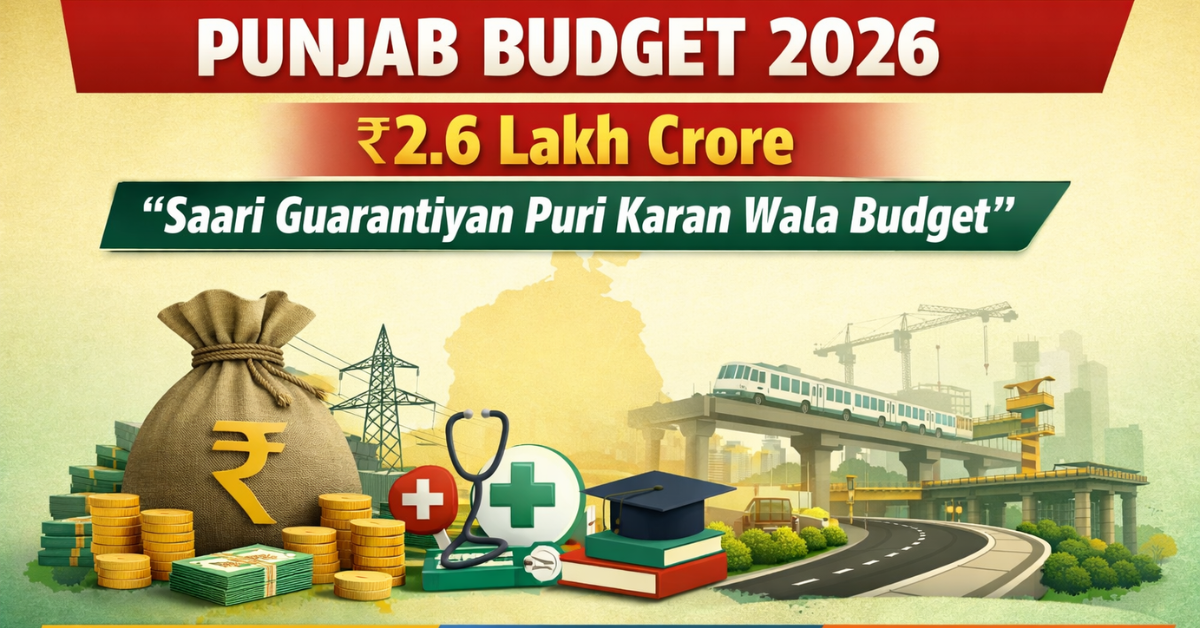
- The Punjab government presented the 2026–27 state budget in the Punjab Vidhan Sabha with a total proposed expenditure of ₹2,60,437 crore.
- The budget projects the state’s Gross State Domestic Product (GSDP) to reach ₹9,80,635 crore in 2026–27 with an expected growth rate of about 10 percent.
- Revenue receipts are estimated at ₹1,26,190 crore while total receipts including capital receipts are projected at ₹1,78,937 crore.
- The revenue deficit is estimated at ₹21,955 crore and the fiscal deficit at ₹39,970 crore, reflecting continued fiscal pressure on the state.
- The budget continues major welfare programmes including free electricity for most households, expansion of Aam Aadmi Clinics, and health insurance coverage under the Mukhyamantri Sehat Yojna, alongside ongoing initiatives like Punjab police recruitment.
- Spending priorities include agriculture, healthcare, education, infrastructure development, and rural services as the government aims to balance welfare commitments with economic growth.
The Punjab government on 8 March 2026 presented the state budget for the financial year 2026–27 in the Punjab Vidhan Sabha. Finance Minister Harpal Singh Cheema outlined the government’s financial plans with a focus on welfare programmes, economic expansion, and improvements in public service delivery. The proposed budget places total expenditure for the year at ₹2,60,437 crore.
The budget was presented at a time when the state continues to face fiscal constraints while attempting to sustain social welfare initiatives and economic development, similar to the two-phase election showdown in West Bengal. Government officials said the financial plan reflects an effort to strengthen the economy while continuing key programmes in healthcare, education, and social protection.
According to the budget estimates, Punjab’s Gross State Domestic Product is projected to reach ₹9,80,635 crore during the financial year 2026–27, compared with about ₹8,91,487 crore in the previous year. The government expects the state economy to grow by around 10 percent, supported by agricultural productivity, expansion in services, and industrial activity.
Punjab Budget 2026–27 — Department-wise Spending
| Department / Sector | Allocation (₹ crore) |
|---|---|
| Education, Sports, Art & Culture | 300 |
| Medical and Public Health | 400 |
| Social Security and Welfare | 300 |
| Water Supply and Sanitation | 75 |
| Urban Development | 850 |
| Crop Husbandry | 49 |
| Animal Husbandry | 260 |
| Forestry and Wildlife | 125 |
| Rural Development Programmes | 300 |
| Major Irrigation | 400 |
| Roads and Bridges | 150 |
| Road Transport | 300 |
| Tourism | 4 |
| Civil Supplies | 309 |
Fiscal Position and Budget Deficits
The financial projections indicate that Punjab will continue to operate with significant deficits. The revenue deficit for 2026–27 is estimated at ₹21,955 crore, representing about 2.24 percent of the state’s gross domestic product. The fiscal deficit is projected at ₹39,970 crore, which is approximately 4.08 percent of GSDP.
The primary deficit, which excludes interest payments on existing debt, is estimated at ₹11,215 crore. These figures suggest that the government will continue to rely on borrowing to finance development spending and welfare programmes.
Interest payments remain a substantial component of the state’s expenditure. A large portion of government revenue is allocated toward servicing past borrowings, highlighting the long-standing issue of public debt in Punjab’s financial structure.
Sources of Government Revenue
The state government expects total receipts for the financial year to reach ₹1,78,937 crore. Revenue receipts account for the largest portion of these funds at ₹1,26,190 crore. Capital receipts, including borrowings and other capital inflows, are projected at ₹52,747 crore.
Punjab’s own tax revenue remains the main source of income for the government. The state expects to generate about ₹70,850 crore from taxes such as Goods and Services Tax, excise duties, vehicle taxes, and stamp duties. Non-tax revenue sources including fees, dividends, and service charges are projected to bring in approximately ₹15,686 crore.
The state also receives financial transfers from the central government. Punjab’s share in central taxes is estimated at ₹30,464 crore, while grants-in-aid from the central government are expected to amount to around ₹9,188 crore during the financial year.
Government Expenditure Priorities
A large share of the budget continues to be devoted to revenue expenditure. This includes spending on government salaries, pensions, interest payments, and routine administrative costs. Salaries and wages for government employees are estimated at ₹39,115 crore for 2026–27, while pension payments to retired employees are projected at ₹22,465 crore.
Interest payments on government debt are expected to reach ₹28,755 crore. In addition to these obligations, other revenue expenditures including welfare schemes and administrative operations are projected to total around ₹57,810 crore.
The government has also allocated funds for capital expenditure amounting to about ₹18,381 crore. Capital spending is primarily directed toward infrastructure projects such as roads, irrigation systems, transport networks, and development works.
Agriculture and Rural Development
Agriculture remains central to Punjab’s economy, and the budget includes several provisions aimed at strengthening the rural sector. Allocations have been made for crop husbandry, irrigation systems, livestock development, fisheries, and rural infrastructure programmes.
The government has emphasized improving irrigation capacity and strengthening agricultural supply chains. Rural development initiatives are expected to focus on infrastructure improvements, cooperative institutions, and better market connectivity for farmers.
Officials also noted that the long-term sustainability of Punjab’s agriculture sector requires diversification beyond traditional wheat and rice cultivation, along with improved water management and technological integration.
Healthcare and Education Initiatives
Healthcare remains one of the major policy priorities in the state budget. The government has continued the expansion of Aam Aadmi Clinics across Punjab to provide accessible primary healthcare services including consultations, medicines, and diagnostic tests.
Another major initiative highlighted in the budget is the Mukhyamantri Sehat Yojna, which provides health insurance coverage of up to ₹10 lakh for families in the state. The programme is intended to reduce the financial burden of medical treatment on households.
In the education sector, the government continues to invest in upgrading public schools through the Schools of Eminence programme. The initiative aims to improve the quality of government education through better infrastructure, modern teaching practices, and expanded academic opportunities.
Infrastructure and Transport Development
The budget includes investments in infrastructure sectors such as roads, bridges, urban development, and public transport systems. Improved connectivity and infrastructure are expected to support trade, industrial growth, and mobility within the state.
Urban development initiatives include projects related to housing, sanitation, and city infrastructure. The government has also emphasized improving rural road networks and transport facilities to strengthen connectivity between villages and urban markets.
Social Welfare Policies
Several welfare programmes remain a central component of the state’s policy agenda. One of the most significant schemes is the free electricity programme, under which the government states that nearly 90 percent of domestic electricity consumers receive zero electricity bills.
The Mukhyamantri Tirath Yatra Scheme, which provides free pilgrimage travel for senior citizens, also continues as part of the state’s social welfare initiatives. These programmes are intended to provide financial relief and social support to households across the state.
The government has emphasized that welfare initiatives will remain an important part of its governance approach while efforts are made to improve fiscal stability.
Punjab Budget 2026–27 — Key Fiscal Indicators
| Indicator | Amount (₹ crore) |
|---|---|
| Total Budget Expenditure | 2,60,437 |
| Revenue Receipts | 1,26,190 |
| Total Receipts | 1,78,937 |
| Revenue Deficit | 21,955 |
| Fiscal Deficit | 39,970 |
| Primary Deficit | 11,215 |
| Projected GSDP | 9,80,635 |
Looking Ahead
The Punjab Budget for 2026–27 reflects the state government’s effort to continue welfare policies while addressing long-standing fiscal pressures. The budget emphasizes public services such as healthcare, education, and rural development while maintaining infrastructure investment.
However, challenges remain due to the state’s high debt levels and persistent budget deficits. The effectiveness of the financial plan will depend on the government’s ability to strengthen revenue collection, manage borrowing, and sustain economic growth across sectors in the coming years.