Key Takeaways
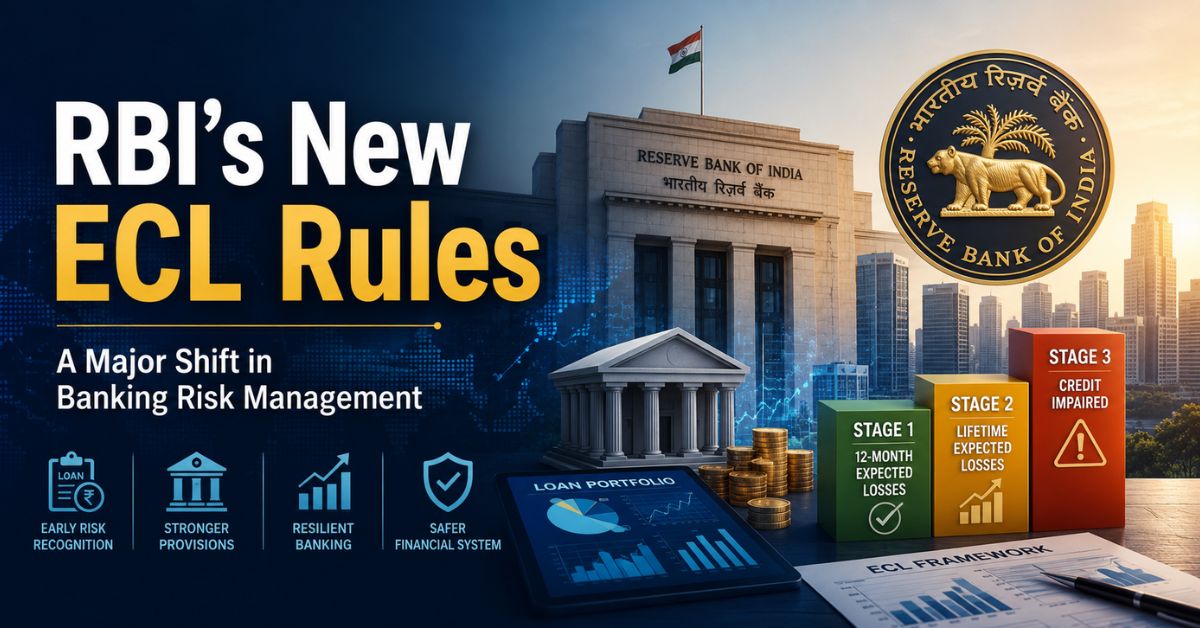
- RBI’s Expected Credit Loss (ECL) framework will come into effect from April 1, 2027, replacing the traditional incurred loss model.
- Banks will be required to identify and provision for potential loan losses much earlier using forward-looking risk assessments.
- The transition could reduce banks’ CET-1 capital ratios by up to 120 basis points, though the impact can be spread over four years until March 2031.
- The new three-stage credit risk model places significant emphasis on Stage 2 assets, where early signs of stress trigger lifetime loss provisioning.
- Borrowers may face stricter credit assessments as banks adopt more predictive risk management systems.
The Reserve Bank of India (RBI) has set the stage for one of the biggest changes in the country’s banking system in decades by finalizing its Expected Credit Loss (ECL) framework. The new rules, which will take effect from April 1, 2027, require banks to move away from the traditional method of recognizing loan losses only after signs of default appear and instead estimate potential losses much earlier.
The shift may appear technical, but its impact on el niño rainfall india will be far-reaching. Banks will need to hold more provisions against risky loans, invest heavily in technology and data systems, and change the way they assess borrowers. For customers, the changes could influence loan approvals, pricing, and access to credit.
The RBI has also provided a four-year transition period ending March 31, 2031, allowing banks to gradually absorb the financial impact of the new framework rather than taking a large hit in a single year.
Why RBI Is Changing the Existing System
For years, Indian banks have followed an “incurred loss” model. Under this approach, lenders generally set aside larger provisions only after a borrower has already shown signs of financial stress or default.
Critics of this system argue that it often recognizes losses too late. During economic downturns, banks may suddenly discover large amounts of bad loans, forcing them to make significant provisions and weakening profitability.
The ECL framework seeks to address this issue by requiring banks to estimate future credit losses before borrowers actually default, similar to the principles outlined in the IBC insolvency law. Instead of looking only at past repayment behavior, banks will also consider future risks and economic conditions.
This approach is already used in many global banking markets through accounting standards such as IFRS 9. Regulators believe that earlier recognition of risk can make banks more resilient during economic shocks and reduce the buildup of hidden stress in the financial system.
A Major Capital Adjustment for Banks
One of the biggest concerns surrounding the transition is its impact on bank capital.
Credit rating agencies and banking analysts estimate that the move to ECL could reduce Common Equity Tier-1 (CET-1) capital ratios by as much as 120 basis points for some lenders.
CET-1 capital represents a bank’s strongest financial cushion and is closely watched by regulators and investors. A decline in this ratio means banks have less capital available relative to their risk-weighted assets.
However, the overall banking sector is entering this transition from a position of strength. Most Indian banks currently maintain healthy capital buffers, with aggregate CET-1 ratios around 14%.
Because of this, analysts do not expect the new framework to create systemic risks for the banking sector.
The RBI’s decision to allow a phased adjustment over four years is also expected to reduce pressure on banks. Instead of recording the entire capital impact immediately, lenders will be able to spread the effect over several years, helping them manage profitability and capital planning more effectively.
Understanding the New Three-Stage System
At the heart of the ECL framework is a new three-stage classification system that measures how credit risk changes over the life of a loan.
| Stage | Criteria | Provision Requirement | Impact |
|---|---|---|---|
| Stage 1 | Performing assets with no significant increase in risk | 12-month expected credit losses | Limited change from current standard asset norms |
| Stage 2 | Significant increase in credit risk but not in default | Lifetime expected credit losses | Highest increase in provisioning requirements |
| Stage 3 | Credit-impaired or defaulted assets | Lifetime expected credit losses | Higher coverage requirements for bad loans |
Stage 2 is expected to be the most closely watched category because loans showing early warning signs will require much higher provisioning long before they become non-performing assets.
How Expected Credit Losses Are Calculated
The ECL framework relies on advanced risk modeling rather than fixed provisioning percentages.
Banks must estimate three key components:
- Probability of Default (PD): The likelihood that a borrower will fail to repay.
- Loss Given Default (LGD): The portion of the loan that may not be recovered if default occurs.
- Exposure at Default (EAD): The amount outstanding when default takes place.
These factors are combined to calculate expected losses across different loan portfolios. The practical implication is that two borrowers with similar loan amounts may attract different provisioning requirements depending on their risk profile.
Off-Balance-Sheet Risks Come Under Scrutiny
Another important feature of the RBI’s framework is its broader scope.
Under the new rules, banks must account not only for loans that have already been disbursed but also for several off-balance-sheet exposures.
These include undrawn credit lines, letters of credit, guarantees, and other commitments that may create future financial obligations.
Previously, many of these exposures received less attention because the funds had not yet been fully utilized. Under the ECL framework, banks must recognize that risk exists even before the money is actually drawn.
Technology Becomes Central to Risk Management
The transition to ECL is not simply an accounting exercise. It requires a fundamental upgrade in how banks collect, analyze, and use data.
Under the old framework, many provisioning decisions depended heavily on loan classification and days-past-due metrics. The new model requires continuous risk assessment.
Banks will need detailed historical data covering multiple economic cycles, borrower categories, and loan products. This information will be used to build predictive models capable of estimating future losses.
The framework also requires banks to incorporate macroeconomic indicators such as GDP growth, inflation, interest rates, and broader economic trends into their calculations.
Industry experts expect significant investments in analytics platforms, automation systems, cloud infrastructure, and artificial intelligence-powered risk monitoring tools over the next few years.
What It Means for Retail Borrowers
Although the ECL framework is designed primarily to strengthen banks, its effects are likely to be felt by borrowers as well.
Because banks will face higher costs when loans show early signs of stress, lenders may become more selective during the approval process.
Borrowers with strong repayment histories and stable incomes are expected to benefit from easier access to credit. However, applicants with weaker credit profiles may face additional scrutiny.
Industry observers believe that credit scores will become even more important in lending decisions. Individuals with lower scores may encounter higher rejection rates, requests for additional documentation, or increased borrowing costs.
Self-employed individuals and first-time borrowers could face particular challenges because their income patterns are often less predictable than those of salaried employees.
Different Challenges for Private and Public Sector Banks
The impact of ECL is unlikely to be uniform across the banking industry.
Many large private sector banks have already invested heavily in advanced risk modeling and analytics. Several institutions also have experience working with frameworks similar to IFRS 9 through subsidiaries or parallel reporting systems.
As a result, they may be better prepared for the transition.
Public sector banks, meanwhile, could face a steeper adjustment process. Many state-owned lenders manage large and diverse loan books, including infrastructure and long-term corporate projects that require sophisticated risk assessment models.
They may need greater investments in technology, data quality improvements, and employee training to meet the new requirements.
Analysts expect some public sector banks to experience more noticeable fluctuations in profitability during the initial years of implementation as provisioning levels adjust to the new standards.
A New Phase for India’s Banking Sector
The RBI’s ECL framework represents far more than a change in accounting methodology. It signals a broader shift toward proactive risk management across India’s banking system.
By forcing lenders to recognize risks earlier, regulators aim to reduce the chances of large hidden losses emerging during economic downturns. The framework is also expected to improve transparency, strengthen investor confidence, and bring Indian banking practices closer to global standards.
The transition will require significant investments in technology, data quality, risk management, and compliance systems. Borrowers may also notice stricter credit assessments as banks adapt to the new framework.
As the April 2027 implementation date approaches, banks will increasingly focus on building the systems and capabilities needed to comply with the rules. How successfully they manage this transition could play a major role in shaping the strength, profitability, and resilience of India’s banking sector over the coming decade.