


Why RBI Is Considering Polymer Notes Again
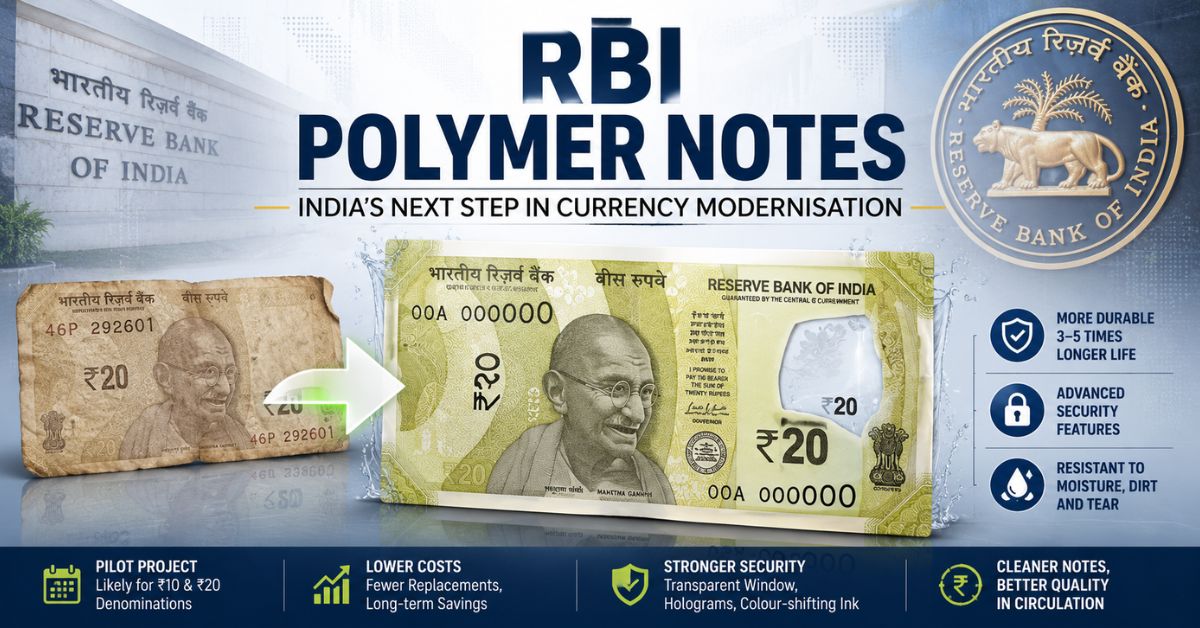
- The Reserve Bank of India is revisiting its plan to introduce polymer banknotes after more than a decade.
- Polymer notes are more durable than paper currency and can last three to five times longer.
- Rising currency printing costs and growing cash circulation are key reasons behind the proposal.
- Advanced security features in polymer notes could help reduce counterfeiting risks.
- RBI is expected to begin with a pilot project focused on lower-denomination banknotes.
The Reserve Bank of India (RBI) is once again considering the introduction of polymer banknotes, reviving a proposal that was first discussed more than a decade ago. The move comes at a time when cash usage remains strong across the country despite the rapid growth of digital payment platforms such as UPI.
Recent discussions within the central bank have indicated that RBI may soon launch a pilot project to test polymer notes in circulation. If approved, the initiative could mark one of the biggest changes to India’s currency system since the introduction of the Mahatma Gandhi New Series banknotes.
The proposal is being driven by three major concerns: the rising cost of printing currency, the large volume of damaged notes that need replacement every year, and the need for stronger security features to combat counterfeiting.
While polymer notes are already used in more than 60 countries, India has yet to adopt them on a large scale. The latest developments suggest that the central bank believes both technology and infrastructure have improved enough to revisit the idea.
RBI’s New Focus on Polymer Currency
Polymer banknotes are made from a special plastic material known as Biaxially Oriented Polypropylene (BOPP). Unlike traditional paper currency, these notes are more resistant to moisture, dirt, tearing, and everyday wear and tear.
For the RBI, the attraction is clear. Although polymer notes cost more to produce initially, they can remain in circulation much longer than paper notes. This means fewer replacements and lower long-term costs.
The renewed discussions come at a time when India’s currency circulation continues to grow. Many expected cash usage to decline sharply after the widespread adoption of digital payments. Instead, cash remains an important part of daily transactions, especially in rural areas, small businesses, local markets, transportation services, and informal sectors.
According to recent reports, currency in circulation reached approximately ₹42.86 trillion in May 2026, highlighting the continued importance of physical cash in the Indian economy.
This growing demand has increased the pressure on the RBI to manage currency more efficiently.
Why RBI Wants More Durable Notes
One of the biggest challenges facing the central bank is the large number of soiled and damaged notes that must be removed from circulation each year.
India’s climate plays a major role in this problem. Banknotes are exposed to humidity, monsoon rains, dust, heat, and frequent handling. Lower-denomination notes often change hands several times a day, causing them to wear out quickly.
As a result, the RBI spends significant resources on replacing damaged currency.
In FY25, currency printing expenses reportedly exceeded ₹6,370 crore. A substantial portion of this cost is linked to the replacement of notes that have become unfit for circulation.
Polymer notes offer a potential solution because they can last three to five times longer than traditional paper notes. Their resistance to water and dirt also helps them maintain quality even after prolonged use.
For a country as large as India, even a modest increase in note lifespan could result in substantial savings over time.
How Polymer Notes Differ From Paper Currency
Many people assume polymer notes feel similar to plastic cards such as debit or credit cards. In reality, polymer banknotes are designed to remain flexible and easy to handle.
They can be folded, carried in wallets, and used in everyday transactions just like paper notes.
The difference lies in the material used to manufacture them.
Traditional Indian banknotes are produced using cotton-based paper. Polymer notes, on the other hand, are created from a specially engineered plastic substrate that offers greater durability.
These notes are smoother to touch and often have a slightly waxy feel. They are less likely to absorb moisture and are harder to tear accidentally.
Another important advantage is that polymer notes remain cleaner because dirt and contaminants do not easily penetrate the surface.
This can help improve the overall quality of currency circulating in the economy.
Enhanced Security Features
Apart from durability, security is another major reason central banks around the world have adopted polymer currency.
Counterfeit currency remains a concern for monetary authorities, and polymer substrates allow the integration of advanced security technologies that are difficult to replicate.
One of the most recognizable features of polymer notes is the transparent window. This clear section is built directly into the note and cannot be reproduced using conventional printing methods.
Polymer banknotes can also support advanced holograms, metallic strips, color-shifting inks, and other security elements that provide multiple layers of protection.
These features make it easier for the public to verify genuine notes while making counterfeiting significantly more difficult.
For the RBI, stronger security could become an important benefit if polymer notes are eventually adopted across multiple denominations.
India’s Earlier Attempt at Polymer Currency
The current discussions are not the first time India has explored polymer notes.
The idea was initially proposed in 2009 when the RBI announced plans to evaluate polymer-based currency. The objective was similar to today’s goals: increase durability, reduce replacement costs, and strengthen security.
In 2012, the government approved field trials involving polymer ₹10 notes. The experiment was conducted in selected cities including Kochi, Mysore, Jaipur, Bhubaneswar, and Shimla.
The ₹10 denomination was chosen because it experiences some of the highest circulation levels in the country and tends to deteriorate quickly.
The trial was expected to provide valuable data on how polymer notes would perform under different climatic conditions and usage patterns.
However, despite the initial momentum, the project failed to move forward on a large scale.
Why the Earlier Project Was Shelved
Several factors contributed to the slowdown of the original polymer currency initiative.
One challenge involved the higher upfront production costs associated with polymer notes. Although long-term savings were expected, the initial investment required for large-scale implementation was considerable.
Another concern related to compatibility with cash-handling infrastructure. ATMs, counting machines, sorting equipment, and other banking systems would need adjustments to process polymer notes efficiently.
Environmental concerns were also raised regarding the disposal and recycling of plastic-based currency.
Combined with operational and logistical issues, these challenges led to the project being put on hold.
As a result, India continued using traditional paper-based banknotes while many other countries moved ahead with polymer currency systems.
What Has Changed Since Then
The situation in 2026 is very different from what it was a decade ago.
Currency-processing technology has improved significantly. Modern ATMs and cash-handling machines are better equipped to handle different types of banknotes.
Global experience with polymer currency has also expanded. More countries have adopted the technology, providing valuable lessons on implementation, maintenance, and recycling.
Manufacturing techniques have become more advanced as well. Today’s polymer notes are more durable, easier to process, and equipped with sophisticated security features.
The RBI appears to believe that many of the obstacles that existed during the previous attempt can now be managed more effectively.
This has paved the way for a renewed evaluation of polymer currency.
Which Notes Could Be Introduced First?
While the RBI has not officially announced the denominations that will be included in the pilot project, lower-value notes are considered the most likely candidates.
Historically, the central bank has focused on denominations such as ₹10 and ₹20 for polymer trials.
These notes experience the highest circulation frequency and usually wear out much faster than larger denominations.
Testing polymer versions of these notes would allow the RBI to measure durability, public acceptance, machine compatibility, and cost savings under real-world conditions.
If the pilot produces positive results, the central bank could gradually expand polymer currency to other denominations in the future.
Global Adoption of Polymer Notes
| Country | Status |
|---|---|
| Australia | First country to introduce polymer banknotes in 1988 and now uses polymer currency across all denominations. |
| Canada | Introduced polymer notes in 2011 to improve durability and reduce counterfeiting. |
| United Kingdom | Completed the transition to polymer banknotes across major denominations by 2022. |
| Singapore | Uses polymer notes extensively for day-to-day transactions. |
| Vietnam | Has adopted polymer notes for most commonly used denominations. |
India would not be entering unfamiliar territory if it proceeds with polymer currency.
The growing global acceptance of polymer currency has strengthened the argument that the technology is mature enough for large-scale deployment.
The experiences of these countries provide useful examples for India as it evaluates the next phase of its currency modernization efforts.
What RBI Polymer Notes Could Mean for India
The possible introduction of polymer banknotes represents more than a simple change in material. It reflects the RBI’s broader effort to improve the efficiency, durability, and security of India’s currency system.
Even in an era dominated by digital payments, cash continues to play a central role in the economy. As long as demand for physical currency remains strong, the cost of printing and replacing banknotes will remain an important issue for policymakers.
Polymer notes offer a potential solution by lasting longer, reducing replacement needs, and supporting advanced anti-counterfeiting technologies.
For now, the RBI appears focused on testing the concept through a pilot programme before making any large-scale commitment. The results of that exercise will likely determine whether India finally joins the growing list of countries that have adopted polymer currency after years of discussion and delays.
The coming months could therefore prove important in shaping the future of physical cash in India, even as the country’s digital payments revolution continues to expand.