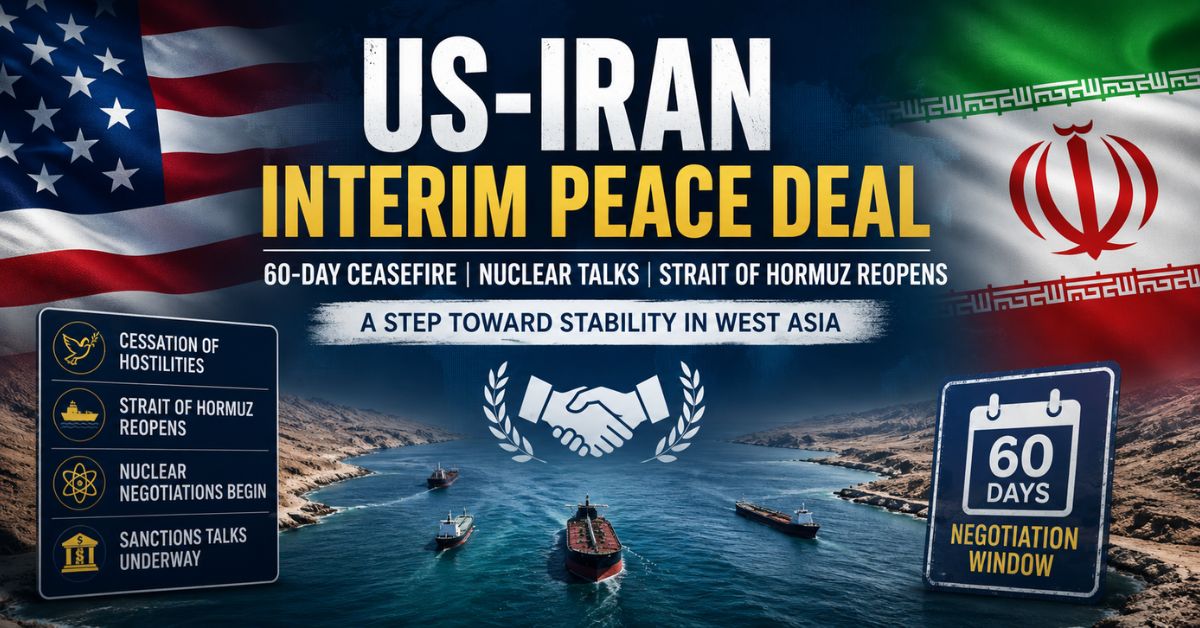
Key Developments in the U.S.-Iran Crisis
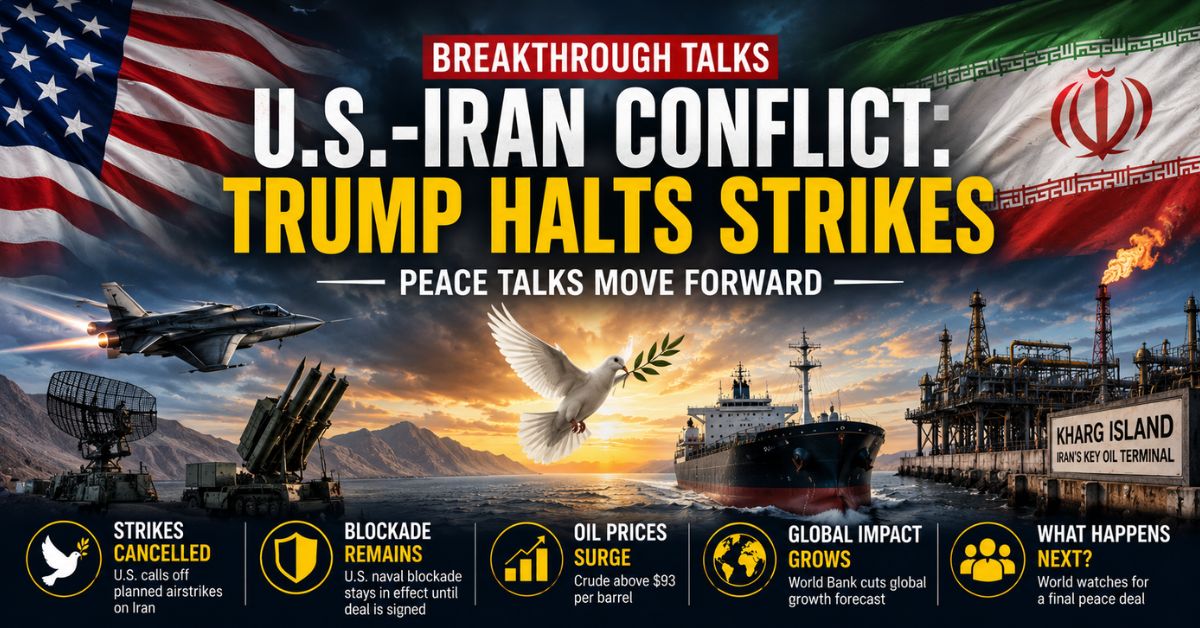
- President Donald Trump announced the cancellation of planned U.S. airstrikes against Iran following progress in diplomatic negotiations.
- The pause comes after days of military exchanges involving U.S. strikes on Iranian targets and Iranian retaliation across the Gulf region.
- Despite easing tensions, the U.S. naval blockade on Iranian ports remains in place pending a final agreement, as the ceasefire fragile hold continues to be tested.
- Oil prices have surged above $93 per barrel, increasing concerns about inflation and global economic growth.
- Iran has not yet publicly confirmed the reported peace settlement, leaving the future of negotiations uncertain, especially in light of the proposed Iran peace plan.
A sudden diplomatic breakthrough has pulled the United States and Iran back from the edge of a major military confrontation, after U.S. President Donald Trump announced that planned airstrikes against Iran had been cancelled amid progress toward a possible peace agreement.
The decision came after several days of intense military exchanges that raised fears of a wider regional war and threatened global energy supplies. Trump said discussions involving senior Iranian figures and key Middle Eastern partners had made enough progress to halt planned military action. He suggested that a formal agreement could be finalized in Europe within days.
However, while the announcement has reduced immediate concerns about further escalation, uncertainty remains. Iranian officials have not publicly confirmed the reported settlement, and military tensions across the Gulf region continue despite the pause in planned U.S. strikes.
Planned Military Action Halted Following Diplomatic Progress
The latest development marks a sharp change in tone from Washington.
Only hours before announcing the cancellation of military action, Trump had warned that the United States was prepared to hit Iran “very hard” if tensions continued to rise. He had also raised the possibility of taking control of Kharg Island, Iran’s most important oil export terminal and a critical source of revenue for the country’s economy.
The White House later confirmed that scheduled bombing operations would not proceed after what Trump described as significant diplomatic progress. According to the U.S. president, discussions had reached the highest levels of Iranian leadership and had received support from several regional governments, including Israel, Saudi Arabia, the United Arab Emirates, and Jordan.
Despite those claims, no official confirmation has yet emerged from Tehran regarding the final terms of any agreement. As a result, analysts continue to describe the situation as highly fluid.
Diplomats familiar with the negotiations have cautioned that many details remain unresolved and that any agreement would require formal approval from all participating parties before it can take effect.
How the Latest Crisis Began
The current crisis developed rapidly following an incident near the Strait of Hormuz earlier this week.
According to U.S. officials, an American Army Apache attack helicopter crashed off the coast of Oman after an encounter involving an Iranian drone. The exact circumstances remain under investigation, but Washington blamed Iran for the incident.
The helicopter loss immediately heightened tensions in a region that had already been experiencing growing instability.
U.S. military commanders argued that the event represented a direct threat to American forces operating in the Gulf. The incident quickly triggered a series of military responses that pushed both countries closer to a larger conflict, with live conflict updates indicating ongoing tensions.
What began as a localized military event soon expanded into one of the most serious confrontations between Washington and Tehran in recent years.
U.S. Launches Retaliatory Strikes on Iranian Military Infrastructure
In response to the helicopter incident, the United States carried out multiple rounds of military operations against Iranian targets.
American officials described the attacks as defensive measures intended to reduce threats to U.S. personnel and regional allies.
The strikes reportedly targeted Iranian air-defense systems, radar facilities, surveillance networks, command stations, and other military infrastructure. Areas near Bandar Abbas, Sirik, and Qeshm Island were among the reported locations affected by the operations.
U.S. military officials said the objective was to weaken Iran’s ability to monitor and challenge American forces operating in the region.
The strikes represented one of the most significant U.S. military actions against Iranian assets since the conflict expanded earlier this year.
Iran strongly condemned the attacks and accused Washington of violating regional stability.
Iran Responds With Missile and Drone Attacks
Iran responded by launching missiles and drones toward countries hosting U.S. military personnel.
Regional governments reported attacks affecting sites in Bahrain, Kuwait, and Jordan. Air-defense systems were activated in several locations as authorities sought to intercept incoming threats.
Kuwait temporarily closed its airspace during the heightened security alert, causing disruptions to commercial aviation and raising concerns about civilian safety.
Although casualty figures remain limited compared with earlier stages of the conflict, the attacks demonstrated Iran’s ability to project force beyond its borders and target locations linked to U.S. military operations.
The exchanges also increased fears that neighboring countries could become more deeply involved in the conflict if hostilities continued.
Security experts warned that even a small miscalculation could have triggered a wider regional war involving multiple governments.
Strait of Hormuz Remains a Critical Flashpoint
Despite the suspension of planned American strikes, one of the most sensitive issues remains unresolved.
Iran’s military leadership previously declared the Strait of Hormuz closed to commercial and oil traffic, warning that vessels entering the waterway could face military action.
The strait is one of the world’s most important energy corridors. A significant portion of global oil exports passes through the narrow passage connecting the Persian Gulf to international shipping routes.
Any prolonged disruption could have serious consequences for energy markets and the global economy.
However, U.S. Central Command has maintained that commercial shipping continues to move through the strait despite Iranian threats.
The differing claims have created uncertainty among shipping companies, insurers, and energy traders who rely on safe passage through the region.
Industry observers note that even limited disruptions can increase transportation costs and create volatility in global commodity markets.
U.S. Naval Blockade Remains in Effect
While Trump halted the planned bombing campaign, he emphasized that American pressure on Iran has not ended.
According to the U.S. president, the naval blockade imposed on Iranian ports will remain active until a final diplomatic agreement is formally signed.
The continued blockade means that economic pressure on Iran remains substantial despite the apparent diplomatic progress.
Washington argues that maintaining the blockade strengthens its negotiating position and helps ensure compliance with any future settlement.
Iran, meanwhile, has repeatedly criticized the measure and described it as an illegal attempt to restrict its economy and international trade.
The continuation of the blockade suggests that the current pause should not yet be viewed as a complete return to normal relations between the two countries.
Conflict Pushes Oil Prices Higher and Weighs on Global Economy
The conflict has already produced significant economic consequences around the world.
Oil prices climbed above $93 per barrel this week as investors reacted to the possibility of prolonged instability in the Gulf region. Since the conflict intensified, crude prices have risen roughly 25%, increasing concerns about inflation and economic growth.
Higher energy costs have affected transportation, manufacturing, and consumer prices in many countries.
The economic pressure has extended beyond energy markets.
The World Bank recently lowered its global growth outlook, citing ongoing conflicts, supply-chain disruptions, inflation concerns, and uncertainty in international trade.
Economists warn that a prolonged confrontation involving major oil-producing regions could further weaken economic activity and increase costs for businesses and households worldwide.
Although the latest diplomatic progress has eased some market concerns, traders remain cautious because the situation can change quickly.
India Raises Diplomatic Concerns After Mariners Killed
The conflict has also created diplomatic challenges for countries outside the immediate region.
India lodged a strong protest after three Indian mariners were killed during enforcement actions connected to the U.S. naval blockade.
The incident drew attention in New Delhi and raised concerns about the safety of civilian workers operating in one of the world’s busiest maritime regions.
Indian officials called for accountability and emphasized the need to protect commercial shipping personnel from becoming caught in military confrontations.
The deaths highlighted how the conflict’s impact extends far beyond the countries directly involved.
Many nations depend on Gulf shipping routes for energy imports, trade, and employment opportunities, making regional stability a global concern.
Uncertainty Remains Despite Diplomatic Breakthrough
The coming days may determine whether the current pause becomes a lasting diplomatic breakthrough or merely a temporary break in hostilities.
Trump has expressed confidence that a broader settlement can be finalized soon, potentially through talks in Europe involving regional stakeholders. However, the absence of formal confirmation from Iran means important questions remain unanswered.
Negotiators must still address security guarantees, military activity, economic restrictions, and the future status of key maritime routes in the Gulf.
At the same time, the continued U.S. naval blockade and ongoing military readiness on both sides demonstrate that tensions have not fully disappeared.
For now, the cancellation of planned American strikes has reduced the immediate risk of a wider war and provided an opportunity for diplomacy to move forward. Whether that opportunity results in a lasting agreement will depend on decisions made in Washington, Tehran, and several regional capitals over the days ahead.
As governments, markets, and military planners closely monitor developments, the world remains focused on whether the latest breakthrough can transform a rapidly escalating conflict into a durable path toward stability.