West Asia Conflict Latest Developments
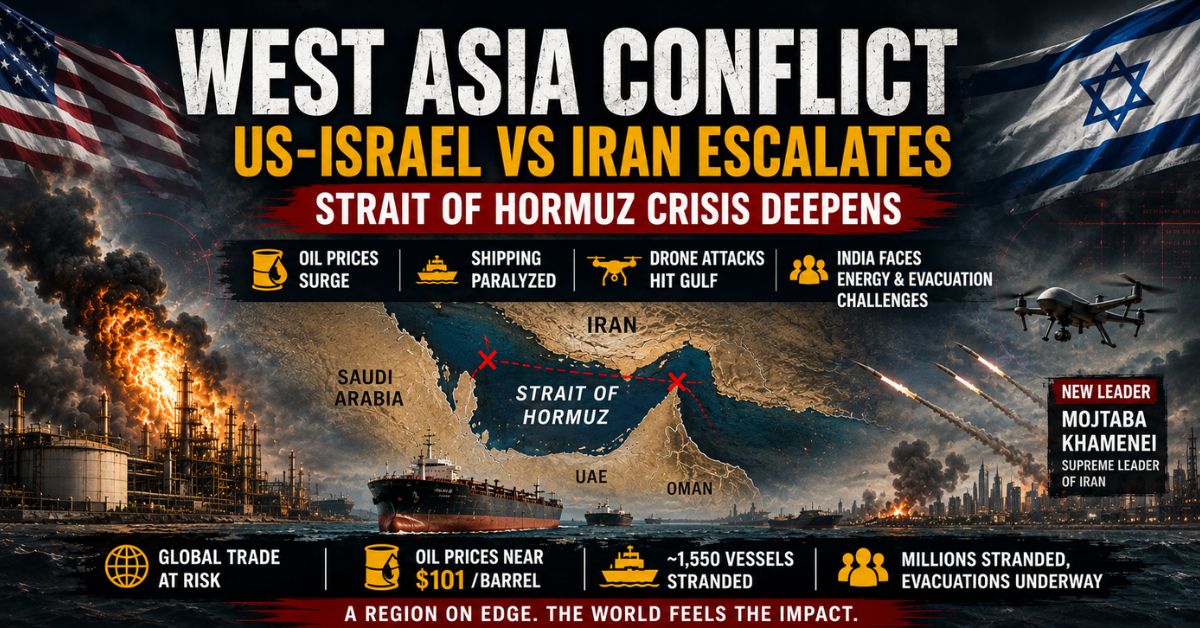
- The Strait of Hormuz crisis has escalated into a major global shipping and energy emergency.
- Iran’s newly announced Persian Gulf Strait Authority signals Tehran’s attempt to regulate maritime movement through the strategic waterway.
- The conflict has expanded beyond Iran and Israel, drawing Gulf nations and regional militia networks into a wider confrontation.
- India faces mounting economic pressure due to energy dependence, evacuation challenges, and disruptions to regional trade corridors, particularly in light of the Hormuz crisis India oil.
- Diplomatic efforts remain stalled as global powers stay divided over the legality and consequences of the US-Israel strikes on Iran.
The conflict unfolding across West Asia has entered one of its most dangerous phases in recent decades, with the Strait of Hormuz crisis now threatening global trade, energy security, and diplomatic stability far beyond the Middle East, as seen in the live conflict updates. What began as a direct military confrontation between the United States, Israel, and Iran has steadily widened into a regional conflict involving Gulf monarchies, militia networks, shipping companies, and major world powers.
The latest developments on May 18, 2026, indicate that the conflict is no longer limited to missile exchanges or targeted strikes. It has evolved into a layered economic and military confrontation that now affects maritime trade routes, energy markets, civilian evacuations, and the strategic calculations of countries like India, China, and Russia.
The immediate roots of the current crisis trace back to February 28, when the United States and Israel launched coordinated strikes on Iranian military and nuclear-linked infrastructure under the codenames “Operation Epic Fury” and “Operation Lion’s Roar.” The ceasefire’s fragile hold has become increasingly precarious since then. Multiple international reports confirmed that the operations targeted missile facilities, naval assets, and strategic Iranian installations.
Following those strikes, Iran retaliated through missile launches, drone attacks, and maritime pressure tactics around the Strait of Hormuz. The conflict then expanded into what analysts now describe as an asymmetric naval war, where Iran relied heavily on drones, mines, fast boats, and militia networks rather than traditional large-scale naval engagements.
The most significant development now is the effective paralysis of the Strait of Hormuz, one of the world’s most critical energy chokepoints, amid rising Hormuz Strait tensions. Roughly one-fifth of global LNG supplies and a major portion of seaborne crude oil normally pass through this narrow maritime corridor. Reports over the past two months have shown that shipping traffic through the region has sharply collapsed after repeated Iranian warnings, naval incidents, and insurance concerns.
Iran has gradually shifted from threatening closure of the strait to building a quasi-administrative structure around it, including the controversial Hormuz toll proposal. Reports regarding the formation of the Persian Gulf Strait Authority, or PGSA, suggest Tehran is attempting to regulate and selectively permit maritime movement through the waterway.
This part of the information shared by you appears broadly aligned with emerging reports and regional analyses. However, some figures, including the exact number of stranded ships and mariners, cannot yet be independently verified through major international agencies. Available reports do confirm that thousands of mariners and large numbers of vessels remain affected by the disruption.
The broader strategic reality now resembles a “dual blockade.” The United States has intensified pressure on Iranian ports and maritime infrastructure, while Iran continues to restrict practical access through the Persian Gulf. Reuters and other international assessments indicate that Iran is attempting to establish selective control over passage through Hormuz rather than enforcing a complete universal shutdown.
The consequences for the global economy are already visible. Oil prices have remained under heavy upward pressure, and major shipping firms have rerouted vessels away from the Gulf toward the much longer Cape of Good Hope route around Africa. This increases freight costs, delays cargo delivery, and raises insurance premiums for shipping companies worldwide.
The conflict has also widened geographically. Drone and missile incidents linked to Iran-aligned groups have increasingly targeted Gulf infrastructure and regional states that were once viewed as relatively insulated from direct confrontation.
One of the most alarming recent developments involves reported attacks linked to strategic infrastructure inside the Gulf region. While there are discussions and claims regarding drone activity near energy and nuclear-linked facilities in the UAE, independent confirmation regarding the specific Barakah reactor-related details remains limited as of now. It is clear, however, that Gulf states are increasingly exposed to spillover risks from the war.
Saudi Arabia has also faced repeated aerial threats from militia-linked drone operations emerging from Iraqi and regional corridors. This reflects a larger pattern where Iran-aligned armed groups are operating across multiple fronts simultaneously, including Iraq, Lebanon, Yemen, Syria, and Gaza.
Meanwhile, violence continues across Gaza and southern Lebanon. Israeli operations targeting militant infrastructure and commanders have intensified, while civilian casualties continue to mount. Regional analysts increasingly warn that the conflict has blurred the line between localized retaliation and sustained regional warfare.
Diplomatic efforts have so far failed to produce meaningful de-escalation. The United Nations Security Council remains divided, with Western nations largely framing the original strikes as defensive or preventive actions, while Russia and China have criticized them as violations of sovereignty.
Former US President Donald Trump has continued issuing public warnings toward Tehran regarding nuclear negotiations and regional security arrangements. Reports indicate that Washington is considering additional military options if negotiations collapse entirely.
Pakistan’s role as an intermediary has also drawn attention. Iranian officials have acknowledged receiving and responding to proposals through Pakistani channels, although Tehran reportedly views many American demands as excessive. This suggests that despite the military escalation, backchannel diplomacy has not completely collapsed.
For India, the crisis is rapidly turning from a geopolitical concern into a direct economic and strategic challenge.
India remains heavily dependent on energy flows from the Gulf region. Any prolonged disruption in the Strait of Hormuz directly threatens fuel imports, LPG availability, industrial production, shipping costs, and inflation. Reports about emergency energy planning and fuel conservation measures reflect the seriousness with which New Delhi is viewing the crisis.
The Indian diaspora dimension is equally critical. Millions of Indian citizens live and work across Gulf countries including the UAE, Saudi Arabia, Kuwait, Qatar, Bahrain, and Oman. Airspace restrictions and regional instability have complicated evacuation efforts. Maritime risks have added another layer of uncertainty.
India has already expanded naval monitoring operations in the Arabian Sea and nearby regions. Reports connected to “Operation Urja Suraksha” indicate that Indian commercial shipping has already encountered security threats connected to the Hormuz crisis.
Another strategic casualty of the conflict is the India-Middle East-Europe Economic Corridor, or IMEC. The corridor had been projected as a major trade and connectivity initiative linking India with Europe through Gulf infrastructure networks. With shipping uncertainty, regional instability, and political fragmentation increasing, the project now faces serious delays and operational uncertainty.
From a broader geopolitical perspective, the current crisis demonstrates how modern conflicts are no longer confined to battlefields alone. Economic warfare, cyber pressure, shipping disruption, proxy militias, and energy insecurity have become central instruments of confrontation.
The most important question now is whether India should move beyond evacuation and economic management and attempt a more assertive diplomatic role.
At present, India’s cautious approach appears strategically practical. New Delhi maintains working relationships with Israel, Iran, the United States, and Gulf Arab states simultaneously. That balancing position gives India diplomatic credibility that many other countries currently lack.
However, aggressive mediation carries risks. India does not possess the direct military leverage or coercive influence needed to enforce agreements between the opposing blocs. Any visibly partisan role could damage long-term relations with one side or another. Moreover, India’s immediate priorities remain energy security, citizen evacuation, maritime safety, and economic stabilization.
That said, India can still expand its diplomatic role in carefully calibrated ways. Quiet shuttle diplomacy, humanitarian coordination, maritime deconfliction talks, and support for limited ceasefire arrangements may allow India to contribute without becoming politically trapped inside the conflict.
India is also uniquely positioned because it is viewed in many regional capitals as a relatively non-interventionist power focused on stability rather than regime change or ideological competition.
The danger now is that the conflict may gradually normalize into a prolonged regional standoff. If the Strait of Hormuz remains partially blocked for months rather than weeks, the economic consequences could become severe not only for West Asia but for Asia, Europe, and Africa as well.
For ordinary citizens worldwide, the first visible effects will likely emerge through rising fuel prices, higher shipping costs, inflation in imported goods, and disruptions in energy-intensive sectors.
For policymakers, the deeper concern is that the conflict increasingly lacks a clear exit path. Both sides appear unwilling to concede strategic ground, yet neither side has achieved decisive dominance.
The result is a dangerous equilibrium where military escalation, economic disruption, and diplomatic paralysis continue simultaneously.