


India Reacts as Hormuz Flashpoint Disrupts Energy Routes
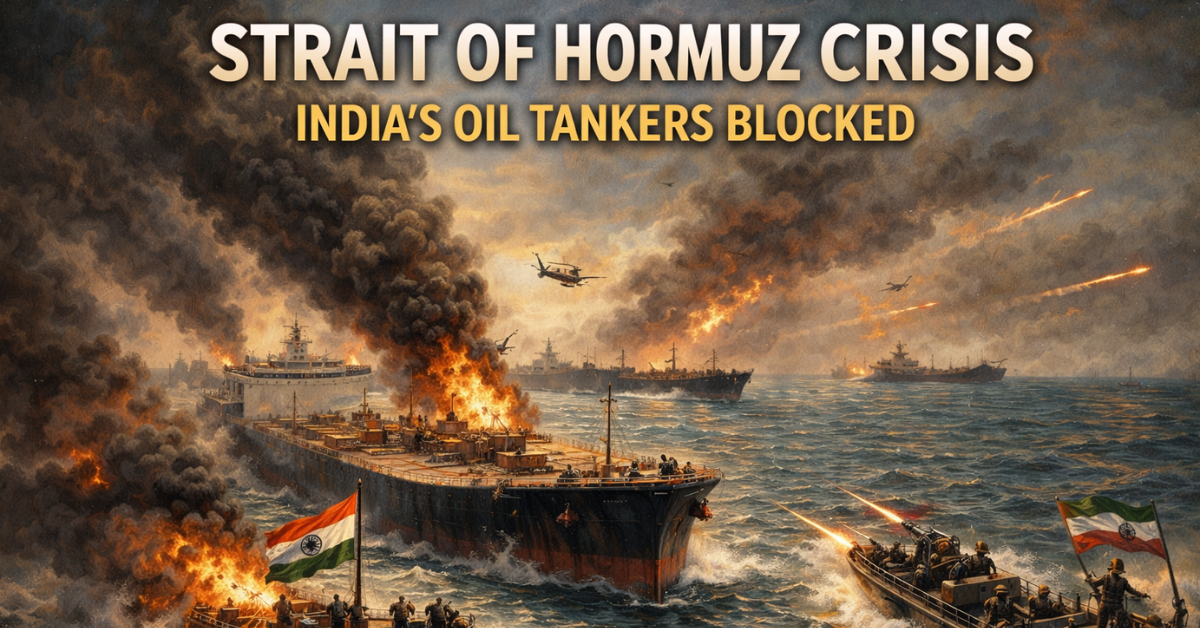
- Iran has effectively shut the Strait of Hormuz, halting or restricting global oil shipments through a key maritime chokepoint.
- At least two India-bound oil vessels were blocked or fired upon, forcing them to reverse course.
- India’s Foreign Secretary Vikram Misri summoned the Iranian envoy, conveying “deep concern” over maritime safety.
- Over a dozen India-bound ships remain stranded or delayed near the Strait amid escalating military tensions.
- The crisis threatens global energy supply chains, with nearly 20% of the world’s oil trade affected.
The closure of the Strait of Hormuz has once again brought global energy security into sharp focus, as Iran’s military escalation in the region disrupts one of the most critical arteries of international trade. India, heavily dependent on imported crude, now finds itself navigating both diplomatic and logistical challenges after its vessels were directly impacted in the latest flare-up.
Flashpoint in the Gulf: What Happened on April 18
On April 18, 2026, tensions in the Persian Gulf escalated sharply when Iranian forces reimposed a near-total shutdown of the Strait of Hormuz, citing ongoing hostilities linked to the broader US-Iran conflict. Reports confirmed that Iranian Revolutionary Guard units issued warnings to vessels and, in some cases, opened fire to enforce the closure.
Two India-bound oil tankers were among those directly affected. According to India’s Ministry of External Affairs, the vessels were either fired upon or forced to retreat due to the heightened threat environment. The incident marked one of the most serious direct disruptions to Indian maritime interests in the ongoing crisis.
The situation was not isolated. As many as 14 ships carrying Indian-linked cargo, including crude oil, liquefied petroleum gas, and fertilizers, were either halted or delayed in the region. Thirteen of these were reportedly stopped by Iranian naval forces and left waiting near strategic points such as Larak Island.
India’s Diplomatic Response: Measured but Firm
In response to the incident, India moved quickly through diplomatic channels. Foreign Secretary Vikram Misri summoned Iran’s ambassador to New Delhi and formally conveyed the country’s “deep concern” over the safety of Indian vessels and crew.
The Indian side urged Tehran to ensure safe passage for merchant shipping and to restore normal transit operations through the Strait. Officials emphasized that maritime security and freedom of navigation are non-negotiable principles, particularly in a waterway that is central to global commerce.
The Iranian envoy reportedly acknowledged the concerns and committed to relaying India’s position to authorities in Tehran. However, there has been no immediate indication that restrictions will be eased.
India’s approach reflects a balancing act. While it has avoided overtly aligning with Western pressure on Iran, it has also made clear that disruptions to its energy lifelines will not be tolerated.
Why the Strait of Hormuz Matters So Much
The Strait of Hormuz is not just another shipping lane. It is one of the world’s most strategically vital chokepoints, connecting the Persian Gulf to the Arabian Sea. Nearly one-fifth of global oil supply passes through this narrow corridor, making it indispensable to energy markets.
Any disruption here has immediate global consequences. Analysts note that even partial closures can trigger spikes in oil prices, supply chain bottlenecks, and insurance risks for shipping companies.
The current crisis is already being described by energy agencies as one of the most severe supply disruptions in modern history, with potential ripple effects on inflation and economic stability worldwide.
For India, the stakes are particularly high. A large share of its crude imports originates from the Gulf region, and alternative routes or suppliers cannot easily compensate for sudden disruptions.
From Tensions to Closure: How the Crisis Escalated
The present shutdown is part of a broader conflict cycle that began earlier in 2026, when US and Israeli strikes on Iranian targets triggered a series of retaliatory measures by Tehran.
Iran’s response included asserting control over the Strait of Hormuz and warning that only approved vessels would be allowed to pass. Over time, this evolved into intermittent closures, threats to shipping, and direct attacks on vessels.
Attempts at de-escalation have repeatedly failed. A brief ceasefire in early April allowed limited reopening, but disagreements over sanctions and naval blockades led to a rapid breakdown.
The United States subsequently imposed its own naval blockade targeting Iranian shipping, further complicating the situation and effectively turning the Strait into a contested military zone.
Maritime Risk and Military Signalling
The current phase of the crisis is characterized by high-risk signaling. Iran’s Revolutionary Guard has issued explicit warnings that any vessel attempting to cross the Strait could face destruction.
Such statements are not merely rhetorical. Reports of gunfire, drone strikes, and missile incidents in and around the Strait have created a climate of uncertainty where commercial shipping becomes untenable.
Insurance providers have already classified the region as a high-risk zone, dramatically increasing costs for ship operators. In some cases, crews have been given the right to refuse transit due to safety concerns.
For global trade, this translates into delays, rerouting, and higher costs that eventually pass on to consumers.
India’s Strategic Calculus: Energy, Security, and Diplomacy
India’s response to the crisis is shaped by three overlapping priorities.
First is energy security. With a significant portion of its oil imports passing through Hormuz, any sustained disruption could affect domestic fuel availability and pricing.
Second is maritime safety. India has already launched naval operations, including escort missions under initiatives like Operation Urja Suraksha, to protect its shipping interests in the region.
Third is diplomatic balance. India maintains working relations with both Iran and the United States, and its response reflects an effort to avoid escalation while safeguarding national interests.
This delicate positioning is evident in its language. While expressing concern, India has avoided direct condemnation of Iran, instead emphasizing dialogue and safe passage.
Global Economic Fallout
The implications of the Strait’s closure extend far beyond regional politics.
Energy markets have already shown signs of stress, with prices rising and volatility increasing. Analysts warn that prolonged disruption could push oil prices significantly higher, potentially reaching levels that would strain both developed and developing economies.
Shipping industries are also under pressure. With limited alternative routes available, many vessels are forced to wait or reroute, adding days or even weeks to delivery schedules.
For countries in Asia, including India, China, Japan, and South Korea, the impact is particularly severe, as they rely heavily on Gulf energy supplies.
Voices from the Region
Officials from across the Gulf have described the situation in stark terms. A UAE minister recently characterized the closure as a form of “economic terrorism,” reflecting the scale of disruption being felt across economies tied to maritime trade.
Such language underscores the growing frustration among countries that are not directly involved in the conflict but are bearing its economic consequences.
At the same time, Iran has defended its actions as a response to external pressure, particularly the US-led naval blockade.
What Comes Next
The immediate future of the Strait of Hormuz remains uncertain.
Diplomatic efforts continue behind the scenes, but the gap between the positions of Iran and the United States remains wide. Without a breakthrough, the current cycle of closure and limited reopening is likely to persist.
For India, the focus will remain on ensuring the safe passage of its vessels while exploring contingency measures, including alternative supply routes and strategic reserves.
The broader question is whether the Strait can remain a reliable artery of global trade in an era of intensifying geopolitical rivalry. The events of April 2026 suggest that its stability can no longer be taken for granted.
A Chokepoint Under Strain
The Strait of Hormuz has long been viewed as a geopolitical pressure point, but the current crisis has pushed it into a new phase where military confrontation and economic disruption are deeply intertwined.
India’s diplomatic engagement with Iran highlights the immediate stakes, but the larger story is one of a global system under stress. Energy flows, trade routes, and strategic alliances are all being tested in real time.
Whether the Strait reopens fully or remains contested will shape not just regional dynamics, but the trajectory of the global economy in the months ahead.