


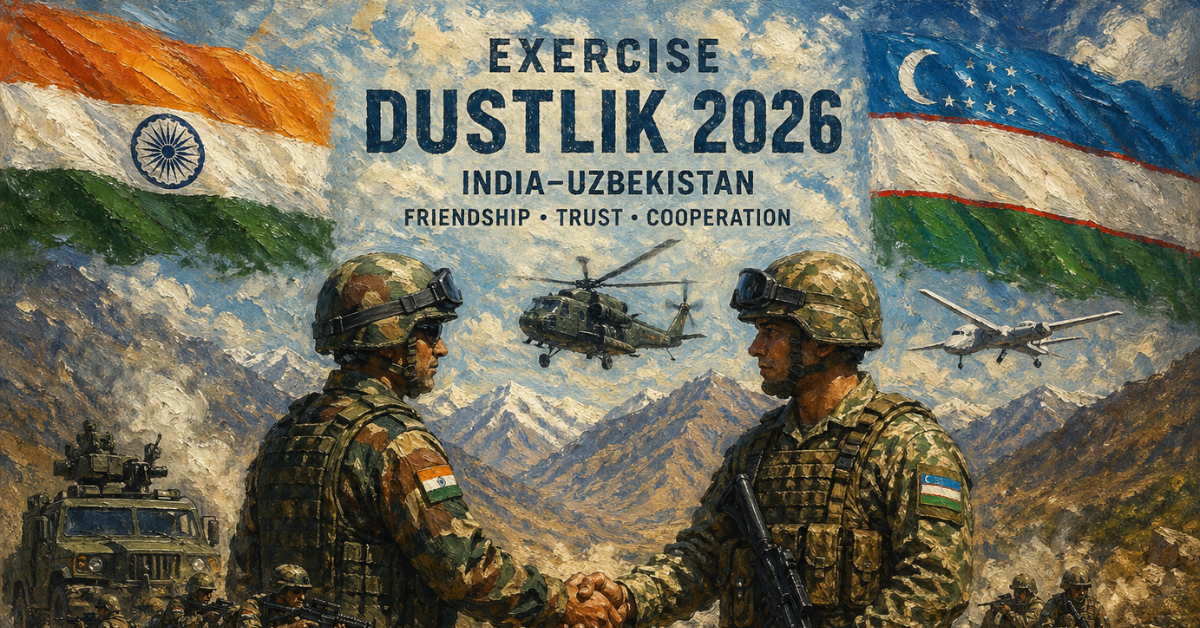
India–Uzbekistan Joint Drill DUSTLIK 2026 Concludes in Central Asia
- 7th edition of Exercise DUSTLIK held from April 12 to April 25, 2026, in Uzbekistan.
- 120 personnel participated, evenly split between Indian and Uzbek forces.
- Training focused on counter-terrorism operations in semi-mountainous terrain.
- Joint drills included UAV use, heliborne missions, and coordinated strike operations.
- Exercise highlights growing defense cooperation and strategic alignment in Central Asia.
The seventh edition of Exercise DUSTLIK, a joint military drill between India and Uzbekistan, concluded in late April after nearly two weeks of coordinated training in Central Asia, reflecting a steady expansion of defense ties between the two countries.
Held from April 12 to April 25, 2026, at the Gurumsaray Field Training Area in Uzbekistan’s Namangan region, the exercise brought together 120 personnel, evenly divided between the two sides. The Indian contingent included soldiers from a battalion of the Mahar Regiment alongside members of the Indian Air Force, while Uzbekistan fielded troops from both its army and air force.
The annual exercise, whose name translates to “Friendship,” has developed into a structured platform for improving interoperability, particularly in counter-terrorism operations. Officials from both countries described this year’s edition as operationally focused, with an emphasis on joint planning and execution under simulated combat conditions.
Training modules were built around semi-mountainous terrain, a setting chosen to reflect the geographic realities of potential conflict zones in the broader region. Troops practiced coordinated maneuvers designed to neutralize armed groups, with attention to rapid response and integrated command structures. The exercise also worked to refine joint decision-making under pressure, a recurring challenge in multinational operations.
Participants carried out a range of tactical drills, from weapon handling and reflex shooting to reconnaissance missions, land navigation and coordinated strikes on simulated hostile positions. Specialized sessions included unmanned aerial vehicle deployment and heliborne operations, indicating a gradual shift toward technology-supported warfare practices.
Physical conditioning remained part of the routine throughout the exercise. Daily schedules combined endurance drills, calisthenics and yoga, aimed at strengthening combat readiness while also building cohesion between the two contingents. Such shared routines often contribute to trust among troops operating in joint environments.
The exercise moved into its final phase toward the end of the schedule, with a validation drill designed to test the combined capabilities of both forces. This concluding segment required participants to plan and execute joint special operations against simulated unlawful armed groups, serving as a comprehensive assessment of the training conducted over the preceding days.
Exercise DUSTLIK has been held annually since its inception, alternating between the two countries. The previous edition took place in Aundh, near Pune, in April 2025. Over time, the exercise has expanded in both scale and complexity, reflecting a broader deepening of defense engagement.
For India, Central Asia remains a region of growing strategic interest, shaped by concerns over regional stability and transnational security threats. Joint exercises such as DUSTLIK function as a practical mechanism to build long-term partnerships, improve operational compatibility and address shared challenges related to terrorism.
Uzbekistan has also increased its participation in bilateral and multilateral defense cooperation as it adjusts its security posture. Military officials from both countries indicated that future editions of the exercise may incorporate more advanced scenarios, including expanded air-ground coordination and complex operational environments.
The conclusion of DUSTLIK 2026 reflects a continuing effort to align capabilities and strengthen a partnership that extends beyond symbolic engagement into sustained operational cooperation.