


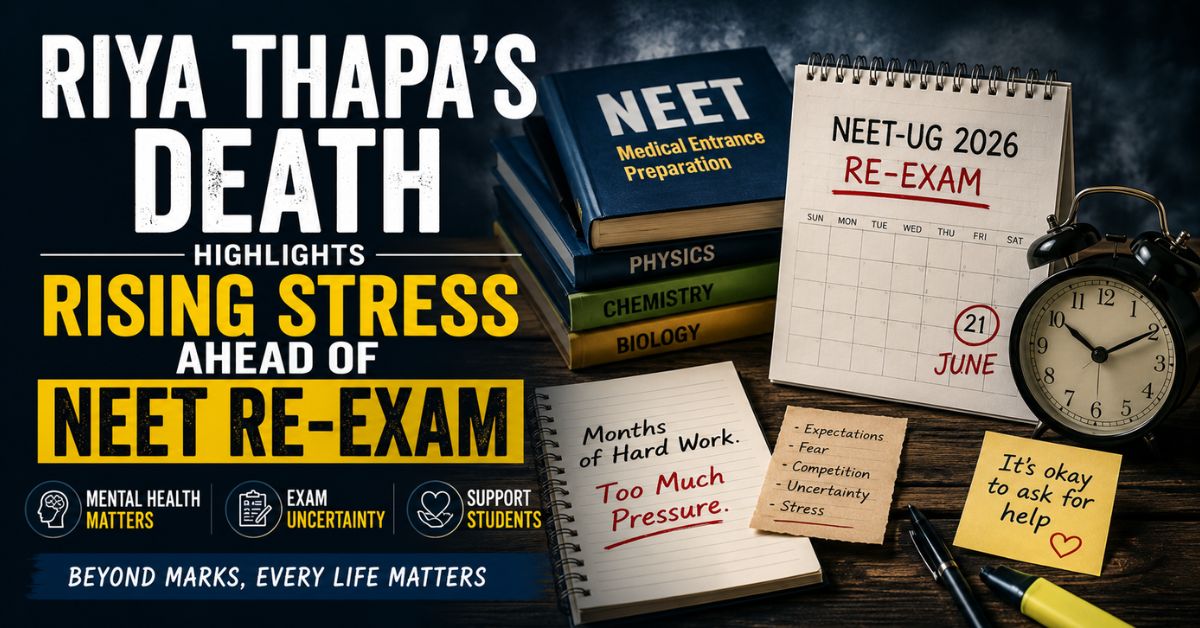
Riya Thapa’s Death Highlights Growing Anxiety Ahead of NEET Re-Exam: Key Highlights
- The death of 23-year-old NEET aspirant Riya Kumari Thapa has intensified concerns about student mental health ahead of the NEET-UG 2026 re-examination.
- Riya’s death occurred days before the June 21 re-exam, drawing national attention to the emotional pressure faced by aspirants.
- The NEET re-exam was ordered after allegations of paper leaks and examination irregularities triggered controversy.
- Experts say prolonged uncertainty can significantly increase stress among students preparing for high-stakes examinations.
- Several other reported student deaths have added urgency to discussions around examination pressure and mental health support.
- Authorities have introduced enhanced security measures ahead of the June 21 re-examination.
The death of 23-year-old NEET aspirant Riya Kumari Thapa in Dehradun has intensified concerns about the emotional pressure facing thousands of students preparing for the NEET-UG 2026 re-examination scheduled for June 21. Her death comes at a time when students across the country are grappling with uncertainty following the cancellation of the original examination amid allegations of paper leaks and irregularities.
While authorities continue to investigate the circumstances surrounding her death, the incident has become part of a larger national conversation about student mental health, examination stress, and the challenges created by disruptions in high-stakes competitive exams.
Who Was Riya Kumari Thapa?
According to reports, Riya Kumari Thapa was a 23-year-old medical aspirant from Dehradun, Uttarakhand. She had been preparing for NEET and had recently appeared for the examination. Family members and local residents described her as a dedicated student with strong academic credentials and a clear ambition of pursuing a career in medicine.
Police said Riya was found at her residence in Dehradun. A note was recovered during the investigation. Reports indicate that the note expressed affection toward her parents and reflected her emotional state before her death. Authorities have not announced any final conclusions regarding the circumstances of the case and investigations remain ongoing.
Her death has drawn widespread attention because it occurred only days before the NEET re-examination, a period during which many students have reported feeling anxious about their future.
The Background: Why Is There a NEET Re-Exam?
The original NEET-UG 2026 examination was conducted on May 3. However, allegations related to paper leaks and examination irregularities triggered a nationwide controversy. Following the developments, authorities announced a re-examination, which is scheduled to take place on June 21.
| Event | Date |
|---|---|
| Original NEET UG 2026 Exam | May 3, 2026 |
| Exam Cancellation | Following Leak Controversy |
| NEET UG 2026 Re-Exam | June 21, 2026 |
| Telegram Restriction Expected Until | June 22, 2026 |
The National Testing Agency (NTA) and the Union government have since introduced additional security measures aimed at protecting the integrity of the examination process. These include stricter monitoring, enhanced security protocols, and warnings against misinformation or attempts to disrupt the exam.
Authorities have also launched dedicated channels for reporting suspicious claims related to the examination and have repeatedly urged students to rely only on official information.
Students Facing Weeks of Uncertainty
For many aspirants, the controversy has meant more than simply preparing for another test.
Students who believed their examination journey was nearing completion suddenly found themselves facing additional weeks of preparation, uncertainty, and emotional strain. Mental health experts note that competitive examinations often require years of preparation, making unexpected disruptions especially difficult to process.
Many candidates had already begun planning the next stage of their education when the examination controversy emerged. Instead, they were required to shift their focus back to preparation, revision, and uncertainty about future outcomes.
Several student groups and parents have publicly expressed concerns regarding the short preparation window available before the re-examination. Some candidates have argued that they need more time to prepare, particularly those from rural areas or financially constrained backgrounds.
Other Cases Have Raised Similar Concerns
Riya’s death is not the only incident that has sparked concern during the lead-up to the re-examination.
Recent reports have highlighted several other cases involving NEET aspirants in different states. According to media reports, students from Coimbatore, Delhi, Rajasthan, and other regions were allegedly experiencing severe stress linked to examination uncertainty and the re-test process.
In Coimbatore, a 19-year-old aspirant reportedly died by suicide after expressing concerns about taking the examination again. Similar reports emerged from Delhi and Rajasthan, drawing attention to the mental health challenges faced by students during the ongoing controversy.
While experts caution against linking any individual death to a single cause, they acknowledge that academic pressure, uncertainty, personal circumstances, and emotional distress can interact in complex ways.
Why Re-Examinations Can Create Additional Pressure
Mental health specialists say that uncertainty often creates a different kind of stress than academic difficulty itself.
Students generally prepare for examinations with a fixed schedule and clear expectations. When those expectations suddenly change, many feel as though months or even years of planning have been disrupted.
Experts describe this as a loss of predictability. Students may feel uncertain about whether their previous efforts still matter or whether they can maintain the same level of preparation for another examination cycle.
For aspirants who have already invested multiple years preparing for medical entrance examinations, these disruptions can feel especially overwhelming.
Financial and Family Expectations
The pressure is often not limited to academics.
Many families invest significant amounts of money in coaching classes, study materials, hostel accommodation, transportation, and other educational expenses. Students are usually aware of these sacrifices and may feel a strong responsibility to succeed.
Mental health professionals say that this sense of responsibility can sometimes turn into emotional guilt when students encounter setbacks or uncertainty.
Parents, meanwhile, often face their own worries. They must balance supporting their children academically while also helping them cope emotionally during difficult periods.
Experts encourage families to maintain open communication and avoid defining a student’s future solely through examination results.
Government Response Ahead of June 21
As the June 21 re-examination approaches, authorities have intensified efforts to restore confidence in the examination process.
The government has warned of strict action against individuals attempting to spread misinformation, disrupt the examination, or engage in unfair practices. Additional security arrangements have been put in place across examination centres.
In a separate move, access to Telegram was temporarily restricted after authorities alleged that examination-related fraud networks were using the platform to spread misinformation and target candidates. Officials said the action was intended to protect students and preserve examination integrity ahead of the re-test.
Several states have also announced measures such as free transportation for candidates appearing in the examination to reduce logistical stress for students and families.
A Broader Conversation About Student Well-Being
The debate surrounding NEET has gradually evolved beyond examination management.
Educators, mental health advocates, and parents are increasingly asking whether student well-being receives enough attention in India’s highly competitive academic environment.
Many experts believe examination reforms should include stronger mental health support systems, counseling services, crisis intervention mechanisms, and awareness programs that help students manage anxiety and uncertainty. They argue that academic success and emotional well-being should be treated as equally important priorities.
For many observers, Riya Thapa’s death has become a painful reminder that behind every examination roll number is a young person with hopes, ambitions, fears, and expectations for the future.
As the country prepares for the June 21 re-examination, discussions are likely to continue not only about examination security and fairness but also about how educational institutions, families, and policymakers can better support students facing extraordinary pressure.
If You Need Help
If you or someone you know is experiencing emotional distress or thoughts of self-harm, seek immediate support from a trusted family member, mental health professional, or a crisis helpline. In India, Tele-MANAS can be reached at 14416, and the KIRAN Mental Health Helpline is available at 1800-599-0019.