


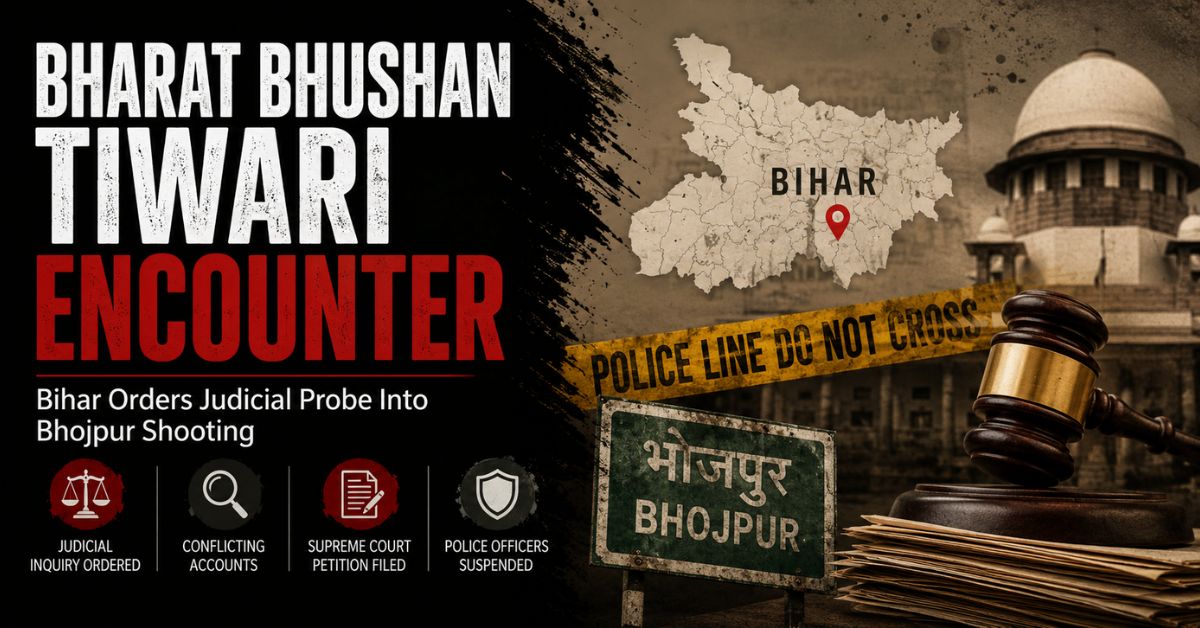
Bharat Bhushan Tiwari Encounter: Key Highlights
- 28-year-old Bharat Bhushan Tiwari died following a police encounter in Bihar’s Bhojpur district on June 17, 2026.
- Bihar Police claim officers acted in self-defense after Tiwari allegedly opened fire during an operation to apprehend him.
- Tiwari’s family has rejected the police account and alleged that the encounter was staged.
- A viral video linked to the incident has become a central piece of evidence and is expected to be examined during the inquiry.
- Public protests, highway blockades, and political reactions followed the encounter across Bihar.
- The Bihar government has ordered a judicial inquiry, while a petition seeking Supreme Court intervention has also been reported.
The death of 28-year-old Bharat Bhushan Tiwari during a police encounter in Bihar’s Bhojpur district has become one of the most discussed incidents in the state in recent weeks. The case has triggered public protests, political reactions, police suspensions, and a judicial inquiry after conflicting accounts emerged about what happened during the operation that ended in Tiwari’s death.
At the center of the controversy are two sharply different versions of events. Bihar Police have maintained that officers acted in self-defense after Tiwari allegedly opened fire on a police team attempting to apprehend him. His family, however, has rejected that account and claimed that the encounter was staged. They argue that Tiwari was attempting to surrender and did not pose a threat at the time he was shot.
The debate intensified after a video linked to the incident circulated widely on social media. The footage has become a key point of discussion and is expected to be examined as part of the official investigation.
With the Bihar government now ordering a judicial inquiry and legal demands reaching the Supreme Court, the case has moved far beyond a local police operation and has become a matter of statewide and national attention.
Encounter in Bhojpur Draws Attention
The incident took place on June 17 in Bilauti village under the Shahpur police station area of Bhojpur district.
According to police officials, a team including members of the Special Task Force was dispatched to apprehend Bharat Bhushan Tiwari following concerns raised about his activities and possession of a firearm.
Police officials have stated that when officers approached him, Tiwari allegedly opened fire on the team. According to the official account, the officers then retaliated in self-defense. Authorities say he sustained injuries during the exchange and was taken for medical treatment.
Tiwari was later shifted to Patna Medical College and Hospital, where he died while undergoing treatment.
The police version forms the basis of the encounter report filed after the operation. However, the circumstances surrounding the shooting have been challenged by family members and local residents, leading to calls for an independent investigation.
| Key Event | Details |
|---|---|
| Encounter | June 17, 2026, Bilauti Village, Bhojpur |
| Police Claim | Tiwari allegedly opened fire on officers |
| Family Claim | Encounter was staged and Tiwari was surrendering |
| Government Response | Judicial inquiry ordered |
| Legal Development | Supreme Court petition reportedly submitted |
Who Was Bharat Bhushan Tiwari?
Before the encounter became a major political issue, Bharat Bhushan Tiwari was known among many local residents for raising public concerns affecting his area.
People familiar with him have described him as a science graduate who frequently used social media to draw attention to local problems, including issues related to flooding, river erosion, and public infrastructure.
Supporters say he often highlighted grievances faced by villagers and attempted to bring administrative attention to local concerns.
However, shortly before the encounter, police officials publicly described him differently. Authorities stated that he appeared to be mentally unstable and claimed that a process was being initiated to shift him to a mental health facility.
His family has strongly rejected those claims. Relatives insist that Tiwari was mentally fit and actively involved in public issues. This disagreement over how he should be characterized has become an important part of the wider controversy.
The Video That Changed the Conversation
The case gained wider attention after a video allegedly recorded by Tiwari shortly before the shooting began circulating online.
According to family members and several people supporting an independent investigation, the footage appears to show Tiwari discarding his weapon and indicating that he was willing to surrender.
The family argues that the video directly contradicts the police version of events and raises serious questions about the use of force during the operation.
Police officials have not accepted this interpretation and continue to maintain that officers responded to a threat while carrying out their duties.
The video has not ended the debate. Instead, it has become one of the central pieces of evidence that investigators may examine to establish a clearer timeline of what happened.
Legal experts say that forensic analysis of the recording could play an important role in determining its authenticity, timing, and relevance to the encounter.
Family Calls Encounter Fake
Soon after Tiwari’s death, his relatives publicly accused the police of carrying out a fake encounter.
Family members have questioned why officers did not arrest him if he was surrounded by multiple personnel. They have also asked why lethal force was used if he was allegedly willing to surrender.
According to relatives, the official version does not match what they believe happened at the scene. They have demanded criminal action against the officers involved and called for an investigation by an independent agency.
The family’s allegations have received support from many local residents who have participated in demonstrations demanding accountability.
At the same time, police authorities have rejected accusations of wrongdoing and have stated that officers acted according to the circumstances they faced during the operation.
As a result, the case remains the subject of competing narratives that investigators will need to examine carefully.
Public Anger Leads to Protests
The encounter triggered strong reactions in Bhojpur district, where many residents demanded a transparent investigation.
In the days following Tiwari’s death, large groups of protesters gathered in different locations to express anger over the incident. Demonstrators called for action against the officers involved and demanded that the government ensure an impartial probe.
One of the most visible protests involved the blocking of the Ara-Buxar highway. The protest disrupted movement in the area and attracted significant public attention.
Many protesters argued that an independent inquiry was necessary because they lacked confidence in an investigation conducted solely by local police authorities.
The demonstrations reflected broader concerns about accountability and the use of force by law-enforcement agencies.
As the protests grew, pressure increased on the state government to take action.
Political Reactions Across Bihar
The encounter quickly became a political issue, drawing reactions from leaders across the state.
Opposition parties questioned the police account and demanded a detailed investigation into the circumstances surrounding the shooting.
Among those who spoke about the case was Tejashwi Yadav, who raised concerns about the encounter and called for accountability.
The issue also prompted reactions from some members of the ruling alliance, reflecting the level of public concern surrounding the incident.
Political leaders from different sides emphasized the need for transparency and stressed that the truth should emerge through an impartial process.
The growing political attention added further pressure on authorities to ensure that the investigation was seen as credible and independent.
Bihar Police Suspend Four Personnel
As scrutiny of the encounter intensified, Bihar Police took disciplinary action against officers who were present during the operation.
Four police personnel, including the Station House Officer of Shahpur police station, were suspended following preliminary examination of the incident.
Officials described the suspensions as an administrative step and not a finding of guilt.
Suspending officers during an investigation is a common measure intended to ensure that inquiries can proceed without interference and that evidence can be examined independently.
Nevertheless, the decision was viewed as a significant development because it acknowledged the seriousness of the allegations being raised.
For many observers, the suspensions signaled that authorities recognized the need for closer examination of what occurred during the encounter.
Judicial Inquiry Ordered
The most important development in the case came when the Bihar government announced a judicial inquiry into the encounter.
The decision was made amid growing public pressure and increasing demands for an independent review of the incident.
According to government officials, the inquiry will be conducted by a retired High Court judge. The objective is to ensure transparency and public confidence in the investigation process.
A judicial inquiry differs from an internal police investigation because it is conducted independently of the police force involved in the incident.
The inquiry is expected to examine witness statements, police records, medical evidence, operational procedures, and other relevant material.
Investigators may also review the viral video and determine how it fits into the overall sequence of events.
The findings of the inquiry could prove crucial in determining whether police actions were justified or whether further legal action is required.
| Inquiry Focus Area | Purpose |
|---|---|
| Witness Statements | Establish sequence of events |
| Police Records | Review operational procedures |
| Medical Evidence | Assess injuries and treatment timeline |
| Viral Video | Verify authenticity and context |
| Ballistic Analysis | Examine use of firearms during encounter |
Questions Investigators Will Examine
The judicial inquiry is likely to focus on several key issues.
One of the most important questions is whether Tiwari fired at police officers before he was shot. Establishing this fact could be central to evaluating the self-defense claim made by authorities.
Investigators may also examine whether officers followed established procedures while conducting the operation.
Another major issue concerns the viral video. The inquiry may seek forensic verification regarding when the footage was recorded and whether it accurately reflects the final moments before the encounter.
Medical evidence is also expected to play a significant role. Post-mortem findings, injury reports, and ballistic analysis may help investigators understand the circumstances under which force was used.
Witness testimony from villagers, police personnel, and others present near the scene could also influence the final conclusions.
The inquiry’s findings are expected to address many of the unanswered questions that continue to fuel public debate.
Matter Reaches Supreme Court
The controversy surrounding the encounter has also reached the national level.
A letter petition has reportedly been submitted to the Chief Justice of India seeking the Supreme Court’s intervention in the case.
The petition urges the court to take suo motu cognisance of the matter and order an independent investigation.
Among the demands reportedly included in the petition are the registration of a murder case against the officers involved, a court-monitored investigation by an agency such as the CBI or a Special Investigation Team, and strict compliance with Supreme Court guidelines governing police encounters.
Whether the Supreme Court decides to act on the petition remains uncertain. However, the move highlights the extent to which the case has attracted attention beyond Bihar.
Legal observers note that encounter cases often receive close scrutiny because courts have repeatedly emphasized that all police actions must remain subject to constitutional safeguards and the rule of law.
| Legal Development | Status |
|---|---|
| Letter Petition Submitted | Reportedly filed before Chief Justice of India |
| Demand for Murder FIR | Included in reported petition demands |
| Independent Investigation | Sought through CBI or SIT probe |
| Supreme Court Action | Awaited |
Wider Questions About Accountability
Beyond the specific facts of the case, the Bharat Bhushan Tiwari encounter has revived broader discussions about policing and accountability.
Supporters of the police position argue that officers often face dangerous situations and must make split-second decisions to protect themselves and others.
Critics, however, contend that every encounter must be examined carefully to ensure that force was used lawfully and only when necessary.
The controversy has once again highlighted the importance of independent investigations in cases where public trust is at stake.
Human rights advocates have emphasized that transparency is essential in maintaining confidence in law-enforcement institutions. At the same time, police organizations have argued that officers should not be judged before investigations establish the facts.
These competing perspectives have contributed to the intensity of the debate surrounding the Bhojpur encounter.
Awaiting Answers
More than a week after the incident, many questions remain unanswered.
Police continue to stand by their version of events. Tiwari’s family continues to reject that account and insists that the encounter was staged.
The judicial inquiry ordered by the Bihar government is expected to examine the evidence and determine what happened on June 17 in Bilauti village.
Until the inquiry submits its findings, many of the claims made by different parties will remain allegations rather than established facts.
For now, the death of Bharat Bhushan Tiwari remains one of Bihar’s most closely watched cases. The outcome of the inquiry may not only determine responsibility in this particular incident but could also influence broader discussions about police accountability, public trust, and the application of the law in encounter cases across India.
As investigators move forward, the focus remains on one central question: what exactly happened during the operation that led to the death of Bharat Bhushan Tiwari, and will the evidence support the police account, the family’s allegations, or reveal a different story altogether?