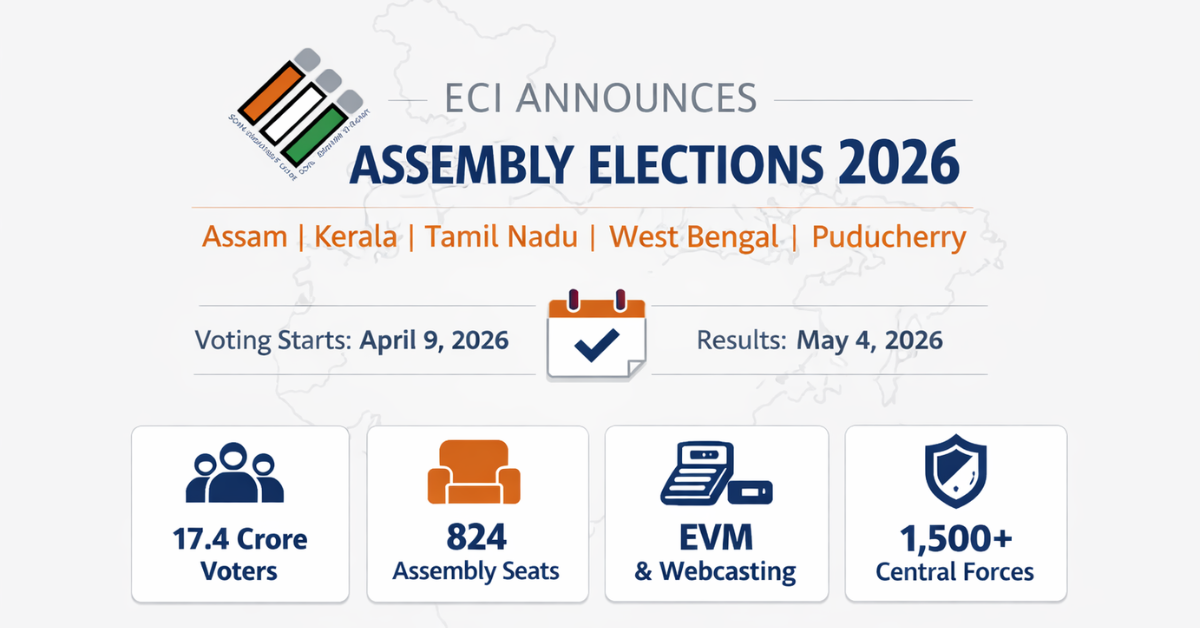
Assembly Election Schedule Across Five Regions
- The Election Commission of India announced assembly election dates for Assam, Kerala, Tamil Nadu, West Bengal, and Puducherry.
- Polling will begin on April 9 and conclude on April 29, with vote counting on May 4, 2026.
- About 17.4 crore voters will participate across 824 assembly constituencies.
- The Model Code of Conduct has come into effect immediately in all five regions.
- Enhanced security deployment, webcasting of polling stations, and strict action against fake news were announced.
| State / UT | Total Seats | Polling Date(s) | Incumbent Government |
|---|---|---|---|
| Assam | 126 | April 9 | BJP-led government under Himanta Biswa Sarma |
| Kerala | 140 | April 9 | Left Democratic Front led by Pinarayi Vijayan |
| Puducherry | 30 | April 9 | AINRC–BJP alliance under N. Rangaswamy |
| Tamil Nadu | 234 | April 23 | DMK-led alliance under M. K. Stalin |
| West Bengal | 294 | April 23 and April 29 | Trinamool Congress government under Mamata Banerjee |
The Election Commission of India announced the schedule for assembly elections in five regions during a press conference held at Vigyan Bhawan in New Delhi on March 15, 2026. The elections will cover Assam, Kerala, Tamil Nadu, West Bengal, and the Union Territory of Puducherry, involving about 17.4 crore voters across 824 assembly seats, with detailed election analysis 2026.
Polling will begin on April 9 and continue through April 29, while counting of votes for all five assemblies will take place on May 4, 2026. Following the announcement, the Model Code of Conduct came into effect immediately in the concerned states and the Union Territory.
Election authorities stated that the upcoming polls are the first to be conducted after a Special Intensive Revision of electoral rolls. The Commission said the revision aimed to improve accuracy of voter lists and strengthen electoral integrity.
Assam Assembly Election
Assam will vote in a single phase on April 9 for all 126 assembly constituencies. The election will determine whether the Bharatiya Janata Party and its allies secure a third consecutive term in the state, as highlighted in our coverage of the Assam election 2026.
The incumbent government is led by Chief Minister Himanta Biswa Sarma. Political campaigning is expected to focus on development policies, regional identity issues, and infrastructure expansion across the northeastern state.
Kerala Assembly Election
Kerala will also hold polling in a single phase on April 9 for its 140-member legislative assembly, which is significant as the Kerala election date 2026 approaches. The contest is expected to revolve around the long-standing rivalry between the Left Democratic Front and the Congress-led United Democratic Front.
The state is currently governed by Chief Minister Pinarayi Vijayan of the Communist Party of India (Marxist). Election debates are likely to focus on welfare programs, economic management, and employment issues.
Puducherry Assembly Election
The Union Territory of Puducherry will conduct voting on April 9 for its 30-member assembly. The territory is currently governed by the All India N. R. Congress in alliance with the Bharatiya Janata Party, led by Chief Minister N. Rangaswamy.
Regional political alliances and governance stability are expected to remain central themes during the election campaign.
Tamil Nadu Assembly Election
Tamil Nadu will vote in a single phase on April 23 for all 234 assembly seats. The election will test the strength of the ruling Dravida Munnetra Kazhagam-led alliance against opposition alliances led by national and regional parties.
The state government is headed by Chief Minister M. K. Stalin. Campaigns are expected to highlight social welfare schemes, economic growth, and industrial development.
West Bengal Assembly Election
West Bengal will conduct polling in two phases on April 23 and April 29 across its 294 constituencies. The state remains politically significant due to intense competition between major national and regional parties.
The incumbent government is led by Chief Minister Mamata Banerjee of the Trinamool Congress. The Election Commission has indicated that security deployment will be increased in sensitive districts during the polling phases.
Election Monitoring and Security Measures
The Election Commission stated that several monitoring measures will be implemented during the election process. These include webcasting at polling stations, EVM verification through photographs, and large-scale deployment of central security forces.
Officials indicated that more than 1,500 companies of central forces may be deployed to maintain law and order during polling. Authorities have also warned of strict action against fake news, voter intimidation, and any attempt to disrupt the electoral process.
The Commission emphasized that the elections will be conducted with a focus on transparency, voter participation, and security across all five regions.