


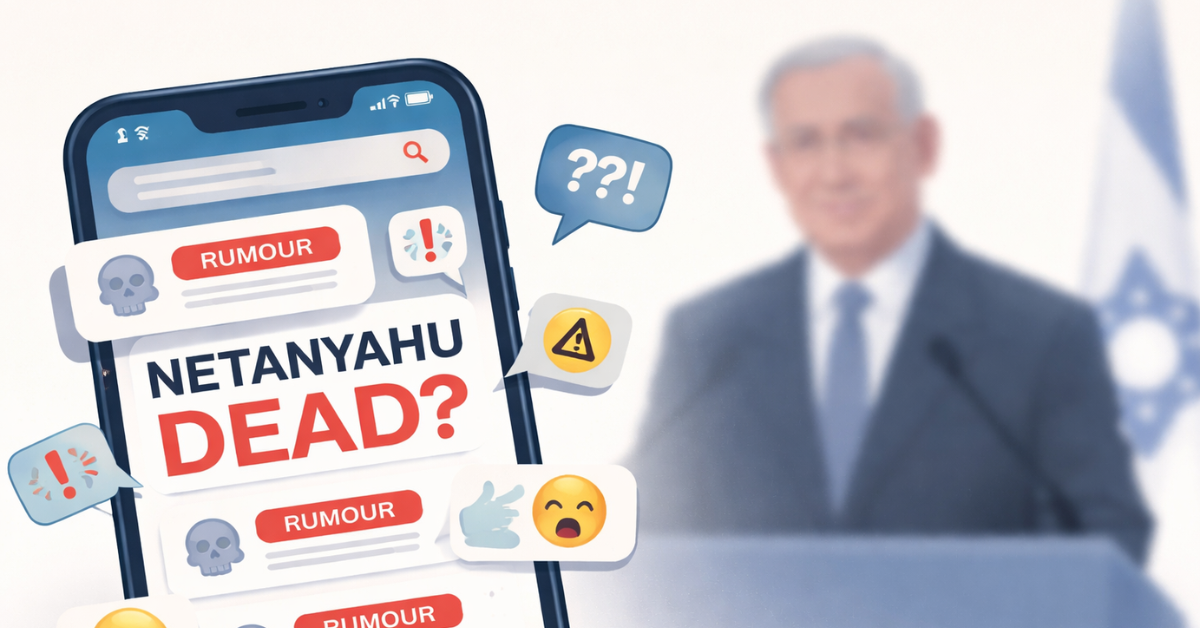
Netanyahu Death Rumour Explained
- Social media posts falsely claimed Israeli Prime Minister Benjamin Netanyahu had been killed or disappeared during the Iran–Israel war.
- The rumours intensified after a viral video showed Netanyahu raising his hand, with some users claiming it showed “six fingers”.
- Conspiracy theories alleged the footage was AI-generated and that Netanyahu had been secretly assassinated.
- The Israeli Prime Minister’s Office dismissed the claims as fake news and confirmed he was alive.
- Netanyahu later appeared publicly and mocked the rumours in a video, showing his hand to debunk the viral claims.
In recent days, social media platforms have been flooded with dramatic claims that Israeli Prime Minister Benjamin Netanyahu had been killed during the ongoing conflict involving Israel, Iran, and allied forces. Videos, screenshots, and posts circulated widely, suggesting that the Israeli leader had either died in an attack or disappeared from public view.
However, credible reporting and official statements confirm that these claims are false. Netanyahu remains alive and continues to carry out his duties as prime minister.
How the Rumours Began
The speculation appears to have started during heightened tensions in the Middle East as Israel and Iran exchanged threats and military actions. In such situations, information moves quickly online, often without verification.
Several viral posts claimed that Netanyahu had been killed in a missile strike or had been secretly assassinated. Others suggested that he had gone missing and was hiding in a secure bunker. None of these claims were supported by any official government statement or by major international news agencies.
The rumours gained traction as users shared edited clips and screenshots across multiple platforms, including X, Telegram, and video-sharing sites. In many cases the posts framed the claim as “breaking news” without any credible source.
The Viral “Six Fingers” Video
The turning point came when a short video clip of Netanyahu speaking about the conflict began circulating widely online. In the clip, Netanyahu raises his hand while speaking during a briefing.
Some viewers claimed that the footage showed six fingers on his hand. From this claim, conspiracy theories quickly emerged. A number of social media users argued that the video must have been generated using artificial intelligence, suggesting that the real Netanyahu had already died.
The claim spread rapidly because short clips removed the surrounding context and were shared alongside captions implying a cover-up.
Fact-Checks and Technical Explanation
Full versions of the video and higher resolution footage show that the “sixth finger” claim came from an optical illusion caused by the angle of the hand and the way shadows fell across the fingers.
Digital media experts and fact-checking organisations reviewed the footage and found no evidence of AI generation or manipulation. Frame-by-frame analysis confirmed that Netanyahu’s hand appeared normal in the full video.
These findings undermined the central claim that the video proved the prime minister had died.
Israeli Government Response
As the rumours spread internationally, the Israeli Prime Minister’s Office issued statements rejecting the claims. Officials described the reports as misinformation and confirmed that Netanyahu was continuing to participate in security discussions and government work.
The government also released footage of Netanyahu attending security briefings related to the conflict, reinforcing that he was actively involved in decision-making.
Netanyahu’s Public Appearance
In response to the growing online speculation, Netanyahu later posted a video addressing the rumours directly. In the clip he jokingly referred to the claims about his death and raised his hand to the camera.
The gesture was widely interpreted as a deliberate response to the “six fingers” conspiracy theory that had spread online.
The video quickly circulated across major media outlets and helped slow the spread of the misinformation.
Why the Rumours Spread So Quickly
Several factors contributed to the rapid spread of the claim. The ongoing conflict in the Middle East created an environment where dramatic developments seemed possible. In such circumstances, unverified information often gains traction before it can be checked.
Short video clips, edited images, and sensational captions further amplified the rumours. Social media algorithms also tend to push emotionally charged content to wider audiences, allowing the claim to reach millions of viewers within hours.
The Verified Reality
Despite the viral speculation, there is no credible evidence that Benjamin Netanyahu has died or disappeared. Major international news organisations, Israeli government officials, and multiple fact-checking groups all confirm that he remains alive and continues to serve as Israel’s prime minister.
The episode highlights how quickly misinformation can spread during periods of conflict and how viral visuals can create convincing but false narratives.
For readers and viewers, the incident serves as a reminder that dramatic claims about world leaders or major events should be verified through credible news organisations before being accepted as fact.