


Election Snapshot
- North Korea held parliamentary elections on March 15, 2026 for the 15th Supreme People’s Assembly.
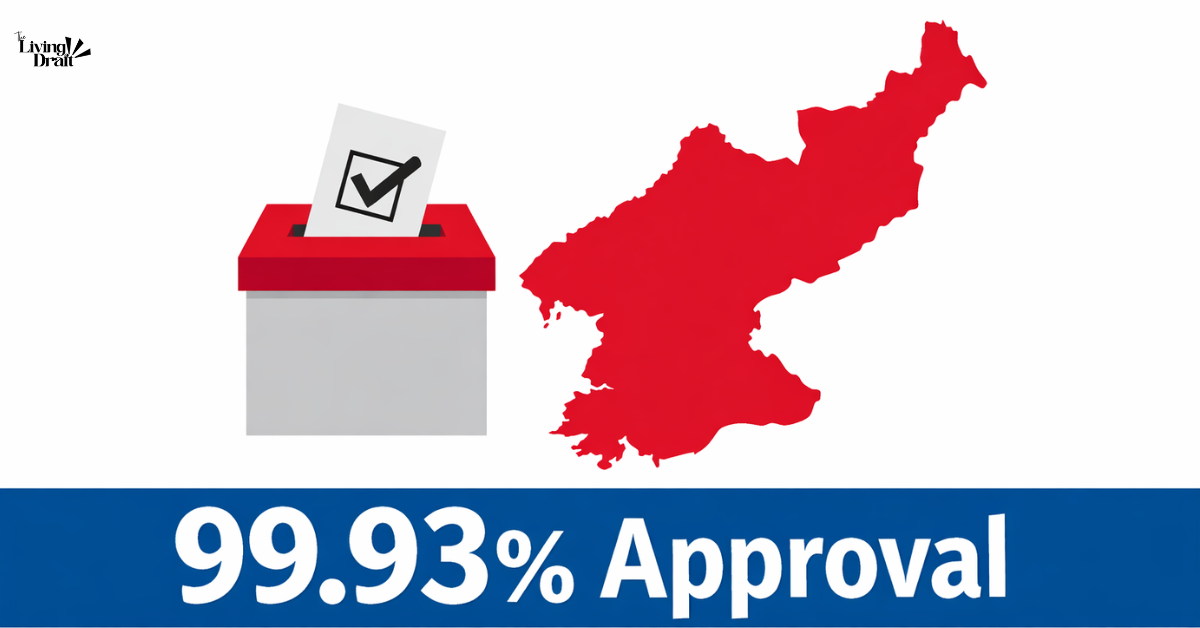
- Authorities reported 99.99% voter turnout and 99.93% approval for state-backed candidates.
- All 687 seats were secured by the ruling Workers’ Party of Korea and its allies.
- The vote followed a delayed schedule aligned with the ruling party’s political calendar.
- Observers outside the country described the process as tightly controlled and non-competitive.
North Korea’s latest parliamentary election, held on March 15, 2026, has delivered an almost complete victory for the ruling establishment led by Kim Jong Un. The vote, conducted for the 15th Supreme People’s Assembly, followed a familiar pattern of near-unanimous turnout and approval, reinforcing the country’s long-standing electoral structure.
Election Timing and Structure
The election was formally announced on March 4, 2026, shortly after the conclusion of the 9th Congress of the Workers’ Party of Korea, where Kim Jong Un was reconfirmed as General Secretary. The timing drew attention from analysts, as parliamentary elections were widely expected earlier, in 2024. The delay appeared to align the electoral process with the party’s broader political calendar.
A total of 687 deputies were elected to the Supreme People’s Assembly, which serves as North Korea’s national legislature. The structure of the vote remained unchanged, with each constituency presenting a single officially approved candidate.
Official Results and Participation
According to the Central Election Committee, turnout reached 99.99 percent of registered voters across the country. Of those who cast ballots, 99.93 percent voted in favour of the approved candidates, while 0.07 percent reportedly submitted ballots indicating rejection.
The Workers’ Party of Korea, along with allied organisations, secured all 687 seats. No opposition candidates or independent representatives were present on the ballot, resulting in complete control of the legislature by the ruling bloc.
How the Voting Process Operates
North Korea’s electoral system continues to function through single-candidate constituencies. In practice, voters are presented with one name per district, typically affiliated with the ruling party or aligned bodies.
Participation in elections is framed as a civic obligation, with state media portraying turnout as an expression of national unity and loyalty. Public messaging around the 2026 vote emphasised collective support for the leadership.
Kim Jong Un was shown casting his vote at a youth coal mine, a setting that underscored his symbolic association with both governance and economic activity.
Political Meaning and Expected Developments
State media described the outcome as a strong endorsement of Kim Jong Un’s leadership, portraying the results as evidence of unified national support. The near-total approval rate was presented as a clear mandate for the ruling party’s policies.
Outside observers, including foreign governments and independent analysts, interpreted the election differently. The process is widely viewed as tightly controlled, with outcomes effectively determined in advance and used to reinforce internal political messaging rather than offer competitive choice.
The newly elected Supreme People’s Assembly is expected to convene for its first session in the coming weeks. Reports indicate that the session may confirm key state positions and consider a significant constitutional revision, potentially formalising recent policy directions under Kim’s leadership.
Context: Local Election Adjustments Since 2023
In November 2023, North Korea introduced limited procedural changes in local People’s Assembly elections. Under revised rules, some constituencies reportedly allowed more than one candidate to compete during preliminary stages.
However, the final ballot still presented a single candidate to voters, maintaining the core structure of the electoral system. These adjustments have been widely interpreted as controlled modifications rather than a shift toward open, multiparty competition.
The 2026 parliamentary election confirms that, at the national level, the traditional model remains firmly in place, with single-candidate ballots and near-unanimous approval continuing to define the country’s electoral process.