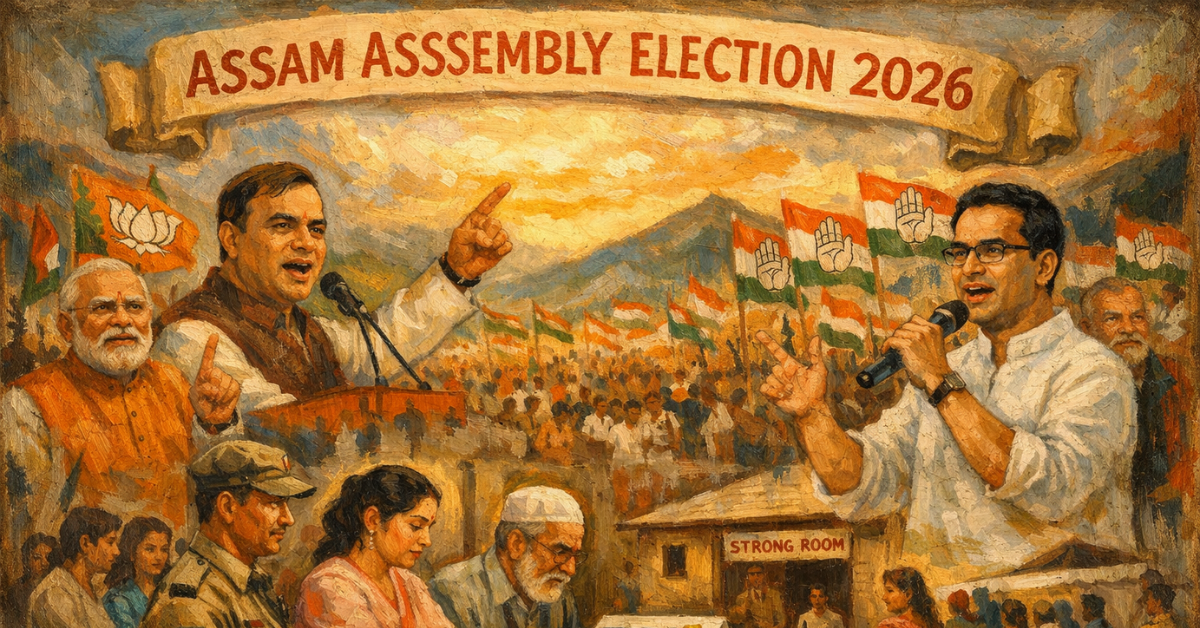
Assam Assembly Election 2026: Timeline and Key Developments
- Election Commission announced a single-phase election, marking a shift from previous multi-phase polls.
- Nomination and scrutiny phases concluded with 789 candidates across 126 constituencies.
- Campaigning is at its peak, with major rallies led by national and state leaders.
- Polling is scheduled for April 9, with counting on May 4, when the Assam election 2026 results will be announced.
- Opinion polls indicate an advantage for the NDA, though regional contests remain competitive, as detailed in our election analysis 2026.
The 2026 Assam Legislative Assembly election marks a structural shift in how the state conducts its polls, similar to the dynamics expected in the Tamil Nadu assembly election 2026. Unlike previous elections held in multiple phases due to geography and security considerations, this cycle has been compressed into a single-phase vote. The change reflects both logistical confidence and a calibrated security deployment strategy led by the Election Commission of India.
As of April 5, 2026, the electoral process has moved past nominations and scrutiny into the most intensive phase of campaigning. What follows is a consolidated, fact-aligned timeline with political context, campaign developments, and voter data, including insights from the Kerala assembly election 2026.
Phase 1: Pre-Election Framework and Notification
The formal process began on March 15, 2026, when the Election Commission of India announced the election schedule. With this, the Model Code of Conduct came into immediate effect across Assam, regulating government activity, campaign conduct, and public communication.
On March 16, the Gazette Notification was issued, opening the legal window for candidates to file nominations.
In parallel, the political groundwork that had been underway since January reached its conclusion. The ruling NDA, led by the Bharatiya Janata Party, finalized its alliance structure with the Asom Gana Parishad, while managing seat adjustments with the United Peoples Party Liberal.
On the opposition side, a broad coalition emerged under the Asom Sonmilito Morcha, led by the Indian National Congress and supported by multiple regional forces, including Raijor Dal and Assam Jatiya Parishad. The alliance aimed to consolidate anti-incumbency sentiment into a unified electoral challenge.
Phase 2: Nominations, Scrutiny, and Final Candidate List
The nomination window closed on March 23, 2026, with 789 candidates filing papers across all 126 constituencies. This number reflects a moderately high contest density, though not unusual for Assam’s competitive political landscape.
Scrutiny took place on March 24 under strict procedural oversight. Returning Officers examined nomination papers for compliance, including affidavit disclosures on assets, criminal records, and educational qualifications. The process was video-recorded to ensure transparency.
March 26 marked the final withdrawal deadline. By 3:00 PM, the list of contesting candidates was locked, and election symbols were formally allotted, particularly for independent and smaller party candidates.
This phase also exposed internal tensions within parties. The Bharatiya Janata Party expelled multiple rebel candidates who filed nominations as independents after being denied tickets, particularly in regions like Bongaigaon and parts of the Barak Valley.
Phase 3: Campaign Period and Political Mobilisation
The campaign window from March 27 to April 7 represents the most politically active segment of the election.
Chief Minister Himanta Biswa Sarma has led the NDA’s campaign with a development-focused narrative built around infrastructure expansion, law enforcement, and demographic control policies.
Opposition leader Gaurav Gogoi has positioned the Asom Sonmilito Morcha around welfare guarantees, institutional accountability, and economic relief measures.
National-level leaders have also played a central role. Prime Minister Narendra Modi addressed a major rally in Dhemaji on April 1, reinforcing national security and identity themes. On April 5, Union Home Minister Amit Shah is conducting a multi-district campaign tour, reiterating the promise of implementing a Uniform Civil Code in the state.
On April 4, the Election Commission of India issued a voter advisory encouraging the use of the ECINET platform and the “Know Your Candidate” disclosure system. These tools provide verified data on candidates’ criminal records, financial assets, and liabilities.
The campaign will formally conclude at 5:00 PM on April 7, initiating the mandatory 48-hour silence period before polling.
Phase 4: Polling, Security, and Counting
Polling is scheduled for April 9, 2026, between 7:00 AM and 6:00 PM across 31,486 polling stations. This includes a significant number of women-managed “pink booths,” designed to improve accessibility and participation.
Following polling, Electronic Voting Machines and VVPAT units will be sealed and stored in strong rooms under continuous surveillance, with layered security protocols involving state police and central forces.
Counting will take place on May 4, 2026. Early trends are expected by mid-morning, with final constituency results likely confirmed by evening.
The entire election process is scheduled to conclude by May 6, as mandated by the Election Commission of India.
Voter Demographics and Electoral Composition
The 2026 voter base includes several segments identified as electorally decisive.
First-time voters aged 18 to 19 number approximately 5.75 lakh. This group is being actively targeted through digital outreach and campus-level engagement.
The 20 to 29 age group, at 66.30 lakh voters, represents the largest demographic bloc and is central to both employment and education-focused campaign messaging.
Senior citizens aged 85 and above total 1.04 lakh, while Persons with Disabilities account for 2.04 lakh voters. Special provisions, including home voting and assisted transport, have been implemented for these groups.
A total of 3,716 polling stations are being operated exclusively by women staff, reflecting a continued institutional push toward gender-inclusive electoral management.
Political Narrative and Strategic Positioning
The election is fundamentally structured as a contest between continuity and consolidation.
The NDA campaign, led by the Bharatiya Janata Party, is anchored in the “Surakshit Axom” framework. Its key commitments include the introduction of a Uniform Civil Code at the state level and continued eviction drives from forest and encroached lands.
The opposition alliance, under the Indian National Congress, is campaigning on a “Nyay for Assam” platform. Its primary promises include restoring the Old Pension Scheme and providing 200 units of free electricity to households.
The All India United Democratic Front, led by Badruddin Ajmal, is contesting independently in around 30 seats, focusing on minority rights and socio-economic development in char and riverine areas.
Meanwhile, regional forces like Assam Jatiya Parishad continue to emphasize indigenous identity, land protection, and opposition to the Citizenship Amendment Act.
Opinion Poll Trends and Electoral Forecast
Pre-poll surveys conducted by agencies such as MATRIZE-IANS and People’s Pulse indicate a consistent advantage for the NDA alliance.
Seat projections place the NDA in the range of 80 to 98 seats, comfortably above the majority mark of 64 in the 126-member assembly. The opposition alliance is projected between 26 and 39 seats, with smaller parties and independents expected to secure marginal representation.
Vote share estimates suggest a narrower gap. In several regions, the difference between the Bharatiya Janata Party and the Indian National Congress remains within a few percentage points, indicating the possibility of localized swings.
A notable factor is the undecided voter segment, estimated at around 13 percent in late March surveys. This group is being actively targeted in the final days of campaigning and may influence outcomes in closely contested constituencies, particularly in Lower Assam and the Barak Valley.
Chief ministerial preference surveys show Himanta Biswa Sarma maintaining a marginal lead, followed closely by Sarbananda Sonowal and Gaurav Gogoi, indicating a competitive leadership perception despite the NDA’s structural advantage.
Structural Shift: Why the Single-Phase Model Matters
The move to a single-phase election is not merely administrative. It reflects improvements in security deployment, transport coordination, and polling infrastructure across Assam’s geographically complex terrain.
It also compresses campaign timelines, reducing the window for narrative shifts between phases, a factor that historically benefited opposition recoveries in multi-phase elections.
In this format, momentum becomes more decisive, and early narrative dominance tends to carry through to polling day with limited interruption.
Final Context Before Polling
As the campaign enters its final 48-hour window, the election remains defined by a clear asymmetry. The NDA holds an organizational and narrative advantage, while the opposition relies on consolidation and localized swings.
The outcome will depend less on broad vote share and more on how effectively each side converts support into constituency-level victories across Assam’s varied political geography.