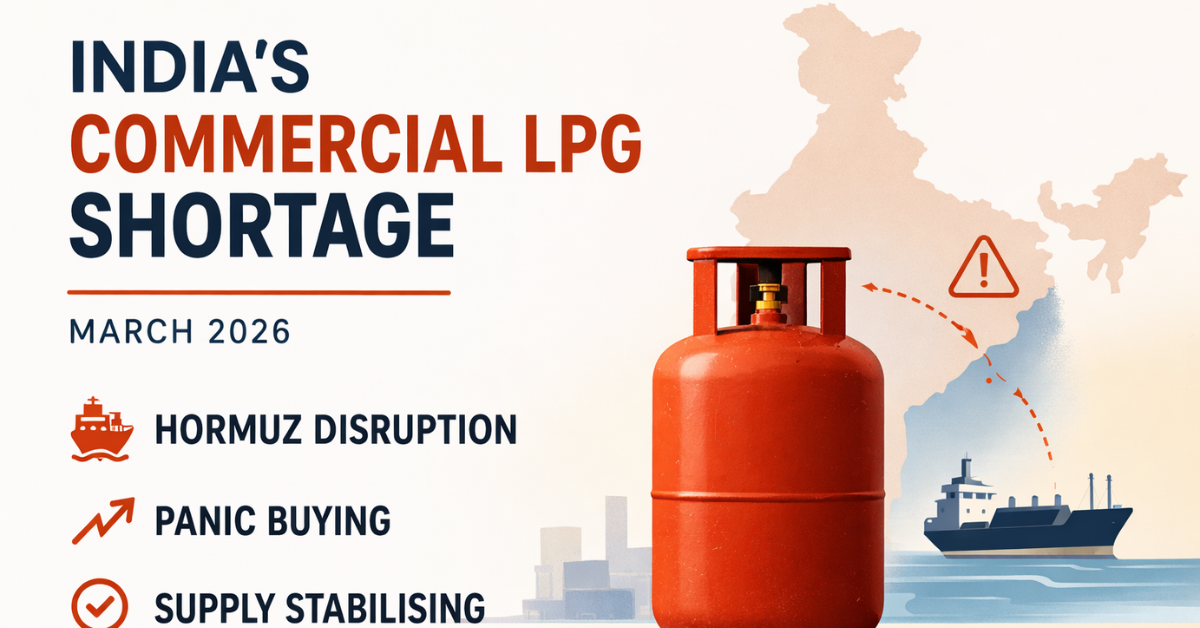
LPG Supply Disruption in India
- Commercial LPG supply across several Indian cities tightened in early March 2026 due to disruptions in shipments through the Strait of Hormuz.
- Restaurants, hotels, and food vendors reported shortages while household LPG supply remained largely protected.
- Panic bookings briefly increased as consumers rushed to secure cylinders, despite government assurances that retail fuel rates remain steady.
- Government instructed refineries to boost domestic production and encouraged PNG usage where available.
- Two LPG tankers carrying about 92,700 tonnes crossed Hormuz and headed to Gujarat ports, easing supply concerns.
| Key Aspect | Details |
|---|---|
| Disruption Start | Early March 2026 |
| Main Cause | Shipping disruption through the Strait of Hormuz due to regional tensions |
| Most Affected Sector | Commercial LPG users such as hotels, restaurants, and food vendors |
| Government Response | Increase refinery output, monitor stocks, anti-hoarding inspections |
| Relief Development | Two LPG cargo ships heading to Gujarat ports with 92,700 tonnes |
Crisis Triggered by Strait of Hormuz Disruption
India experienced a sharp disruption in commercial liquefied petroleum gas (LPG) supplies during early March 2026 after geopolitical tensions in West Asia slowed shipping traffic through the Strait of Hormuz. The narrow waterway is one of the world’s most important energy corridors and carries a large portion of India’s LPG imports.
India relies heavily on imported LPG to meet domestic demand, with imports accounting for a significant share of the country’s total consumption. Any interruption in shipping routes quickly affects supply chains and distribution across the country.
The disruption created uncertainty in the market, particularly regarding supply controls West Asia. LPG booking requests increased sharply for a short period as consumers rushed to secure cylinders despite government assurances that household LPG availability remained stable.
Hospitality Sector Hit Hardest
The impact of the disruption was felt most strongly by commercial LPG users. Restaurants, hotels, and food vendors across major cities such as Mumbai, Bengaluru, and Chennai reported difficulty obtaining commercial cylinders during the peak of the shortage.
Industry groups said several food businesses reduced menu options or adjusted operating hours as cooking gas availability tightened. In some locations, vendors increased prices of popular snacks and street foods because of higher fuel costs and supply uncertainty.
Some state governments also reported reduced commercial LPG allocations during the disruption. Authorities in several regions prioritised supplies for essential services such as hospitals, hostels, and educational institutions.
Government Measures to Stabilise Supply
The central government initiated a series of measures to manage the supply disruption. Oil refineries were directed to maximise LPG production by increasing extraction from refinery streams. Domestic supply was prioritised for household consumers to ensure cooking gas availability for homes.
Officials urged consumers not to panic book cylinders and asked residents in cities with piped natural gas connections to rely on PNG systems wherever possible. These measures were aimed at reducing pressure on LPG cylinder distribution networks.
Authorities also intensified inspections to prevent hoarding and illegal storage of cylinders. Enforcement teams conducted checks across several states to monitor distribution channels and ensure fair supply.
LPG Tankers Resume Passage Through Hormuz
The situation began to improve in mid March when two LPG tankers carrying cargo for India successfully crossed the Strait of Hormuz after shipping movement gradually resumed.
The vessels Shivalik and Nanda Devi carried about 92,700 tonnes of LPG and were scheduled to dock at Mundra and Kandla ports in Gujarat around March 16 and March 17. The shipments represented a significant volume of cooking gas and helped ease immediate supply pressure.
The arrival of these shipments indicated that the shipping corridor was reopening and that supply chains were beginning to stabilise.
Government Urges Calm as Supply Normalises
Government officials have repeatedly emphasised that domestic LPG stocks remain adequate and that the disruption primarily affected commercial supply chains due to temporary import delays.
Refineries across the country have been operating at high capacity to compensate for the shortfall while imports resume normal movement. Authorities also asked consumers not to form queues at gas agencies or engage in panic purchasing.
Although the immediate crisis appears to be easing, the episode has once again highlighted India’s dependence on imported energy and the strategic importance of global shipping chokepoints such as the Strait of Hormuz.