


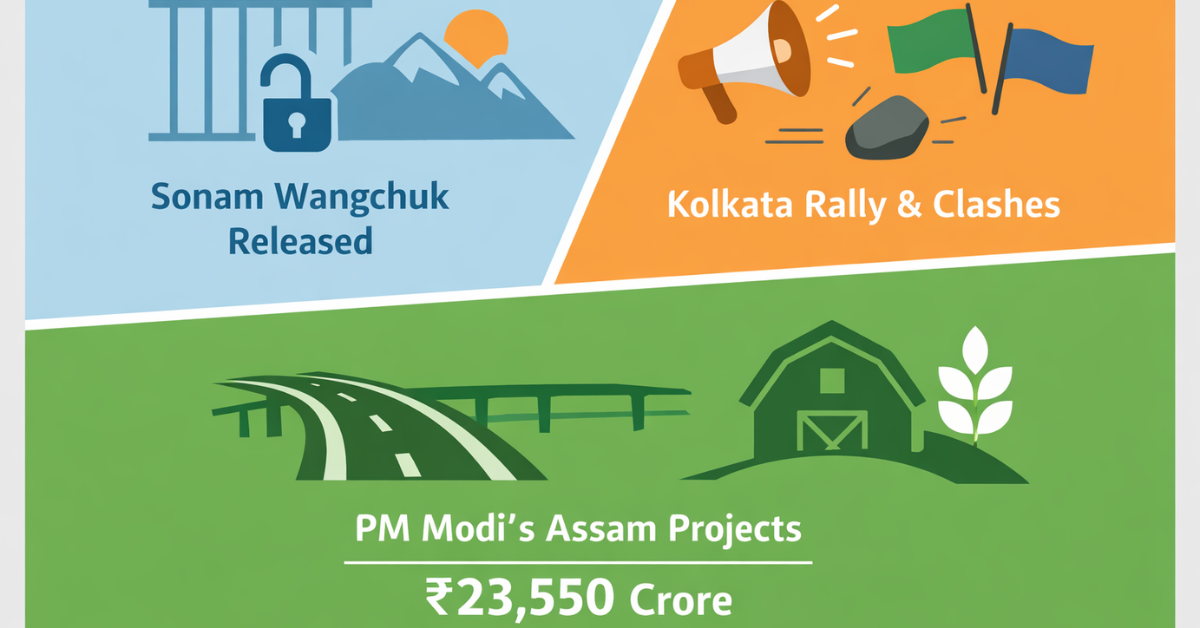
India, March 16, 2026: A series of political and infrastructure developments unfolded across India over the weekend, with Prime Minister Narendra Modi launching major connectivity projects in Assam’s Barak Valley, addressing a high-profile rally in Kolkata, and Ladakh climate activist Sonam Wangchuk being released from jail after the government revoked his detention under the National Security Act.
Infrastructure Push, Political Clash, and Activist Release
- Prime Minister Narendra Modi launched infrastructure projects worth ₹23,550 crore in Silchar, Assam, aimed at strengthening connectivity and economic growth in the Barak Valley.
- The ₹22,864 crore Shillong–Silchar High-Speed Corridor will reduce Guwahati–Silchar travel time from about 8.5 hours to roughly 5 hours once completed.
- Clashes were reported in Kolkata before Modi’s Brigade Parade Ground rally between BJP and TMC supporters.
- West Bengal Chief Minister Mamata Banerjee announced a ₹500 increase in monthly stipends for imams, muezzins, and priests.
- Ladakh activist Sonam Wangchuk was released from Jodhpur Central Jail after the Union government revoked his NSA detention order issued in September 2025.
| Key Event | Location | Main Details |
|---|---|---|
| Infrastructure Projects Launch | Silchar, Assam | ₹23,550 crore projects including Shillong–Silchar expressway, Silchar flyover, and agricultural college. |
| Political Rally | Kolkata, West Bengal | Clashes between BJP and TMC supporters ahead of Modi’s Brigade Parade Ground rally. |
| Stipend Increase | West Bengal | Mamata Banerjee announced ₹500 hike in monthly honorariums for religious leaders. |
| Activist Release | Jodhpur, Rajasthan | Sonam Wangchuk released after NSA detention order issued in 2025 was revoked. |
Major Infrastructure Push in Assam
Prime Minister Narendra Modi launched development projects worth approximately ₹23,550 crore in Silchar, Assam, focusing on improving connectivity and strengthening economic opportunities in the Barak Valley region.
The centerpiece project is the ₹22,864 crore Shillong–Silchar High-Speed Corridor, a 166.8-kilometre four-lane greenfield expressway being developed under National Highway-06. Once completed, the project is expected to significantly improve road connectivity between Meghalaya and Assam.
Officials estimate the new corridor could reduce travel time between Guwahati and Silchar from roughly 8.5 hours to about five hours by 2030, which could benefit trade, tourism, and access to healthcare services across the region.
Alongside the expressway project, the Prime Minister also initiated other infrastructure initiatives in the Barak Valley.
- The ₹565 crore Silchar Town Flyover (Phase I) to ease congestion along National Highway-306.
- The ₹122 crore Patharkandi College of Agriculture, planned across about 88 hectares to provide agricultural education, research, and training opportunities for farmers and students in the region.
During his address, Modi highlighted the strategic importance of the Northeast within India’s Act East policy, which aims to strengthen trade and connectivity with Southeast Asian economies. He also criticised previous Congress governments, alleging that the region had been neglected for decades in terms of infrastructure and investment.
The Prime Minister also spoke about employment opportunities linked to upcoming sectors such as semiconductor manufacturing, healthcare infrastructure including institutions like AIIMS, and expanding regional trade corridors.
Kolkata Rally and Political Confrontation
On the same day, Prime Minister Modi addressed a large public rally at Kolkata’s Brigade Parade Ground, a politically significant venue that has historically hosted major political gatherings in West Bengal.
Before the rally began, clashes reportedly erupted between supporters of the Bharatiya Janata Party (BJP) and the ruling Trinamool Congress (TMC). Reports indicated incidents of stone-pelting and tensions in parts of the city, prompting increased security deployment.
During his speech, Modi criticised the West Bengal government led by Chief Minister Mamata Banerjee, accusing it of failing to maintain law and order in the state. He referenced several controversies including the Sandeshkhali case and the RG Kar hospital incident while alleging that illegal immigration was affecting employment opportunities for local residents.
The Prime Minister also announced development initiatives for the eastern region, stating that projects worth between ₹18,680 crore and ₹19,480 crore were being advanced, with a focus on infrastructure and economic development.
Mamata Banerjee Announces Stipend Increase
Amid the political exchanges, West Bengal Chief Minister Mamata Banerjee announced an increase in monthly honorariums paid to religious leaders across the state.
Under the revised scheme, imams, muezzins, and Hindu priests will receive an additional ₹500 per month as part of the state government’s welfare support programs.
The decision follows a series of welfare initiatives introduced by the state government in recent years, including schemes such as Lakshmir Bhandar and Yuva Sathi.
Leaders of the Trinamool Congress also responded to the Prime Minister’s remarks at the rally by accusing the central government of failing to address rising LPG prices and supply issues. Party representatives alleged that nearly 250 LPG cylinders were used during the rally event while households in parts of the state were facing shortages and long queues for refills.
Sonam Wangchuk Released After NSA Revocation
In a separate development, Ladakh climate activist and engineer Sonam Wangchuk was released from Jodhpur Central Jail on March 14 after the Union government revoked his detention under the National Security Act (NSA).
Wangchuk had been detained since September 26, 2025, after protests in Ladakh linked to demands for statehood and the inclusion of Ladakh under the Sixth Schedule of the Constitution, which provides special protections for tribal areas.
The detention order had been issued by the Leh magistrate following demonstrations in the region. After nearly six months in custody, the Ministry of Home Affairs withdrew the preventive detention order, leading to Wangchuk’s release.
He walked out of Jodhpur Central Jail at around 1:30 PM on March 14 after legal formalities were completed by his family, including his wife Geetanjali Angmo.
Following his release, Wangchuk indicated that he intends to focus on peaceful advocacy for Ladakh’s environmental protection and political demands, while continuing dialogue on the region’s future governance structure.
Broader Political Context
The developments come amid a politically charged environment as parties intensify campaigning ahead of upcoming assembly elections in several states. Infrastructure announcements in the Northeast, political mobilisation in eastern India, and debates over regional governance issues such as Ladakh’s constitutional status have collectively shaped the national political discourse in recent weeks.