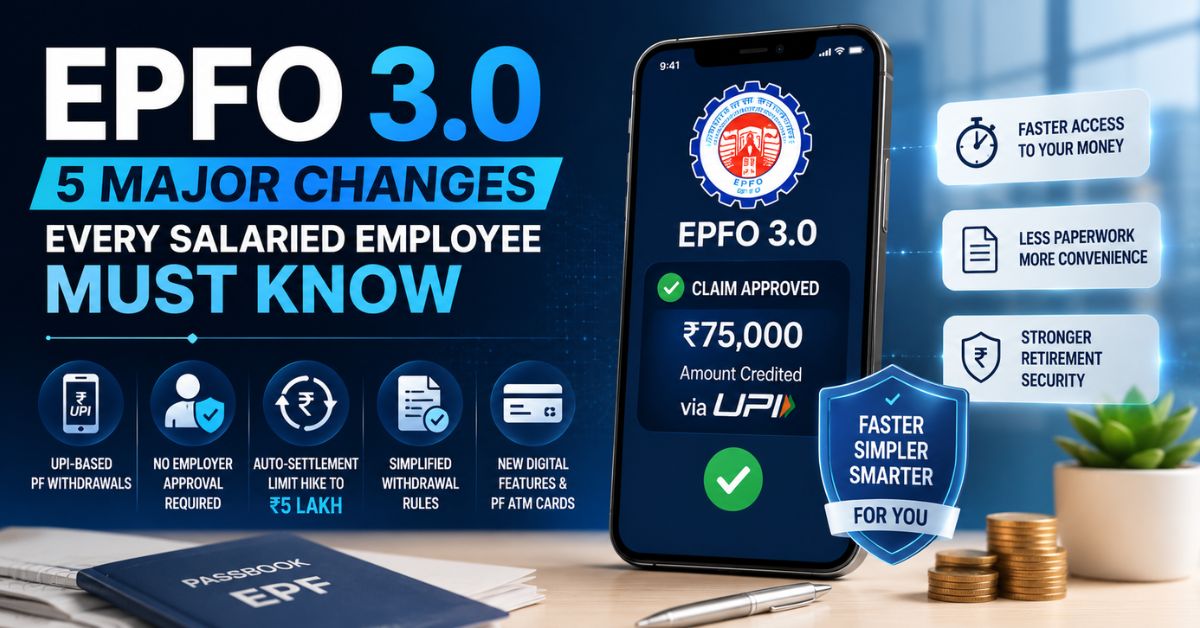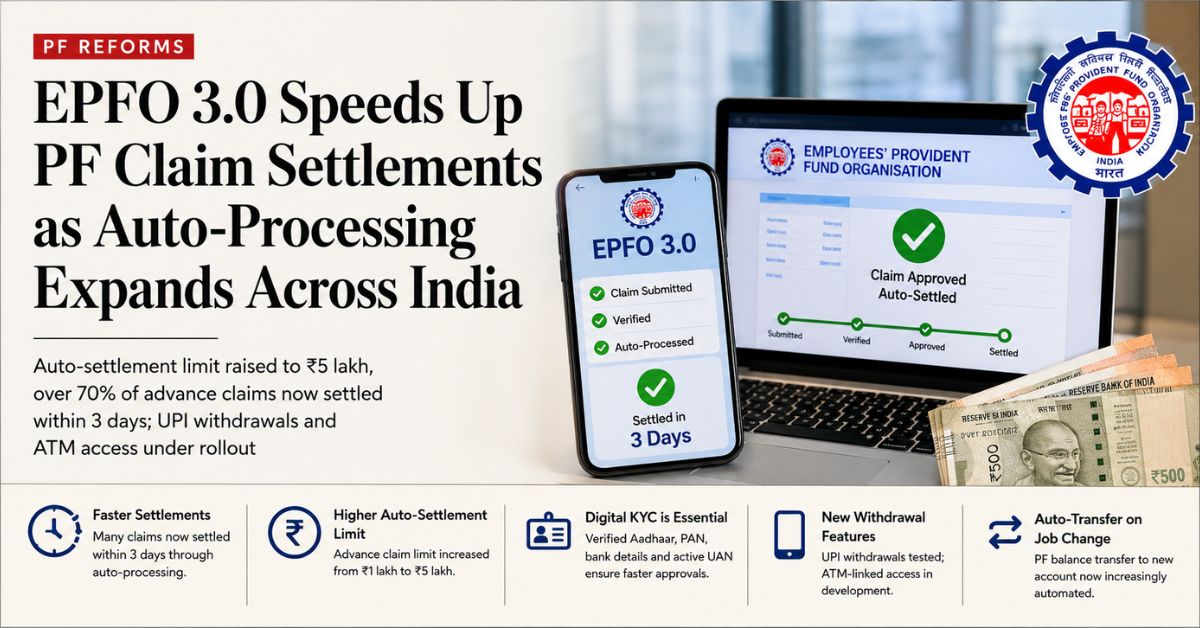
EPFO Faster Claim Settlement: Key Highlights
- EPFO has reduced processing time for many PF claims from nearly 20 days to around 3 days through automation.
- The auto-settlement limit for advance claims has been increased from ₹1 lakh to ₹5 lakh.
- More than 70% of advance claims are now processed digitally without manual intervention.
- UPI-based PF withdrawals and ATM-linked access are being developed under the EPFO 3.0 modernization program, which includes various EPFO withdrawal methods.
- Verified Aadhaar, PAN, bank account, and active UAN are critical for faster claim approval.
The Employees’ Provident Fund Organisation, commonly known as EPFO, is rapidly transforming the way provident fund claims are processed in India. What once required physical paperwork, repeated employer follow-ups, and waiting periods of up to 20 days is increasingly becoming a digital process completed within three days for a large section of users.
The changes are part of the government’s broader EPFO 3.0 modernization plan, which focuses on automation, Aadhaar-based verification, and faster direct transfers to employees’ bank accounts, similar to the digipin rollout that enhances digital address systems. The reforms are especially important for salaried workers who depend on PF withdrawals during emergencies, unemployment, medical treatment, housing needs, or retirement, similar to how changes in the IBC insolvency law aim to expedite debt recovery.
Auto-Settlement System Becomes the Core of EPFO 3.0
The most significant confirmed reform so far is the expansion of the auto-settlement system. Under this framework, eligible claims are processed digitally without manual review by EPFO officers. The system uses algorithms and verified KYC records to validate applications and release payments directly to bank accounts.
According to official EPFO updates issued through the Ministry of Labour and Employment, the auto-settlement limit for advance claims has been increased from ₹1 lakh to ₹5 lakh. This means employees can now receive substantially larger amounts through automated processing, provided their records meet verification requirements.
Officials have stated that more than 70 percent of advance claims are now being settled through the auto-mode system. Many of these claims are processed within 72 hours, marking one of the fastest improvements in EPFO operations in recent years.
Why Earlier PF Withdrawals Took Longer
The modernization effort comes after years of criticism over delays in PF withdrawals. Under the older structure, claims often moved through multiple levels of manual scrutiny. Employees regularly faced problems because of incorrect KYC details, unverified Aadhaar numbers, inactive Universal Account Numbers (UANs), or employers failing to update records.
The new digital model attempts to reduce these bottlenecks by shifting the process toward direct verification systems linked with Aadhaar and banking infrastructure.
Under the current setup, users with fully verified KYC details can submit claims online without depending heavily on employer approval in many cases. If Aadhaar, PAN, and bank account details are already digitally verified, the system can process claims automatically through the EPFO portal.
This has become particularly useful for workers whose former employers are inactive, unresponsive, or delayed in approving withdrawal requests.
Key Requirements for Faster PF Claim Approval
The EPFO’s digital transition also reflects a broader government effort to integrate welfare and financial systems through centralized identity verification. Aadhaar-based authentication now plays a major role in determining how quickly claims move through the settlement process.
Employees who wish to benefit from the faster claim system are required to maintain an active UAN linked to their current mobile number. Their Aadhaar, PAN, and bank account details must also be correctly seeded and verified on the EPFO portal.
Financial experts say even small errors in bank account numbers, IFSC codes, or Aadhaar details can still trigger manual scrutiny and delay payments.
| Requirement | Purpose |
|---|---|
| Active UAN | Required for login and authentication |
| Verified Aadhaar | Enables digital verification |
| PAN Linked | Avoids tax and identity issues |
| Verified Bank Account | Ensures smooth direct transfer |
| Correct IFSC Code | Prevents payment failures |
| Updated Mobile Number | Needed for OTP verification |
Date of Exit Update Remains Important
Another important requirement is the updating of the Date of Exit, especially for final settlements. If a member leaves a company and the employer does not update the exit date in the EPFO system, the employee may face delays while filing Form 19 for final withdrawal.
Under recent reforms, EPFO has allowed certain users to update their Date of Exit themselves if enough time has passed since leaving employment. This change is intended to reduce dependence on employers for basic account updates.
The EPFO 3.0 reforms are also expanding beyond advance claims into final settlement processing. Traditionally, final PF withdrawals required stricter manual screening because they involved closure-related verification checks. However, officials are now gradually introducing automation for these claims as well.
UPI-Based PF Withdrawals Under Development
One of the most discussed developments under EPFO 3.0 is the planned integration of UPI-based withdrawals. Reports indicate that EPFO has completed testing for a system that would allow members to receive approved PF balances directly through UPI-linked transfers.
If fully implemented nationwide, the system could allow workers to authenticate transactions using UPI PIN verification and receive funds much faster than traditional bank transfer methods.
The proposed UPI integration is being viewed as a major shift because it would bring provident fund withdrawals closer to the speed and convenience of modern digital payment platforms already widely used across India.
However, industry experts note that the rollout is still evolving. While testing has reportedly been completed, a fully standardized nationwide deployment is still in progress. This means availability may vary depending on operational readiness and integration stages.
ATM-Based PF Access Still in Rollout Phase
Another proposal receiving attention is the introduction of EPF-linked ATM access. Under this model, members could potentially withdraw part of their approved provident fund balance directly from ATMs using specially linked cards.
The idea behind the proposal is to provide faster liquidity during emergencies and reduce dependency on lengthy settlement cycles.
At present, however, ATM-based PF withdrawal remains at a developmental stage. Public discussions and financial industry reports have referred to the proposal, but large-scale operational deployment across the country has not yet been officially confirmed through a comprehensive EPFO circular.
Automatic PF Transfer During Job Changes
The reforms are also attempting to simplify the process during job changes. Earlier, employees often had to manually request transfer of PF balances from their previous employer to the new account. This process sometimes created duplicate accounts and settlement confusion.
Under the newer system architecture, EPFO is increasingly automating the transfer of balances after job transitions, reducing paperwork and lowering the risk of inactive PF accounts.
The shift toward automation is expected to reduce the workload on EPFO offices while improving settlement speed for members. Officials believe this approach can help EPFO manage rising claim volumes more efficiently as India’s formal workforce expands.
Challenges Still Remain for Some Users
At the same time, experts caution that the success of the system still depends heavily on data accuracy. Even under automated processing, claims may be diverted into manual review if there are mismatches in Aadhaar details, banking records, signatures, or employment history.
Cybersecurity and digital literacy also remain important concerns. Since the system now depends more on online verification and mobile-linked authentication, users are being advised to protect their UAN credentials and avoid sharing OTPs or login information with third parties.
Employees are also encouraged to regularly monitor their passbooks and KYC status through the EPFO portal and the UMANG application.
UMANG App Helps Users Track Claims Faster
The UMANG platform has become one of the key tools for tracking claim status in real time. Under the newer system, users can check whether their claim is under process, approved, settled, or transferred to the bank. In many cases, once the claim status changes to “Settled,” funds are dispatched shortly afterward.
Financial planners say the reforms could significantly improve emergency access to savings for middle-class households. Earlier delays often created problems during medical treatment, unemployment, or urgent housing needs.
EPFO Moving Toward a Bank-Like Digital System
At the same time, policymakers are also attempting to balance liquidity with retirement protection. Discussions around maintaining part of the EPF balance as a long-term retirement reserve have gained attention during the rollout of newer withdrawal systems.
Reports linked to the proposed framework suggest that certain withdrawal structures may require members to retain a portion of their total balance except in cases of final withdrawal after prolonged unemployment. However, experts note that detailed operational rules continue to evolve.
For now, the most immediate and visible impact of EPFO 3.0 is the sharp reduction in settlement timelines for digitally verified claims.
The transformation marks one of the largest operational upgrades in the history of the provident fund system. While some features are still under phased rollout, the broader direction is clear. EPFO is moving toward a faster, paperless, and more automated framework designed to function closer to a modern banking platform than a traditional government processing office.