Vedanta Demerger: Key Points
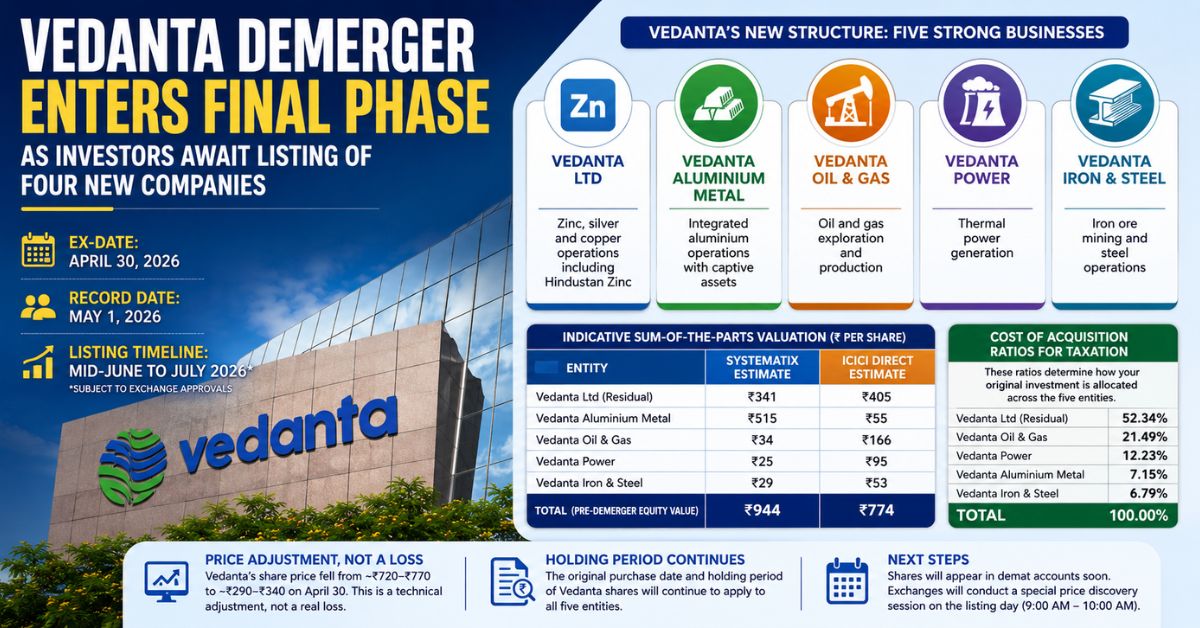
- Vedanta’s five-way demerger has officially taken effect after the stock traded ex-demerger on April 30, 2026.
- Shareholders will receive one share each in four newly created companies for every Vedanta share held on the record date.
- The residual Vedanta Ltd will continue to hold zinc, silver and copper businesses, including the Hindustan Zinc stake.
- Brokerages have projected combined valuations between ₹774 and ₹944 for the five resulting companies.
- The four demerged entities are expected to list separately between June and July 2026 after exchange approvals and price discovery sessions.
Vedanta’s long-awaited corporate restructuring has entered its final operational phase after the mining and metals group completed the exchange adjustment process for its five-way demerger. The move, one of the largest corporate reorganisations seen in the Indian market in recent years, is aimed at splitting Vedanta’s diversified businesses into independently managed sector-focused companies, much like the recent exit poll predictions.
The restructuring became effective after the stock traded ex-demerger on April 30, 2026, with May 1 fixed as the record date for shareholder eligibility, similar to the ongoing Calcutta Stock Exchange revival efforts. Investors who held Vedanta shares on the record date are entitled to receive one share each in four newly created companies in addition to their holding in the residual Vedanta Limited.
Vedanta’s New Corporate Structure Takes Shape
The demerger has divided Vedanta’s operations into five separate listed businesses covering zinc, aluminium, oil and gas, thermal power, and iron and steel operations. The company has said the move is designed to simplify the group structure, unlock value from individual businesses, and allow each vertical to pursue independent growth and fundraising opportunities.
Under the new structure, the existing Vedanta Limited will continue to house the zinc, silver and copper businesses, including the company’s strategic stake in Hindustan Zinc Limited. The newly formed entities include Vedanta Aluminium Metal, Vedanta Oil & Gas, Vedanta Power, and Vedanta Iron & Steel.
| Entity | Business Focus |
|---|---|
| Vedanta Ltd | Zinc, silver and copper operations |
| Vedanta Aluminium Metal | Integrated aluminium operations |
| Vedanta Oil & Gas | Oil and gas exploration and production |
| Vedanta Power | Thermal power generation |
| Vedanta Iron & Steel | Iron ore and steel operations |
Why Vedanta’s Share Price Fell After the Ex-Date
Market attention intensified after Vedanta’s share price adjusted sharply lower on April 30 during the ex-demerger transition. The stock, which had previously traded near the ₹720 to ₹770 range, fell to around ₹290 to ₹340 after the adjustment.
The decline initially caused confusion among retail investors, particularly those unfamiliar with demerger mechanics. However, analysts and brokerage firms clarified that the drop was technical in nature and did not represent an actual destruction of shareholder wealth.
The reduction in Vedanta’s quoted market price reflected the separation of the other business divisions into independently tradable entities that are still awaiting formal listing on the stock exchanges, including the upcoming Bharat Electronics Q4 results.
In practical terms, shareholders now hold economic ownership across five businesses rather than a single diversified company, similar to the dynamics seen in the DMK exit poll 2026. Until the four new companies are listed separately, part of the investor’s value remains temporarily unreflected in visible market pricing.
Brokerages Estimate Combined Value Between ₹774 And ₹944
Brokerage firms tracking the restructuring say the market is now entering a “price discovery” phase, where investors and institutions will begin assigning independent valuations to each business vertical once trading begins.
According to recent estimates published by brokerage houses including Systematix Institutional Equities, ICICI Direct and Nuvama, the combined valuation of the five businesses could range between ₹774 and ₹944 per share on a sum-of-the-parts basis.
The largest differences among brokerage estimates are centred around the aluminium and oil and gas businesses, which analysts believe could see sharp valuation swings depending on commodity cycles, operational performance, and debt allocation.
Systematix Institutional Equities has assigned one of the most aggressive valuations to the aluminium business, estimating a value of roughly ₹515 per share for Vedanta Aluminium Metal. Analysts at the brokerage noted that the company now includes the BALCO stake and several captive power assets, which could improve profitability and operational efficiency over time.
The brokerage’s overall sum-of-the-parts valuation for the Vedanta group stands near ₹944 per share.
ICICI Direct has taken a more conservative near-term approach but also highlighted aluminium as one of the strongest businesses in the demerged structure. The brokerage believes the integrated nature of the aluminium operations could eventually support significantly higher valuations after independent listing and market stabilisation.
| Entity | Systematix Estimate | ICICI Direct Estimate |
|---|---|---|
| Vedanta Ltd | ₹341 | ₹405 |
| Vedanta Aluminium | ₹515 | ₹55 |
| Vedanta Oil & Gas | ₹34 | ₹166 |
| Vedanta Power | ₹25 | ₹95 |
| Vedanta Iron & Steel | ₹29 | ₹53 |
| Combined Value | ₹944 | ₹774 |
Tax Rules And Cost Of Acquisition Explained
One of the most important disclosures made by Vedanta during the restructuring process relates to the “cost of acquisition” allocation for taxation purposes. These ratios determine how an investor’s original purchase cost in Vedanta shares will be distributed among the five resulting companies after the demerger.
According to the company’s allocation formula, approximately 52.34 percent of the original acquisition cost will remain attributed to residual Vedanta Limited. Around 21.49 percent will be assigned to Vedanta Oil & Gas, 12.23 percent to Vedanta Power, 7.15 percent to Vedanta Aluminium, and 6.79 percent to Vedanta Iron & Steel.
| Entity | Cost Of Acquisition Ratio |
|---|---|
| Vedanta Ltd | 52.34% |
| Vedanta Oil & Gas | 21.49% |
| Vedanta Power | 12.23% |
| Vedanta Aluminium | 7.15% |
| Vedanta Iron & Steel | 6.79% |
Tax experts say these percentages will become important when investors eventually sell shares in any of the five companies and calculate capital gains liability.
Importantly, the original holding period of the Vedanta shares will continue to apply to all newly issued shares. This means investors do not lose their long-term holding status merely because of the restructuring.
For example, an investor who originally purchased Vedanta shares more than one year ago will generally continue to receive long-term capital gains treatment across all five entities after listing, subject to prevailing tax rules.
What Happens Next For Shareholders
The next major milestone for shareholders is the listing of the four newly created companies on the stock exchanges. Market participants expect these listings to occur sometime between mid-June and July 2026, though official dates are still awaited.
Until listing takes place, many investors may see the shares reflected in their demat accounts as temporary placeholders, unlisted securities, or zero-value holdings. This temporary gap has added to confusion among retail investors, especially first-time participants experiencing a large demerger event.
Once the listing process begins, exchanges are expected to conduct special trading sessions to establish market-driven opening prices for each company. Such sessions are commonly used during major demergers to allow institutional and retail investors to determine fair market valuation through live bidding.
Risks, Opportunities And Market Outlook
Historical examples including Jio Financial Services, Piramal Pharma, and Siemens Energy India suggest that newly demerged businesses can experience sharp volatility during the initial days of trading as investors reassess earnings quality, debt levels, and sector-specific growth potential.
Analysts say investor appetite for the Vedanta entities may differ significantly across sectors. Aluminium and zinc businesses may attract commodity-focused institutional investors, while the oil and gas vertical could appeal to energy-focused funds seeking exposure to domestic exploration assets.
At the same time, the power and iron and steel businesses may face closer scrutiny because of debt burdens, capital expenditure requirements, and exposure to industrial demand cycles.
The restructuring also carries broader strategic significance for the Anil Agarwal-led group. Over the years, investors and analysts frequently criticised Vedanta’s conglomerate structure for making valuation assessment difficult and limiting sector-specific investor participation.
By creating separate businesses, Vedanta hopes to improve transparency, unlock hidden value, and provide management teams with greater operational flexibility. Independent listings could also help each business raise capital more efficiently in the future.
Still, market participants caution that actual shareholder value creation will ultimately depend on execution, commodity price trends, debt management, and the ability of each vertical to maintain profitability independently.
For now, shareholders remain in a waiting phase as the market prepares for the formal listing and price discovery process. While Vedanta’s post-demerger share price adjustment created temporary confusion, analysts maintain that the “missing value” has not disappeared but is instead spread across the four new entities that are yet to begin trading independently.
The coming weeks are expected to determine whether the restructuring delivers the value unlocking that Vedanta management and brokerages have projected for investors.