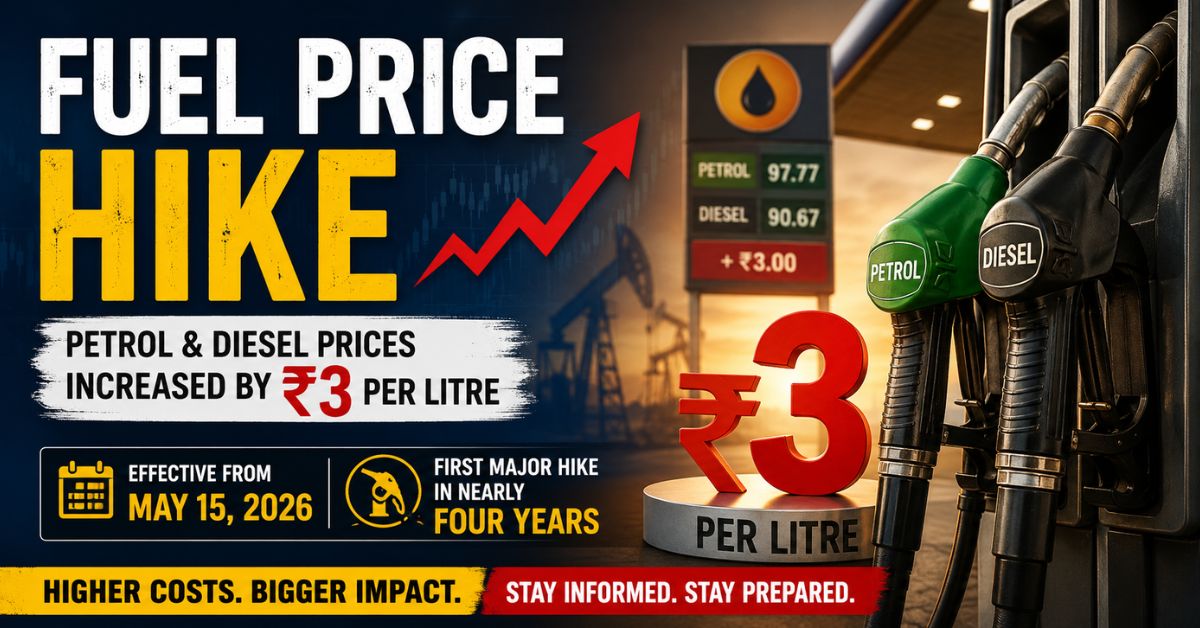
Fuel Price Hike in India
- Petrol and diesel prices in India have been increased by ₹3 per litre from May 15, 2026.
- The hike comes after nearly four years of stable fuel prices despite rising global crude oil costs.
- Global tensions involving Iran, Israel, and the US have pushed crude oil prices above $100 per barrel.
- Oil companies reportedly faced heavy under-recoveries due to higher import costs and frozen retail prices.
- Experts warn the fuel hike could increase inflation and raise transportation and food costs across India.
India has officially increased petrol and diesel prices by ₹3 per litre from Friday, May 15, 2026, marking the first major fuel price hike in nearly four years. The increase comes at a time when global crude oil markets remain under pressure due to the ongoing West Asia conflict and disruptions around the Strait of Hormuz, one of the world’s most important oil shipping routes.
State-run oil marketing companies including Indian Oil Corporation, Bharat Petroleum Corporation Limited, and Hindustan Petroleum Corporation Limited implemented the price revision across the country after holding rates largely unchanged since 2022. Analysts say the latest increase is only a partial correction and more hikes may follow if crude oil prices continue to stay above $100 per barrel.
The move has immediately triggered concerns about inflation, transportation costs, food prices, and retail fuel rates steady across India.
New Petrol and Diesel Prices in Major Cities
Fuel prices continue to vary across states because of local VAT and transportation charges, making it essential to stay updated on petrol prices in India. After the latest revision, metro cities are now seeing significantly higher retail prices.
| City | Petrol Price | Diesel Price |
|---|---|---|
| New Delhi | ₹97.77 | ₹90.67 |
| Mumbai | ₹106.68 | ₹93.14 |
| Kolkata | ₹108.74 | ₹95.13 |
| Chennai | ₹103.67 | ₹95.25 |
The figures for Delhi and other metro cities match the updated rates reported after the nationwide revision.
In Maharashtra and parts of eastern India, consumers are facing even sharper retail prices because of higher state taxes. Mumbai remains among the costliest major cities for petrol purchases.
Why Fuel Prices Have Increased in India
The immediate reason behind the fuel price hike is the sharp rise in global crude oil prices after the escalation of the US-Israel-Iran conflict, which has contributed to the ongoing India fuel price rise. Since February 2026, international oil markets have seen extreme volatility, with Brent crude briefly crossing $120 per barrel before stabilizing near the $100–$110 range.
The biggest concern globally has been the disruption around the Strait of Hormuz, particularly regarding supply controls West Asia. A large portion of the world’s oil trade passes through this narrow route connecting the Persian Gulf to global shipping lanes. Any conflict or blockade in the region immediately pushes oil prices upward because traders fear supply shortages.
India is heavily dependent on imported crude oil, making it highly vulnerable to geopolitical disruptions and global price shocks, such as the recent LPG shortage in India. Nearly 85% to 90% of the country’s oil requirement comes from imports, making India highly vulnerable to geopolitical disruptions and global price shocks.
Industry experts say Indian oil companies had been absorbing rising costs for months instead of passing them directly to consumers. That strategy became increasingly difficult as international prices remained elevated for a prolonged period.
Oil Companies Were Under Heavy Financial Pressure
According to reports cited by financial analysts and industry sources, state-run oil companies were facing massive under-recoveries because fuel prices at retail pumps remained artificially stable despite soaring import costs.
Some earlier estimates claimed oil firms were losing around ₹14 per litre on petrol and ₹42 per litre on diesel before the latest hike.
Other market analysts estimated even larger losses in specific fuel categories and refining operations. Reports suggested combined daily under-recoveries for public sector oil companies could have crossed ₹1,600 crore to ₹1,700 crore per day during peak crude price pressure.
The ₹3 increase therefore provides only limited relief to the companies. Analysts from brokerage firms and rating agencies have warned that further calibrated hikes may still be required if global crude prices remain elevated for several more weeks.
Reports About Massive Diesel Losses Need Caution
Some claims circulating online stated that oil companies were losing nearly ₹100 per litre on diesel. While such figures have appeared in certain market discussions and commentary reports, most verified mainstream financial reporting places estimated diesel under-recoveries significantly lower than that level.
Similarly, reports regarding India’s crude reserves falling exactly 15% and specific “Kpler” stock numbers could not be independently verified through reliable public government data at the time of writing. Those claims should therefore be treated cautiously until officially confirmed.
However, there is broad agreement among analysts that India’s strategic and commercial oil reserves are under pressure because of higher imports, supply uncertainty, and expensive alternative sourcing.
PM Modi’s Appeal to Reduce Fuel Consumption
One of the most unusual developments during this fuel crisis has been the government’s increasing emphasis on fuel conservation.
Prime Minister Narendra Modi urged citizens and institutions to rationalize fuel consumption as India attempts to manage its growing import bill and foreign exchange burden. Measures under discussion reportedly include greater work-from-home adoption, reduced travel, and wider use of online meetings.
The renewed push for electric vehicles and public transport is also gaining momentum as policymakers attempt to reduce India’s dependence on imported oil.
CNG and LPG Prices Also Under Pressure
The impact of the global energy crisis is not limited to petrol and diesel.
CNG prices in Delhi-NCR have also increased by ₹2 per kg, taking rates close to ₹79.09 per kg. Similar revisions have already been reported in Mumbai and nearby regions.
There are also concerns about future LPG price revisions, especially for commercial cylinders used by restaurants, hotels, and small businesses. Any sustained increase in cooking fuel prices could further contribute to inflation in the food and services sectors.
How the Fuel Price Hike Will Affect Common People
Economists believe the biggest impact of the fuel price hike will likely come through transportation and logistics costs rather than direct household fuel spending alone. Diesel is heavily used in trucking, farming equipment, buses, and supply chain movement across India.
As transport costs rise, prices of vegetables, milk, fruits, groceries, and other daily essentials may gradually increase in local markets.
Experts estimate the current fuel revision could add around 15 to 25 basis points to inflation if higher crude prices persist.
Ride-hailing services, delivery companies, intercity transport operators, and airlines are also expected to face cost pressure in the coming weeks.
Private Fuel Retailers Are Already Charging More
Private fuel retailers had already started increasing prices faster than public sector companies in some regions. Reports from Bengaluru showed private operators selling petrol and diesel at substantially higher prices than state-run pumps.
This reflected the growing mismatch between global fuel costs and India’s controlled retail pricing environment.
Because government-owned companies dominate over 90% of India’s fuel retail network, any nationwide price revision from them has a much wider economic effect.
Fuel Price Hike Comes After Election Season
The timing of the increase has also become politically sensitive.
Opposition parties and critics have pointed out that fuel prices remained frozen during the recent assembly election cycle and were revised almost immediately after voting concluded in several states.
At the same time, the government has argued that global crude prices and extraordinary geopolitical circumstances left oil companies with limited room to continue absorbing losses.
Is This the Beginning of More Fuel Price Hikes?
Most analysts believe the current ₹3 increase may not be the final adjustment.
Several brokerage reports suggest that if Brent crude remains above $100 per barrel for an extended period, oil companies may require additional price revisions to restore profitability and reduce under-recoveries.
Some experts estimate total hikes of ₹10 to ₹15 per litre could eventually be necessary unless global crude prices cool sharply or the government introduces fresh tax relief measures.
For now, Indian consumers are entering a new phase where fuel costs are once again becoming a central economic issue after several years of relative stability.
The latest fuel price hike has already started affecting transportation, inflation expectations, and household spending patterns across the country. With global oil markets still unstable and geopolitical tensions unresolved, the possibility of further increases cannot be ruled out in the coming months.