Key Highlights of Field Marshal Cariappa’s Legacy
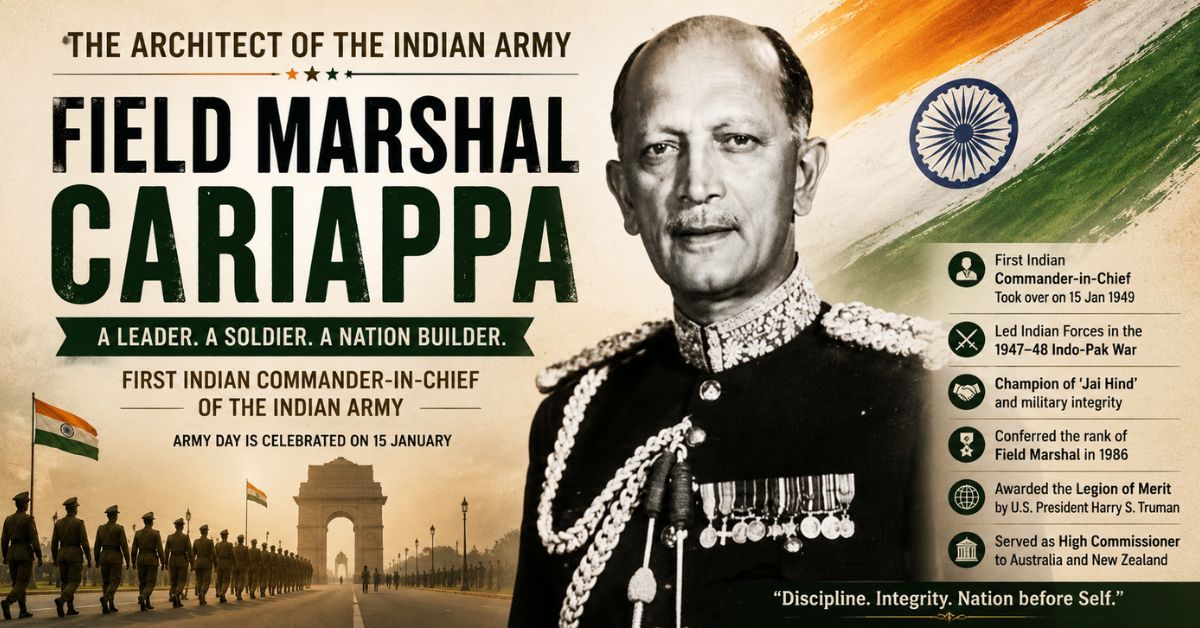
- Field Marshal Kodandera Madappa Cariappa became the first Indian Commander-in-Chief of the Indian Army in 1949.
- Army Day in India is celebrated every year on January 15 to mark his historic appointment.
- He played a major role in shaping the Indian Army into a disciplined and apolitical institution after independence.
- Cariappa also led Indian military operations during the 1947–48 Indo-Pak war in Jammu and Kashmir.
- He remains one of only two Indian Army officers to receive the five-star rank of Field Marshal.
Field Marshal Kodandera Madappa Cariappa remains one of the most respected military leaders in Indian history. Long before modern India developed into a strong military power, Cariappa laid the foundation of a disciplined, professional, and politically neutral Indian Army. Even decades after his death, his name continues to be closely associated with Army Day, military integrity, patriotism, and national service.
Known affectionately as “Kipper” Cariappa, he became the first Indian Commander-in-Chief of the Indian Army after independence. His appointment on January 15, 1949, marked the formal transfer of military leadership from British officers to Indian command, and that date is still celebrated every year as Army Day in India.
More than a decorated officer, Cariappa is remembered as the man who shaped the identity of the Indian Army during the most difficult years after independence and Partition.
Who Was Field Marshal Cariappa?
Field Marshal Kodandera Madappa Cariappa was born on January 28, 1899, in Shanivarsanthe in present-day Kodagu district of Karnataka, then part of the princely region of Coorg. He came from a Kodava family, a community widely known for its military tradition and contribution to the armed forces.
Cariappa studied at Central High School in Madikeri and later at Presidency College in Madras. At a time when very few Indians were allowed into higher military ranks under British rule, he emerged as one of the earliest Indians selected for formal officer training.
In 1919, he received the King’s Commission, becoming part of the first generation of Indian officers in the British Indian Army. This achievement alone made him a pioneer during colonial India, when senior military leadership was almost entirely controlled by the British establishment.
During his long military career, he served in several regions, including Mesopotamia, Iraq, Iran, and Burma. His performance during World War II earned him recognition as a capable and disciplined officer.
Why Is Field Marshal Cariappa Called the Architect of the Indian Army?
After India became independent in 1947, the country faced one of the most difficult military transitions in modern history. The British Indian Army had to be divided between India and Pakistan during Partition. Weapons, troops, command structures, and regiments all needed reorganization.
Cariappa played a major role in ensuring this transition happened smoothly and professionally. Military historians often credit him with helping India avoid the instability that affected several newly independent countries after colonial rule ended.
On January 15, 1949, he took charge from General Sir Roy Bucher and became the first Indian Commander-in-Chief of the Indian Army. This was a historic turning point because the Indian Army was finally under full Indian leadership, especially with the recent appointment of N.S. Raja Subramani as the new Chief of Defence Staff.
His leadership helped establish several principles that continue to define the Indian Army today:
- Political neutrality of the military
- Equal treatment of soldiers across regions and communities
- Discipline above personal ambition
- National service before individual identity
Many experts believe Cariappa’s insistence on keeping the Army away from politics became one of his greatest contributions, similar to the strategic shifts seen in the Sindoor operation. Unlike several neighboring countries where military intervention later entered governance, India maintained firm civilian control while preserving military professionalism.
Cariappa’s Role in the 1947–48 Indo-Pak War
Field Marshal Cariappa also played a major role during the first Indo-Pak war over Jammu and Kashmir in 1947–48.
As General Officer Commanding-in-Chief of Western Command, he supervised operations that helped Indian forces regain strategic areas including Zoji La, Drass, and Kargil. These operations were vital in securing access routes and stabilizing Indian military positions in Kashmir.
Military analysts often describe his wartime leadership as calm, methodical, and decisive. At a time when India was still organizing itself after Partition violence, refugee crises, and administrative uncertainty, the Army remained functional largely because of leaders like Cariappa.
The Meaning Behind the Name “Kipper” Cariappa
The nickname “Kipper” became famous across military circles and public life, but it did not come from his family.
According to several historical accounts, the wife of a British officer found it difficult to pronounce “Kodandera Madappa Cariappa” and began calling him “Kipper.” The name stayed with him throughout his career and eventually became widely recognized within the Army.
Even today, many veterans and historians refer to him as “Kipper Cariappa” while discussing India’s military history.
How Field Marshal Cariappa Popularized “Jai Hind”
One of the lesser-known but important parts of Cariappa’s legacy involves the slogan “Jai Hind.”
The phrase had originally gained popularity through Netaji Subhas Chandra Bose and the Indian National Army. Cariappa admired the patriotic energy behind the slogan and gradually adopted it within the Indian Army system.
Historical records show that he used “Jai Hind” as a greeting among personnel, and over time it became an official salutation across the Army.
Today, “Jai Hind” is one of the most recognized patriotic greetings in India, used not only by soldiers but also by civilians, political leaders, and students.
The Famous Story of Cariappa and His Son During the 1965 War
Perhaps the most powerful story connected to Field Marshal Cariappa came years after his retirement.
During the 1965 India-Pakistan war, his son, K.C. “Nanda” Cariappa, an Indian Air Force pilot, was shot down and captured by Pakistan.
At that time, Pakistan’s President Ayub Khan had once served under Cariappa before Partition. After learning that Cariappa’s son had become a prisoner of war, Ayub Khan reportedly offered to arrange his special release.
Cariappa refused.
According to widely quoted historical accounts, he responded by saying that his son should receive no special treatment and should be treated like every other Indian prisoner of war.
That moment became symbolic of military ethics, equality, and personal sacrifice. Even today, the incident is regularly cited during discussions about leadership and integrity in the armed forces.
Why Field Marshal Cariappa Was Made a Field Marshal
In 1986, the Government of India conferred the five-star rank of Field Marshal upon Cariappa in recognition of his contribution to the nation and the Indian Army.
He became only the second Indian Army officer to receive the honor after Sam Manekshaw.
The rank of Field Marshal is ceremonial and awarded only in exceptional cases. It recognizes military service of historic national importance.
Even today, only two Indian Army officers have received this rank.
International Recognition and Legion of Merit
Cariappa’s reputation extended far beyond India.
The United States awarded him the “Order of the Chief Commander of the Legion of Merit,” one of the highest military honors given to foreign military leaders. The decoration was presented during the presidency of Harry S. Truman.
This recognition reflected the global respect he earned as a military professional and strategist.
Diplomatic Career After Retirement
After retiring from the Army in 1953, Cariappa served as India’s High Commissioner to Australia and New Zealand until 1956.
He was known for his strong personality, straightforward communication style, and disciplined public conduct. Several accounts from that period describe him as a highly respected Indian representative abroad.
Even after retirement, he remained connected to ex-servicemen welfare, military reform discussions, sports promotion, and environmental conservation.
Cariappa’s Interest in Sports and Discipline
Field Marshal Cariappa strongly believed that sports built character, teamwork, and leadership qualities.
He was particularly interested in hockey and tennis. Bengaluru’s famous Field Marshal Cariappa Hockey Stadium was named in his honor.
For Cariappa, physical fitness and discipline were not separate from military life. He believed that the mental strength of soldiers was directly linked to physical endurance and team spirit.
Did Cariappa Really Keep the Army Away From Politics?
Most historical experts agree that this is one of his greatest achievements.
After independence, several newly formed nations struggled with military coups and political interference from armed forces. India did not face that situation, and many historians credit Cariappa for establishing a culture where the Army remained loyal to the Constitution rather than political leadership.
He openly believed that the armed forces should remain professional, disciplined, and completely outside political competition.
This principle continues to define the Indian military structure today.
Death and Lasting Legacy
Field Marshal Cariappa passed away on May 15, 1993, in Bengaluru at the age of 94.
More than three decades later, his legacy remains deeply connected with Army Day celebrations, military leadership training, and Indian patriotic history.
In Kodagu, his birthplace continues to produce a large number of officers for the Indian Armed Forces. His life story is widely taught in military academies and remembered across regimental traditions.
For many Indians, Field Marshal Cariappa represents a rare combination of patriotism, discipline, humility, and national duty. While later military leaders achieved battlefield victories and strategic milestones, Cariappa is often remembered as the officer who built the institutional backbone of the Indian Army itself.
His contribution was not limited to winning wars. He helped shape the values of the Army during the fragile years of India’s birth as an independent nation.