Agni-1 Missile Test Highlights
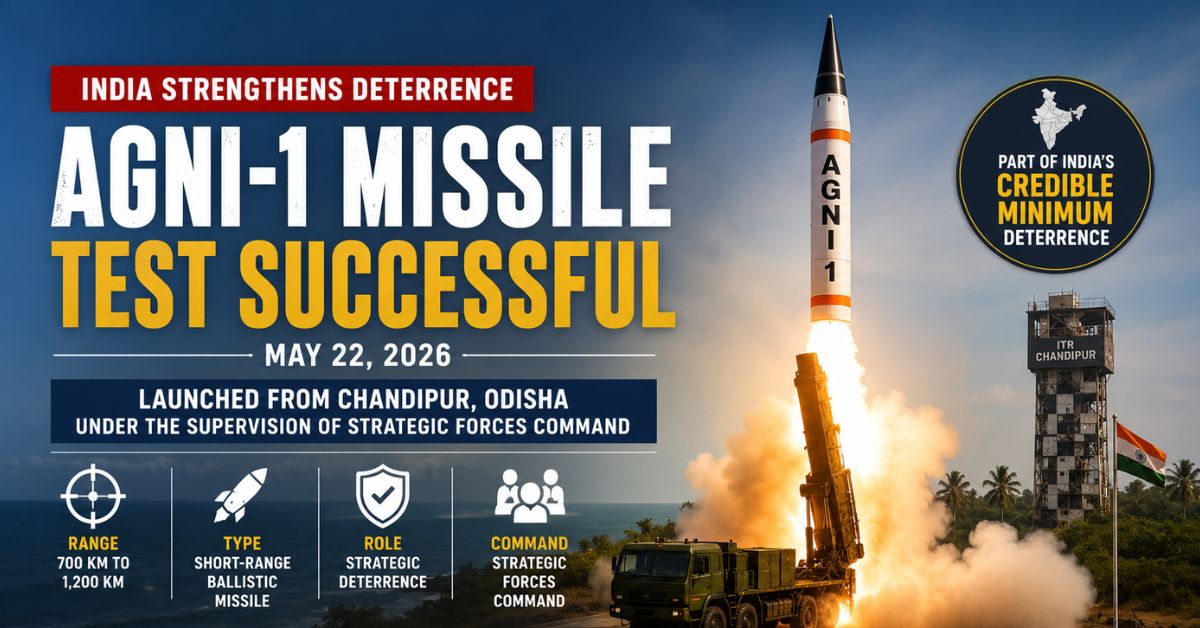
- India successfully tested the Agni-1 ballistic missile on May 22, 2026, from Chandipur, Odisha.
- The launch was conducted under the supervision of the Strategic Forces Command.
- Defence officials confirmed that all operational and technical parameters were successfully validated.
- The Agni-1 remains an operational part of India’s strategic nuclear deterrence structure, which has evolved significantly since events like the Smiling Buddha 1974.
- The missile test follows recent reports of advanced Agni missile trials involving MIRV technology.
India successfully carried out a test flight of the nuclear-capable Agni-1 ballistic missile on Friday, May 22, 2026, from the Integrated Test Range (ITR) at Chandipur in Odisha. The launch was conducted under the supervision of the Strategic Forces Command (SFC), which is responsible for handling India’s strategic missile forces and nuclear delivery systems.
The successful test comes at a time when India’s missile programme is receiving renewed attention following reports of an advanced Agni missile test with MIRV capability earlier this month, alongside the recent India emergency alert test. The latest Agni-1 launch is being viewed as part of a broader effort to maintain operational preparedness across the entire Agni missile family, from short-range battlefield deterrence systems to long-range strategic weapons, including the upcoming Vikram-1 private launch.
For people searching terms such as “India Agni missile MIRV test May 2026”, “Strategic Forces Command missile launch Odisha”, “Agni-1 test flight Chandipur May 2026”, and “India missile test today news”, the May 22 launch represents India’s latest confirmed strategic missile test in a month already marked by multiple defence trials.
Agni-1 Missile Test Conducted From Chandipur, Odisha
According to reports, the Agni-1 missile was launched from the Integrated Test Range located at Chandipur on the Odisha coast. Defence officials stated that the launch successfully validated all operational and technical parameters linked to the missile system.
The Agni-1 is a short-range ballistic missile developed under India’s indigenous missile programme, which plays a crucial role in establishing India nuclear status. It is already operationally deployed and forms an important part of India’s land-based nuclear deterrence capability.
Unlike developmental missile trials, Friday’s launch appears to have been a routine user validation exercise conducted by the Strategic Forces Command. Such launches are meant to confirm that deployed missile systems remain combat-ready and capable of functioning under real operational conditions. Historical records show that the SFC regularly conducts similar user trials of Agni-series missiles from Odisha test facilities.
The Ministry of Defence has not released detailed flight data publicly, which is standard practice for strategic weapons testing in India.
Verification of Claims Shared About the Agni-1 Test
Most of the information shared regarding the Agni-1 launch is accurate based on currently available reports and previously established technical details.
The following points are verified or strongly supported by available reporting:
- India conducted a successful Agni-1 missile test on May 22, 2026.
- The launch took place from the Integrated Test Range at Chandipur, Odisha.
- The Strategic Forces Command supervised the test.
- Agni-1 is a short-range ballistic missile with an estimated strike range between 700 km and 1,200 km.
- The missile is operationally deployed within India’s strategic forces structure.
- India recently conducted an advanced Agni missile test involving MIRV technology in May 2026.
However, some details mentioned in the shared information remain either unconfirmed officially or are based on defence analysis rather than direct government statements.
These include:
- The exact accuracy figure of approximately 25 meters CEP has not been officially confirmed in the latest reports.
- Claims that the May 22 launch specifically validated “immediate response capabilities” are analytical interpretations rather than formal statements from the Ministry of Defence.
- The suggestion that the Agni-1 is undergoing major canisterization upgrades is plausible and discussed in defence circles, but detailed official confirmation remains limited.
- The statement that India intentionally signaled a “deterrence ladder” strategy by testing Agni-1 after an Agni MIRV test is strategic analysis, not an officially declared doctrine.
The mention of “Suryastra” or “Predator Hawk” rocket demonstrations on May 18-19, 2026, could not be independently verified through authoritative public government releases at the time of writing.
Why the Agni-1 Missile Still Matters in 2026
Although India has developed more advanced systems such as Agni-4, Agni-5, and the newer Agni-Prime missile, the Agni-1 remains strategically important.
The missile was designed primarily for short-to-medium range deterrence and is considered especially relevant for regional security scenarios. Its mobility, relatively quick launch capability, and operational deployment make it suitable for rapid response roles.
The Agni-1 uses solid-fuel propulsion, which allows faster deployment compared to older liquid-fuel missile systems. Defence analysts have long noted that solid-fuel missiles are easier to maintain and can be launched with less preparation time.
The missile is believed to carry either conventional or nuclear payloads, though India does not publicly discuss operational nuclear deployment details.
Technical assessments available in public defence records describe Agni-1 as:
| Feature | Details |
|---|---|
| Missile Type | Short-Range Ballistic Missile |
| Estimated Range | 700 km to 1,200 km |
| Propulsion | Solid Fuel |
| Launch Platform | Road-Mobile |
| Role | Strategic Deterrence |
| Operator | Strategic Forces Command |
The Agni missile series overall forms a central part of India’s nuclear triad, particularly the land-based leg of its deterrence structure.
Connection Between Agni-1 Test and MIRV Missile Activity
The latest Agni-1 launch has drawn additional attention because it comes just days after India confirmed a successful test involving MIRV technology on an advanced Agni missile.
MIRV stands for Multiple Independently Targetable Re-entry Vehicle. This technology allows a single ballistic missile to carry several warheads capable of striking different targets independently.
India first publicly demonstrated MIRV capability under the “Mission Divyastra” programme in 2024. Recent May 2026 reports suggest that India is continuing work toward operational deployment of advanced MIRV-equipped strategic missiles.
The May 2026 MIRV-related missile test reportedly took place from Dr APJ Abdul Kalam Island off the Odisha coast. Defence officials described the trial as a major technological achievement for India’s strategic deterrence programme.
While the Agni-1 itself is not associated with MIRV technology, the timing of the two missile events highlights the broad range of India’s missile development efforts, from short-range tactical systems to long-range strategic strike platforms.
Strategic Forces Command’s Role in India’s Missile Programme
The Strategic Forces Command plays a central role in nearly all operational ballistic missile exercises conducted by India.
Created in 2003, the SFC is responsible for managing the country’s nuclear arsenal and ensuring the readiness of strategic missile units. User validation trials conducted under the SFC are intended to test actual operational readiness instead of experimental design capability.
Previous Agni-series missile launches in 2025 and 2026 have also been carried out under the SFC’s supervision.
This repeated testing cycle helps maintain reliability in India’s strategic systems while also allowing armed forces personnel to train in launch procedures, missile handling, targeting systems, and emergency deployment protocols.
India’s Agni Missile Programme Continues to Expand
India’s Agni missile programme has evolved significantly since the first Agni missile tests decades ago.
The current Agni family includes:
- Agni-1 for short-range deterrence
- Agni-2 and Agni-3 for intermediate-range strike capability
- Agni-4 for improved accuracy and mobility
- Agni-5 for long-range strategic deterrence
- Agni-Prime as a newer-generation replacement platform
Recent discussions around Agni-6 and future MIRV-capable variants suggest that India is continuing to expand its missile technology base.
The successful Agni-1 test conducted from Chandipur on May 22, 2026, may appear routine compared to long-range MIRV developments, but it remains an important operational milestone. It confirms that India continues to actively validate both older and newer systems within its strategic arsenal.
At a time when global military tensions and missile developments are increasingly shaping regional security calculations, the latest Agni-1 launch reinforces India’s focus on maintaining a credible and continuously tested deterrence posture.
Sources: Ministry of Defence, PIB, defence analysts, Economic Times, Times of India, publicly available strategic defence records.