OnePlus Shutdown Rumors: What Is Actually Happening
- Reports of a “OnePlus shutdown” have surged following leadership exits and internal restructuring under Oppo.
- Robin Liu stepped down as CEO of OnePlus India on March 24, 2026, intensifying uncertainty.
- Industry sources suggest a planned withdrawal from parts of Europe and North America by April 2026.
- OnePlus is being integrated more closely with Oppo and Realme under a unified leadership structure.
- The company is expected to continue operations in China and India, with a shift toward mid-range devices.
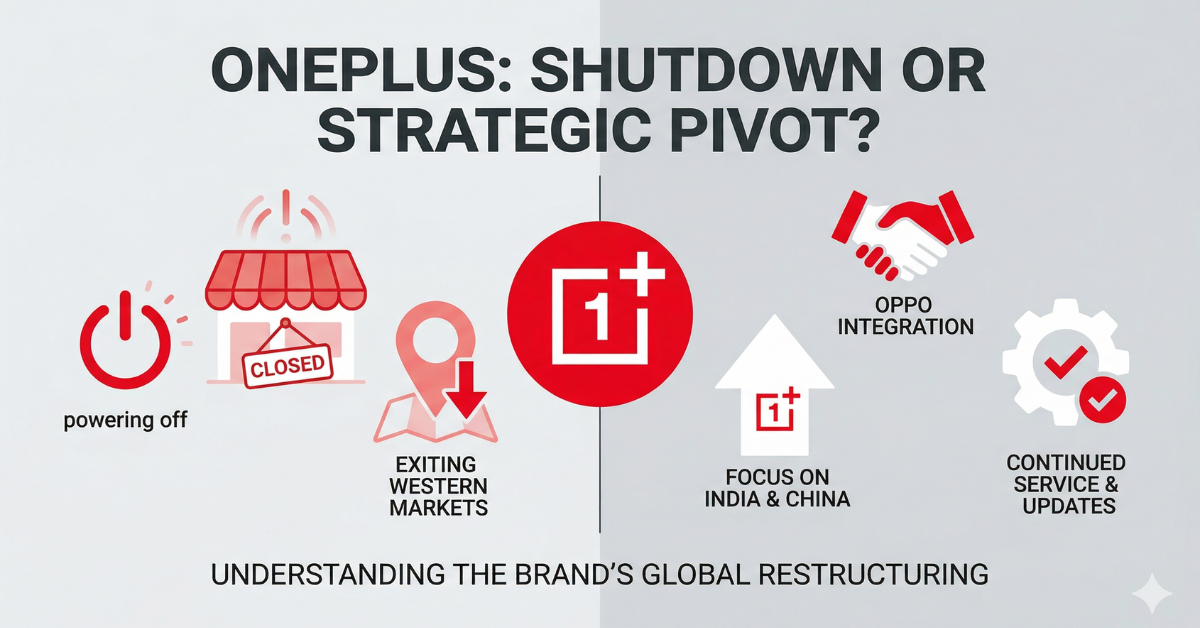
The phrase “OnePlus shutdown” has gained widespread attention in late March 2026, driven by a series of rapid developments involving leadership changes, corporate restructuring, and reports of market exits, similar to the recent news surrounding the RBI Paytm license. While the wording suggests a complete closure, available information indicates a more complex transition. OnePlus is not shutting down as a company. Instead, it appears to be undergoing a strategic contraction, reducing its presence in certain global markets while reinforcing its focus on Asia.
Leadership Exit Triggers Fresh Speculation
The most immediate trigger for renewed concern was the resignation of Robin Liu, CEO of OnePlus India, on March 24, 2026. His departure came at a sensitive moment, given that he had publicly dismissed shutdown rumors as misinformation earlier in the year. The timing has led to questions about whether internal developments shifted more quickly than expected.
Leadership changes in technology companies are not uncommon, but in this case, the exit aligns with broader structural changes across the parent organization. It has therefore been interpreted as part of a larger strategic reset rather than an isolated personnel move.
Reports of Withdrawal from Western Markets
Multiple industry reports, including coverage from 9to5Google and commentary from well-known tipster Yogesh Brar, indicate that OnePlus is preparing to significantly scale back or exit operations in key Western markets. These include the United States, the United Kingdom, and several European countries.
According to these reports, the transition could begin as early as April 2026. While there has been no single official announcement outlining a complete withdrawal, distribution slowdowns, reduced marketing activity, and inventory shifts have been cited as early indicators.
Such a move would represent a major shift for a brand that once built its global identity through Western markets, particularly among enthusiast users who were drawn to its early “flagship killer” positioning.
Integration Under Oppo’s Corporate Structure
At the center of the restructuring is Oppo, the parent company that has steadily increased operational alignment across its associated brands. OnePlus and Realme are now reportedly functioning under a more unified leadership framework, with Realme CEO Sky Li playing a central coordinating role.
This shift effectively reduces OnePlus’s earlier semi-independent status. Over the past few years, the brand had already begun sharing research, development, and software resources with Oppo. The current changes formalize that integration at an organizational level.
The consolidation is consistent with broader trends in the smartphone industry, where companies seek to streamline operations, reduce duplication, and improve cost efficiency in an increasingly competitive environment, similar to the recent GPT 5.6 release.
Regional Strategy: Where OnePlus Continues
Despite the “OnePlus shutdown” narrative, the company is expected to remain active in key markets, particularly China and India, especially with the upcoming oneplus nord 6 launch.
China: Core Market Stability
China remains the primary base of operations for OnePlus. The brand continues to have strong supply chain integration, manufacturing support, and market familiarity in the region. There are no indications of withdrawal from this market, and it is expected to remain central to future product launches.
India: Strategic Pivot Rather Than Exit
India is expected to remain one of the most important markets for OnePlus, though with a noticeable shift in product strategy. Instead of focusing heavily on premium flagship devices, the company is likely to prioritize its Nord series and other mid-range offerings.
This pivot reflects changing consumer demand patterns as well as pricing pressures in the premium segment. India’s competitive smartphone landscape, where value-driven devices dominate sales volumes, aligns more closely with this adjusted focus.
United States, United Kingdom, and Europe: Likely Contraction
In contrast, Western markets appear to be facing a phased reduction in OnePlus operations. Reports suggest that the company may cease new product launches, reduce retail partnerships, and limit direct distribution in these regions.
It remains unclear whether this will result in a complete exit or a reduced, online-only presence. However, the direction points toward a significant scaling down rather than expansion.
Underlying Reasons Behind the Shift
Rising Production Costs
The global smartphone industry has faced sustained cost pressures due to component shortages, particularly in memory and advanced chipsets. These increases have narrowed margins, especially in the premium segment where competition is intense and pricing flexibility is limited.
Declining Shipment Volumes
Industry data from 2025 indicates that OnePlus experienced a sharp decline in global shipments, estimated at around 39 percent. This drop has reduced its competitiveness against larger players with stronger distribution networks and broader product portfolios.
Internal Brand Overlap
Another factor is internal competition within the parent company’s portfolio. Oppo’s Find X series has increasingly occupied the premium flagship space that OnePlus once targeted globally. This overlap has led to questions about brand positioning and the efficient allocation of resources.
By consolidating efforts under a more unified structure, the company can reduce redundancy and focus each brand on clearer market segments.
Impact on Existing OnePlus Users
For current OnePlus users, the most immediate concern is device support. The company has reiterated that existing commitments will be honored.
Software Updates
Devices already in circulation are expected to continue receiving scheduled Android updates and security patches, typically within the previously announced support window of three to four years.
After-Sales Service
Warranty services and repairs are also expected to continue. Over time, these services may be integrated more closely with Oppo’s existing service network, which could lead to changes in service center branding but not necessarily in service availability.
Reframing the “OnePlus Shutdown” Narrative
The current situation highlights how quickly narratives can form around incomplete information. The term “shutdown” suggests a complete cessation of operations, which is not supported by available evidence. Instead, OnePlus appears to be undergoing a strategic realignment shaped by market conditions, internal restructuring, and evolving business priorities.
The company’s future will likely look different from its past, with less emphasis on global flagship competition and greater focus on selective markets and product segments. This transition reflects broader changes in the smartphone industry, where consolidation and specialization are becoming more common.
What Comes Next for the Brand
In the near term, further clarity is expected as the company formalizes its plans for different regions. Official announcements, product launch patterns, and distribution strategies over the coming months will provide a clearer picture of the long-term direction.
For now, the available evidence points toward a transformation rather than a shutdown. OnePlus remains active, but its global footprint is being reshaped in response to both internal and external pressures.