


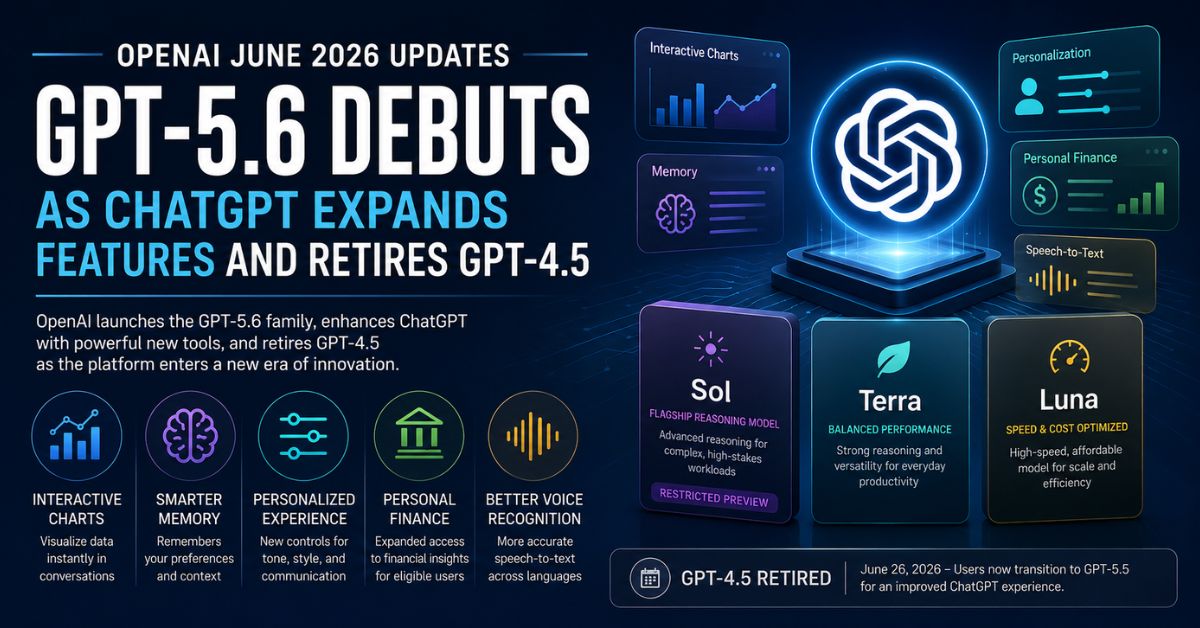
OpenAI’s June 2026 Updates: Key Highlights
- OpenAI introduced the GPT-5.6 family, including Sol, Terra, and Luna, each designed for different workloads and deployment needs.
- GPT-5.5 remained ChatGPT’s primary model with improvements in reasoning, instruction following, and reliability.
- Sol entered a restricted preview while undergoing additional cybersecurity evaluations before wider availability.
- OpenAI expanded ChatGPT with interactive charts, enhanced memory capabilities, improved speech recognition, and broader personalization options.
- The company expanded Personal Finance support for eligible Plus and Pro subscribers in the United States.
- GPT-4.5 was retired from ChatGPT on June 26 as users transitioned to GPT-5.5, while OpenAI continued enhancing enterprise and developer capabilities.
| Event | Date |
|---|---|
| GPT-5.5 Becomes Primary ChatGPT Model | June 2026 |
| GPT-5.6 Family (Sol, Terra, Luna) Announced | Late June 2026 |
| Interactive Charts Introduced | June 2026 |
| GPT-4.5 Retired from ChatGPT | June 26, 2026 |
June 2026 marked one of OpenAI’s busiest months in recent memory, with the company announcing a new family of artificial intelligence models, expanding ChatGPT’s capabilities, introducing new personalization features, and rolling out updates for consumers, developers, and enterprise customers.
The month included the debut of the GPT-5.6 model family, continued improvements to GPT-5.5, new interactive data visualization tools, broader memory capabilities, expanded financial account integration, and updates to speech recognition. OpenAI also made changes to product availability and continued refining ChatGPT across its subscription plans, according to official announcements and release notes.
Several reports published during June also described additional changes related to personalization, enterprise management, and pricing. While many of these developments were confirmed by OpenAI, some features were reported by independent technology publications before broader official documentation became available. As a result, it is important to distinguish between company announcements and independently reported developments.
The updates come as competition in the artificial intelligence industry continues to intensify. Companies including Google, Anthropic, Microsoft, Meta, and xAI have introduced increasingly capable AI systems during the past year, placing greater emphasis on reasoning, coding, multimodal capabilities, and enterprise deployment.
GPT-5.5 Remains ChatGPT’s Primary Model
One of the most significant developments during June was the continued rollout of GPT-5.5 as ChatGPT’s primary model.
According to OpenAI’s release notes, GPT-5.5 Instant became the default experience for most ChatGPT users after a series of refinements focused on improving response quality, instruction following, and overall reliability.
The company said the updated model produces more natural conversations, follows complex instructions more consistently, and reduces factual errors in areas where accuracy is particularly important, including medicine, law, and finance.
OpenAI has increasingly focused on improving model reliability rather than only expanding benchmark performance. Company researchers have repeatedly said that reducing hallucinations and increasing factual consistency remain key priorities as AI systems become more widely used in education, software development, research, customer support, and business operations.
The latest refinements also continue OpenAI’s broader strategy of making newer models available without requiring users to manually switch between different versions for everyday conversations.
GPT-5.6 Family Introduced
The biggest announcement of the month came when OpenAI introduced the GPT-5.6 family of language models.
According to the company, GPT-5.6 consists of three models designed for different workloads rather than a single universal system.
The lineup includes Sol, Terra, and Luna.
OpenAI described Sol as its flagship reasoning model, designed for highly demanding tasks involving advanced reasoning, scientific research, software engineering, and cybersecurity.
However, Sol is not broadly available.
The company said access is currently limited to a small group of trusted partners while additional cybersecurity evaluations are conducted.
OpenAI said the restricted rollout follows a request from the U.S. government to perform additional security assessments before wider deployment.
The company did not specify how long the restricted preview will remain in place.
Industry observers note that advanced AI models are increasingly receiving additional scrutiny from governments because of their potential capabilities in areas including cybersecurity, biological research, and autonomous software development.
Terra Targets Everyday Workloads
Alongside Sol, OpenAI introduced Terra.
The company described Terra as a balanced model intended for general-purpose work.
According to OpenAI, Terra is designed to provide strong reasoning performance while maintaining lower operating costs than the flagship Sol model.
The company said Terra is suitable for tasks including document drafting, customer support, software development, business analysis, education, and general productivity.
The model reflects a growing trend among AI developers to offer multiple models optimized for different use cases instead of expecting one system to meet every requirement.
Competitors including Anthropic and Google have similarly expanded their product portfolios with models aimed at balancing performance, speed, and cost.
Luna Focuses on Speed and Cost
The third model introduced during June was Luna.
OpenAI said Luna is optimized for high-speed responses and affordability, making it suitable for applications that require rapid interactions or large-scale deployments.
Such workloads may include customer service automation, content classification, translation, summarization, data extraction, and other high-volume enterprise applications where response time and operating costs are important considerations.
While Luna delivers lower operating costs, OpenAI positioned the model as part of a broader strategy that allows developers to select an AI model based on performance requirements rather than relying on a single system.
The three-model approach also reflects increasing segmentation across the AI industry, where companies are building separate models for premium reasoning, balanced productivity, and cost-efficient inference.
Safety Review Remains Central
OpenAI’s decision to restrict access to Sol represents one of the clearest examples of how AI deployment has evolved over the past year.
Instead of immediately releasing its most capable model to all users, the company chose a phased rollout while additional safety reviews continue.
According to OpenAI, the restricted preview is intended to gather feedback from trusted partners and allow further evaluation before broader availability.
The company has increasingly published deployment reports explaining its testing procedures, model evaluations, and safeguards before releasing advanced systems.
These assessments include testing for cybersecurity capabilities, misuse risks, harmful outputs, and other potential concerns.
The additional review of Sol also reflects growing government interest in advanced AI systems.
Governments in the United States, Europe, and several Asian countries have continued developing regulatory frameworks intended to balance innovation with public safety.
Although regulations vary across jurisdictions, developers of advanced foundation models are facing increasing expectations to document testing procedures, publish safety information, and cooperate with regulators before launching new capabilities.
GPT-4.5 Retired From ChatGPT
June also marked the retirement of GPT-4.5 from ChatGPT.
According to OpenAI’s release information, GPT-4.5 was removed from ChatGPT on June 26 as the company transitioned users to GPT-5.5.
Existing conversations continue to function, but users opening older chats are now served by GPT-5.5 rather than GPT-4.5 inside ChatGPT.
The retirement applies to the ChatGPT product rather than necessarily affecting developer access through OpenAI’s API.
The change is consistent with OpenAI’s broader practice of periodically retiring older consumer-facing models as newer versions become the default experience.
For users, the transition means improved reasoning, better instruction following, and access to the latest platform capabilities without requiring manual migration.
The company has followed a similar approach with previous model generations, gradually replacing older systems as newer versions mature and become more reliable.
AI Competition Continues to Accelerate
OpenAI’s announcements arrive during a period of rapid competition across the artificial intelligence sector.
Technology companies have continued releasing increasingly capable models focused on reasoning, software development, multimodal understanding, scientific research, and enterprise automation.
The pace of development has accelerated significantly over the past year, with major AI developers introducing frequent model updates rather than waiting for annual product cycles.
Industry analysts say this faster release cadence reflects both growing customer demand and intense competition among leading AI companies seeking to improve performance while lowering inference costs.
For businesses, the expanding range of models also provides greater flexibility, allowing organizations to choose AI systems based on budget, latency requirements, and task complexity rather than relying on a single general-purpose model.
Interactive Charts Expand ChatGPT’s Data Analysis Capabilities
Another notable update during June was the introduction of interactive charts within ChatGPT.
According to OpenAI’s release notes, users can now ask ChatGPT to generate visual representations of data directly inside conversations. The feature supports several common chart types, including bar charts, line charts, pie charts, and scatter plots.
Previously, users often needed to export data into spreadsheet software or dedicated visualization tools to create charts. The new capability allows users to generate and refine charts without leaving the conversation.
OpenAI said the feature is intended to make data analysis more accessible for students, researchers, business professionals, educators, and everyday users who need to understand trends or compare datasets.
Users can also request modifications after a chart is generated, allowing them to change chart types, update labels, adjust values, or visualize different portions of the same dataset through follow-up prompts.
The addition reflects OpenAI’s broader effort to transform ChatGPT from a conversational assistant into a more comprehensive productivity platform capable of handling research, analysis, writing, coding, and visual data interpretation within a single interface.
Memory System Receives a Major Upgrade
OpenAI also expanded ChatGPT’s memory capabilities during June.
The company has gradually developed memory features over the past two years to allow ChatGPT to remember user preferences across conversations. During June, these capabilities were enhanced to provide more relevant responses based on a user’s long-term interactions.
OpenAI’s official documentation describes improvements to memory that help ChatGPT better understand ongoing projects, recurring preferences, and user-specific context while maintaining user control over saved information.
Several technology publications referred to this upgraded system as “Dreaming” memory. Those reports described background processes that synthesize stored information into more useful long-term context instead of simply recalling isolated facts.
While independent reporting consistently used that description, OpenAI’s public documentation has focused on explaining the expanded functionality rather than formally branding the feature as “Dreaming.”
Regardless of terminology, the updated system is designed to reduce repetitive conversations by allowing ChatGPT to remember information that users have chosen to retain.
According to OpenAI, users remain able to review, modify, or delete saved memories and disable the feature entirely if they prefer conversations without persistent memory.
The company has said memory remains an optional capability rather than a mandatory feature.
Personalization Settings Become More Flexible
OpenAI also introduced broader personalization controls during June, giving users more direct influence over how ChatGPT communicates.
According to reports covering the rollout, users can choose a preferred base communication style, such as Friendly, Professional, or Concise, through the application’s settings instead of repeatedly requesting a preferred tone in individual conversations.
Additional controls allow users to adjust characteristics such as warmth and enthusiasm.
The feature is intended to make responses more consistent across conversations while reducing the need for repeated prompting.
OpenAI has increasingly emphasized personalization as ChatGPT expands beyond one-time conversations into a platform that users rely on daily for work, education, planning, software development, and creative projects.
The company has also stated that personalization settings operate separately from factual accuracy. Adjusting style does not change how ChatGPT evaluates information or follows safety policies.
Personal Finance Features Expand to More Users
June also brought an expansion of ChatGPT’s Personal Finance feature.
According to OpenAI’s release information, the capability became available to more Plus subscribers on the web and iOS in the United States, while Android availability expanded to eligible Plus and Pro users.
The feature allows users to securely connect supported financial accounts to ChatGPT.
After obtaining user permission, ChatGPT can provide dashboards, summaries, spending insights, and financial information based on connected account data.
OpenAI said financial account information is handled through secure connections and remains under user control.
The company emphasized that the feature is designed to provide grounded insights based on available financial information rather than offering personalized investment advice.
As with other financial software, users are encouraged to independently verify important financial decisions and consult qualified professionals where appropriate.
The expansion reflects a broader trend across the technology industry as AI companies seek to integrate conversational assistants with everyday digital services while maintaining privacy protections.
Speech Recognition Improves Across Languages
OpenAI also deployed an updated speech-to-text model during June.
According to the company, the new system improves transcription accuracy across multiple languages, regional accents, and noisy environments.
Voice interaction has become an increasingly important part of ChatGPT’s user experience, particularly on smartphones and other mobile devices.
Improved speech recognition is expected to reduce transcription errors during voice conversations, making the assistant more reliable for users who communicate through spoken prompts instead of typing.
The company said the upgraded system performs better when processing varied speaking styles and background noise, allowing conversations to remain more accurate in real-world environments.
OpenAI has continued investing in multimodal capabilities, combining text, voice, images, and other forms of input into unified AI systems.
The improved speech model forms part of that broader strategy.
ChatGPT Continues Expanding Beyond Text
Taken together, the June updates demonstrate how ChatGPT is evolving beyond a text-based chatbot.
The platform now combines conversation, reasoning, coding assistance, visual analysis, memory, voice interaction, document handling, and personalized experiences within a single application.
Rather than releasing isolated features, OpenAI has steadily integrated these capabilities into a unified user experience.
This approach reflects changing expectations among users, who increasingly view AI assistants as everyday productivity tools rather than question-and-answer systems.
Businesses are also adopting AI for document analysis, customer support, software development, research, workflow automation, and knowledge management.
As a result, AI developers are placing greater emphasis on practical usability alongside improvements in model intelligence.
Balancing Personalization and Privacy
The expansion of memory and personalization has also renewed discussion about user privacy.
OpenAI has stated that users retain control over what ChatGPT remembers.
According to the company, users can view saved memories, remove individual entries, clear all stored memories, or disable memory entirely through settings.
The company has also continued offering Temporary Chat, which allows conversations without creating persistent memories.
Privacy experts have generally noted that transparent controls are an important component of AI personalization because they allow users to decide how much information is retained between conversations.
As AI assistants become more integrated into daily life, questions surrounding data retention, transparency, and user consent are expected to remain important areas of discussion for both technology companies and regulators.
Productivity Remains the Primary Focus
Although several June announcements introduced new capabilities, they share a common objective.
Most of the updates are intended to reduce friction during everyday work.
Interactive charts eliminate the need for separate visualization software for many routine tasks.
Improved memory reduces repetitive instructions.
Personalization settings create more consistent conversations.
Enhanced speech recognition improves mobile interactions.
Financial integration brings account summaries into ChatGPT instead of requiring separate applications.
Together, these changes suggest OpenAI is continuing its strategy of positioning ChatGPT as a general-purpose productivity platform capable of supporting a wide range of professional and personal tasks within a single interface.
Pricing Changes Reflect a Broader Platform Strategy
June also brought changes to OpenAI’s pricing structure, although not every reported adjustment was confirmed through official company announcements.
OpenAI formally introduced new pricing for its GPT-5.6 family through its developer platform. The company positioned the three models to serve different performance and cost requirements, allowing developers to choose a model based on workload rather than relying on a single premium option.
According to OpenAI, Sol is intended for complex reasoning and demanding workloads, while Terra offers a balance between capability and operating cost. Luna is designed for applications where speed and affordability are the primary considerations.
Technology publications also reported changes affecting some ChatGPT subscription plans during June. However, OpenAI did not publish comprehensive release notes confirming all reported pricing revisions. As a result, reports of broader consumer pricing changes should be attributed to independent sources unless confirmed by the company.
Industry analysts say tiered pricing has become increasingly important as AI providers compete not only on model quality but also on affordability. Businesses deploying AI at scale often evaluate models based on operating costs, response speed, and task complexity rather than benchmark scores alone.
Codex Continues to Expand
OpenAI also continued updating Codex, its AI-powered coding assistant.
During June, the company announced improvements aimed at supporting longer-running software development tasks. These updates are intended to help developers work on more complex coding projects that extend beyond short prompts.
Independent technology publications also reported that Codex Remote became generally available, allowing users to monitor and manage coding tasks running on Mac and Windows computers from mobile devices.
OpenAI has not published a standalone announcement confirming the broader rollout of Codex Remote during June. Consequently, reports regarding its general availability should be attributed to independent reporting.
The updates nevertheless reflect OpenAI’s continuing investment in developer tools, an area that has become increasingly competitive as AI-assisted programming gains wider adoption across the software industry.
Enterprise Features Continue to Grow
OpenAI also introduced additional capabilities for business customers during the month.
According to reports covering enterprise updates, organizations gained improved administrative controls, including expanded usage analytics and spending management tools.
These features are intended to help businesses monitor AI usage across teams, better understand operational costs, and manage organizational deployments.
Reports also described enhancements allowing users to review and manage active ChatGPT sessions across multiple devices.
Although OpenAI regularly updates its enterprise offerings, some of these specific features have been documented primarily through product updates and industry reporting rather than detailed public announcements. Organizations considering enterprise deployment are therefore encouraged to review OpenAI’s latest official documentation for the most current feature availability.
Competition Across the AI Industry Intensifies
OpenAI’s June announcements arrived amid rapidly increasing competition across the artificial intelligence industry.
Technology companies have continued releasing increasingly capable models focused on reasoning, software development, multimodal understanding, scientific research, and enterprise automation.
Google has continued expanding its Gemini family of models and integrating AI into Workspace, Search, and Android.
Anthropic has focused on advancing Claude for enterprise applications, software development, and long-context reasoning.
Microsoft has continued incorporating OpenAI’s technology into Microsoft 365, Windows, GitHub, and Azure services while expanding its own AI offerings.
Meta has increased investment in open-weight AI models through its Llama family, targeting developers and enterprise customers.
xAI has also continued developing Grok while expanding its integration across the X platform and other services.
Rather than competing on model intelligence alone, AI companies are increasingly differentiating themselves through ecosystem integration, pricing, enterprise tools, security, and specialized capabilities.
Industry analysts say customers are placing greater emphasis on practical productivity gains, reliability, and operating costs as AI adoption expands beyond experimentation into everyday business operations.
Safety and Regulation Remain Key Themes
OpenAI’s decision to limit access to its flagship Sol model also reflects broader discussions about AI governance.
Governments in several countries have continued evaluating regulatory frameworks intended to address risks associated with increasingly capable AI systems.
Areas receiving greater attention include cybersecurity, misinformation, intellectual property, privacy, and the responsible deployment of advanced models.
OpenAI has continued publishing system cards, deployment reports, and safety evaluations for many of its major releases.
The company’s decision to conduct additional reviews before making Sol broadly available illustrates the growing importance of staged deployments for frontier AI models.
Several leading AI developers have adopted similar approaches by introducing limited previews, trusted tester programs, and phased rollouts before wider public availability.
Industry observers say these practices allow developers to identify potential risks, gather feedback, and refine safeguards before expanding access.
Timeline of Major June 2026 Developments
| Event | Date |
|---|---|
| Memory, Personalization and Productivity Updates | Early June 2026 |
| Interactive Charts Introduced | June 2026 |
| Personal Finance Expansion and New Speech-to-Text Model | Late June 2026 |
| GPT-5.6 (Sol, Terra, Luna) Announced | Late June 2026 |
| GPT-4.5 Retired from ChatGPT | June 26, 2026 |
The month saw a steady stream of announcements rather than a single major product launch.
Early June included continued improvements to ChatGPT’s core experience, including enhancements to memory, personalization, and productivity features.
OpenAI also introduced native interactive charts, allowing users to visualize information without relying on external software.
As the month progressed, the company expanded access to Personal Finance features and deployed an updated speech-to-text system designed to improve voice interactions across languages and accents.
The most significant announcement came near the end of June with the introduction of the GPT-5.6 family, comprising Sol, Terra, and Luna.
Around the same period, GPT-4.5 was retired from ChatGPT, with existing conversations transitioning to GPT-5.5.
Collectively, these developments represented one of OpenAI’s most active product release periods of the year.
What June’s Announcements Mean
The breadth of June’s updates suggests OpenAI is pursuing several objectives simultaneously.
The company is continuing to improve the quality of its core AI models while expanding the practical capabilities available inside ChatGPT.
Rather than focusing exclusively on larger models, OpenAI is increasingly investing in tools that improve everyday usability, including memory, personalization, data visualization, financial integration, and voice interaction.
The introduction of multiple GPT-5.6 models also reflects an industry-wide shift toward offering specialized AI systems optimized for different performance and cost requirements.
For developers and enterprise customers, this approach provides greater flexibility when selecting models for specific applications.
For consumers, many of the changes are designed to simplify routine tasks by reducing the need to switch between separate applications for writing, analysis, visualization, and productivity.
Looking Ahead
OpenAI has not announced when Sol will become generally available.
The company has said the flagship model will remain in a restricted preview while additional cybersecurity evaluations continue.
Future updates are also expected to further refine ChatGPT’s memory, multimodal capabilities, reasoning performance, and enterprise features as competition across the AI sector continues.
While some reports published during June described additional product developments, not every claim has been confirmed through official OpenAI documentation. Where official confirmation was unavailable, those reports have been attributed accordingly rather than presented as established fact.
For now, June 2026 stands out as one of OpenAI’s most significant months since the introduction of GPT-5. The company expanded its model lineup, strengthened ChatGPT’s productivity capabilities, broadened personalization options, and continued positioning the platform as an integrated AI assistant for consumers, developers, and businesses.
Taken together, the month’s announcements demonstrate that the competition among leading AI developers is shifting beyond model performance alone. Companies are increasingly competing on usability, reliability, security, enterprise adoption, and the ability to integrate AI into everyday workflows, making the user experience as important as the underlying technology itself.