Key Takeaways
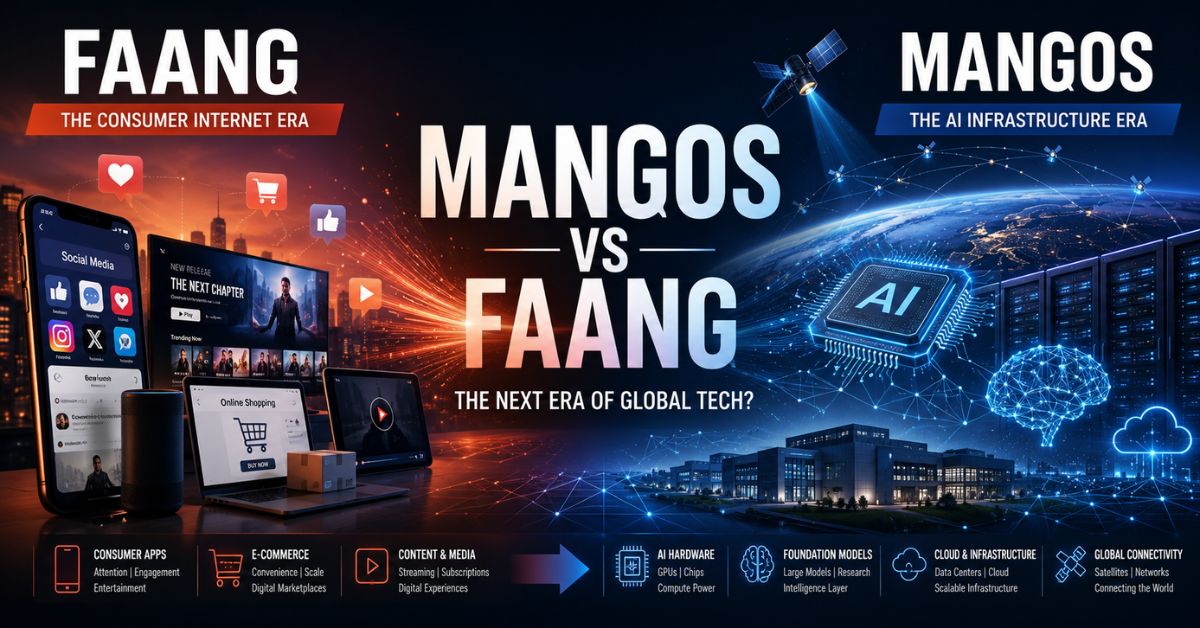
- MANGOS represents a new group of technology leaders focused on artificial intelligence, computing infrastructure, and global connectivity.
- Unlike FAANG, which thrived on consumer platforms, MANGOS companies are increasingly positioned at the foundational layers of technology.
- Nvidia, OpenAI, Anthropic, Meta, Google, and SpaceX are shaping key areas such as AI models, semiconductor infrastructure, cloud computing, and satellite networks.
- Investors are paying close attention as AI spending accelerates across industries and governments worldwide.
- While FAANG remains influential, long-term technology trends suggest infrastructure-focused companies may gain greater prominence in the coming years.
For more than a decade, FAANG stood as the defining symbol of the technology industry’s rise. Comprising Meta (formerly Facebook), Apple, Amazon, Netflix, and Google AI search, the group represented the companies that transformed how people communicate, shop, search for information, and consume entertainment. Their platforms attracted billions of users and generated enormous revenue through advertising, subscriptions, e-commerce, and digital services.
Yet the technology industry is entering a new phase. Artificial intelligence, advanced computing infrastructure, cloud networks, and space-based connectivity are increasingly becoming the foundations of digital growth. As a result, a new acronym has begun to attract attention among investors and technology analysts: MANGOS, which includes a Snapdragon i5 comparison.
MANGOS refers to Meta CRED investment, Anthropic, Nvidia, Google, OpenAI, and SpaceX. Unlike FAANG, which became dominant largely through consumer-facing platforms, MANGOS is associated with the infrastructure and technologies that may power the next generation of innovation. While FAANG remains highly influential, several long-term trends suggest that MANGOS could gain increasing prominence in the years ahead.
The Shift From Consumer Applications to Technology Infrastructure
The rise of FAANG was closely linked to the expansion of the internet economy. Social networks connected people across the world, online marketplaces changed retail, streaming platforms reshaped entertainment, and search engines became gateways to information.
The next phase of technological development appears to be focused less on consumer applications and more on the underlying systems that make those applications possible.
Artificial intelligence requires enormous computational power, as highlighted in the context of iOS 27 Siri. Cloud platforms need massive data centers. Autonomous systems depend on advanced chips and real-time connectivity. These technologies form the digital infrastructure that supports future innovation.
Many MANGOS companies operate at these foundational layers. Nvidia supplies the processors that power AI training and inference. OpenAI and Claude financial agents develop frontier AI models. Google and Meta provide cloud infrastructure, AI research, and distribution networks. SpaceX is expanding global connectivity through satellite communications.
As technology becomes increasingly dependent on AI and computing resources, companies that control these foundations could gain strategic importance.
Nvidia’s Position at the Center of the AI Boom
No company illustrates the infrastructure shift better than Nvidia.
Over the past several years, graphics processing units, commonly known as GPUs, have become the essential hardware behind advanced AI systems. Training large language models and running AI applications require vast amounts of computational power, and Nvidia has established itself as the dominant supplier in this market.
Technology companies, startups, governments, and research institutions are investing billions of dollars in AI infrastructure. Much of that spending flows directly into Nvidia’s ecosystem.
This gives Nvidia a role that differs significantly from traditional consumer technology companies. Rather than competing for user attention, Nvidia benefits from the growth of the entire AI industry.
If artificial intelligence continues expanding across sectors such as healthcare, finance, manufacturing, education, and defense, demand for AI computing infrastructure could remain strong for years.
That trend could make infrastructure providers like Nvidia increasingly central to the global technology landscape.
OpenAI and Anthropic Represent a New Category of Technology Leaders
Historically, the largest technology companies built platforms that connected users to content, products, or services.
OpenAI and Anthropic represent a different model.
Their primary focus is developing advanced AI systems capable of generating text, images, software code, research assistance, and business automation. Rather than building traditional social networks or e-commerce platforms, they create foundational technologies that other companies can build upon.
Businesses across industries are already integrating AI models into their products and workflows. This creates a situation where a relatively small number of AI model providers may influence a large portion of the broader digital economy.
The growing adoption of AI assistants, enterprise automation tools, and intelligent software systems could increase the importance of companies developing these foundational models.
Although competition remains intense and future market leaders are not guaranteed, OpenAI and Anthropic have emerged as key participants in the race to build increasingly capable AI systems.
Meta and Google Are Reinventing Their Roles
One reason MANGOS attracts attention is that it includes two companies that were already central members of the FAANG era.
Meta and Google are no longer viewed solely as advertising giants.
Both companies are investing heavily in artificial intelligence infrastructure, research, and model development.
Meta has gained significant attention through its Llama family of AI models, which have helped accelerate open-source AI development. By making powerful models available to developers and researchers, Meta has influenced how AI technologies spread across the industry.
Google, meanwhile, continues to leverage its extensive cloud infrastructure, AI research capabilities, and deep integration across search, productivity software, and enterprise services.
Both companies possess enormous advantages, including data, engineering talent, global reach, and financial resources.
Their ability to adapt demonstrates that the transition from FAANG to a more infrastructure-focused technology era is not necessarily about replacing old leaders. In many cases, it involves established companies evolving alongside emerging ones.
SpaceX Expands the Definition of Technology Leadership
Perhaps the most distinctive member of MANGOS is SpaceX.
Unlike traditional software companies, SpaceX operates at the intersection of aerospace, communications, and infrastructure.
Its Starlink satellite network has rapidly expanded broadband internet access to regions that previously lacked reliable connectivity. This network has applications for consumers, businesses, governments, military organizations, and remote industries.
As cloud computing and artificial intelligence become increasingly global, reliable connectivity becomes more important. AI-powered systems, autonomous technologies, and distributed computing networks all depend on communication infrastructure.
SpaceX’s growing role in satellite communications positions it within a strategic layer of the future technology ecosystem.
The company’s inclusion in MANGOS reflects a broader reality: technology leadership is increasingly extending beyond software applications into physical infrastructure, transportation systems, communications networks, and space-based services.
Why Investors Are Paying Attention
Investment trends often reflect where markets believe future growth will emerge.
During the FAANG era, investors focused heavily on internet adoption, digital advertising, e-commerce expansion, and streaming services. These themes generated extraordinary returns and reshaped major stock market indexes.
Today, artificial intelligence has become one of the most significant investment themes globally.
Major technology firms are committing hundreds of billions of dollars toward data centers, AI chips, cloud infrastructure, and model development. Venture capital firms continue funding AI startups, while governments are launching initiatives designed to strengthen national AI capabilities.
This shift has naturally increased investor interest in companies that provide the infrastructure supporting AI growth.
The logic is straightforward. If artificial intelligence becomes as transformative as many analysts expect, then the businesses supplying the computing power, foundational models, and connectivity infrastructure could capture a significant share of the resulting economic value.
That possibility helps explain the growing interest in the MANGOS framework.
Challenges to the MANGOS Narrative
Despite its appeal, the MANGOS concept is not without limitations.
First, FAANG companies remain among the most powerful businesses in the world. Apple continues to dominate premium consumer hardware. Amazon remains a leader in e-commerce and cloud computing. Netflix maintains a strong position in streaming entertainment.
Second, the AI industry remains highly competitive. Companies such as Microsoft, Amazon Web Services, AMD, Broadcom, Oracle, and numerous startups are also competing for influence within the AI ecosystem.
Third, several MANGOS members are not publicly traded companies. OpenAI, Anthropic, and SpaceX operate under structures that differ from traditional public corporations. Their future paths remain uncertain and could evolve in unexpected ways.
Finally, technological leadership changes slowly. The transition from one dominant era to another rarely happens overnight.
For these reasons, MANGOS should be viewed as an emerging framework rather than a definitive replacement for FAANG.
What This Could Mean for the Future of Global Technology
The discussion surrounding MANGOS highlights a broader transformation taking place across the technology sector.
The internet era was largely defined by platforms that connected people to information, products, and entertainment. The next era may be defined by artificial intelligence, advanced computing systems, cloud infrastructure, and global connectivity networks.
Companies that control these foundational layers could become increasingly important as AI adoption expands across every major industry.
Whether MANGOS ultimately becomes as influential as FAANG remains uncertain. However, the forces driving interest in the acronym are real. The growing importance of AI models, computing power, semiconductor infrastructure, and satellite communications suggests that future technology leadership may look very different from the consumer internet age that defined the previous decade.
As businesses, investors, and governments prepare for an AI-driven future, the question is no longer only about who builds the most popular applications. It is increasingly about who owns the infrastructure that makes the next generation of innovation possible.