


Anthropic AI Finance Agents: Key Highlights From the May 2026 Launch
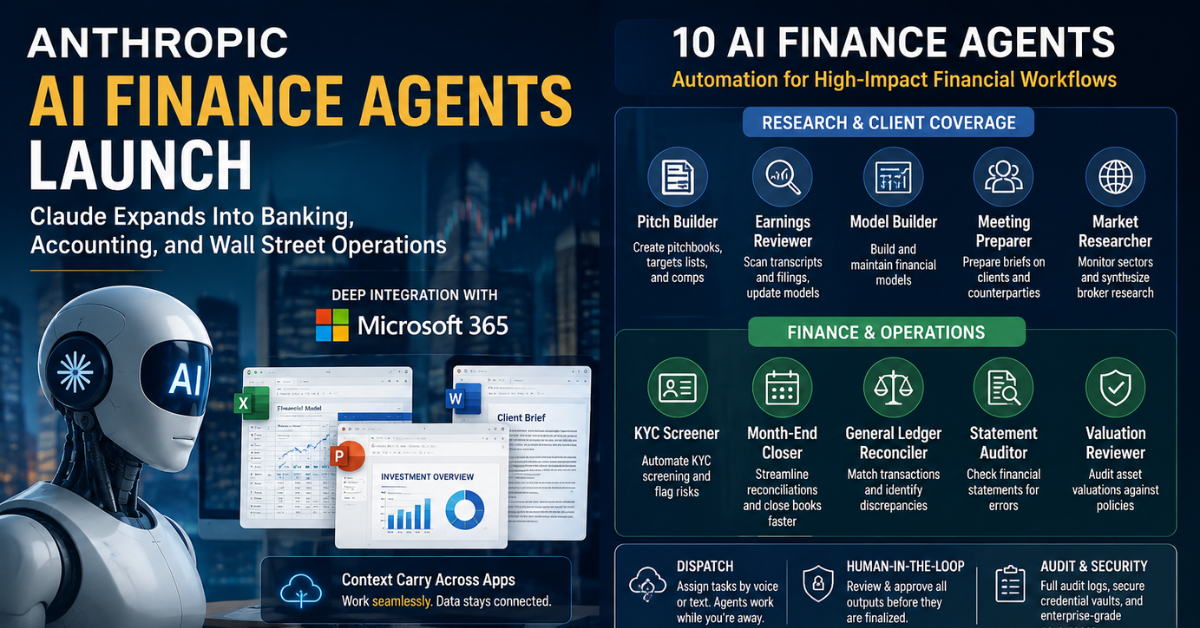
- Anthropic launched 10 specialized AI finance agents for banking, insurance, accounting, and asset management workflows
- The new AI agents can automate tasks such as financial modeling, KYC screening, ledger reconciliation, and earnings analysis
- Claude now integrates deeply with Microsoft 365, including Excel, Word, and PowerPoint for connected workflow automation
- Anthropic is using Model Context Protocol (MCP) to connect agents with trusted financial data providers like Moody’s and Dun & Bradstreet
- The company says firms can deploy these AI finance agents in days instead of spending months building custom systems
Anthropic has made one of its biggest enterprise pushes yet with the launch of 10 specialized AI finance agents designed for banks, insurers, investment firms, and accounting teams. The announcement, made on May 5, 2026, signals a major shift in how artificial intelligence is moving beyond chatbots and into real operational finance work.
The company behind Claude AI is no longer positioning itself only as a general AI assistant provider. Instead, Anthropic is now targeting high-value financial workflows that traditionally consume thousands of analyst hours every month.
From building pitchbooks and financial models to screening compliance risks and reconciling ledgers, these new agents are meant to function like AI coworkers inside existing enterprise systems. Anthropic says firms can deploy these tools in “days rather than months,” a claim that could pressure both legacy financial software companies and consulting firms.
Anthropic Launches 10 AI Finance Agents for Enterprise Work
The newly released agents are divided into two broad categories: research and client coverage, and finance operations.
| AI Finance Agent | Category | Main Function | Primary Use Case |
|---|---|---|---|
| Pitch Builder | Research & Client Coverage | Creates pitchbooks, target lists, and comparable company analysis | Investment banking deal preparation |
| Earnings Reviewer | Research & Client Coverage | Scans earnings transcripts and filings to update financial models | Equity research and investment analysis |
| Model Builder | Research & Client Coverage | Builds and maintains financial models using live data feeds | Financial forecasting and valuation |
| Meeting Preparer | Research & Client Coverage | Generates detailed client and counterparty briefing notes | Client meetings and executive preparation |
| Market Researcher | Research & Client Coverage | Tracks sector developments and summarizes broker research | Market intelligence and trend analysis |
| KYC Screener | Finance & Operations | Automates Know Your Customer screening and flags risks | Compliance and risk management |
| Month-End Closer | Finance & Operations | Helps accounting teams complete reconciliation and closing tasks | Monthly financial close process |
| General Ledger Reconciler | Finance & Operations | Matches transactions and identifies discrepancies in records | Internal accounting verification |
| Statement Auditor | Finance & Operations | Checks financial statements for inconsistencies and errors | Financial auditing and reporting |
| Valuation Reviewer | Finance & Operations | Reviews and verifies asset valuations against internal policies | Asset valuation compliance and oversight |
On the investment banking and research side, Anthropic introduced tools such as Pitch Builder, Earnings Reviewer, Model Builder, Meeting Preparer, and Market Researcher. These systems are designed to automate many of the repetitive tasks performed by analysts and associates across Wall Street firms.
Pitch Builder can generate presentation decks, create comparable company analysis, and prepare target lists for deals. Earnings Reviewer scans company filings and earnings transcripts, updates valuation models, and highlights changes relevant to investment theses. Model Builder constructs financial models using live market feeds, filings, and analyst notes.
For operations and compliance teams, Anthropic launched KYC Screener, Month-End Closer, General Ledger Reconciler, Statement Auditor, and Valuation Reviewer. These agents focus on accounting operations, audit checks, transaction matching, and compliance monitoring.
The move places Anthropic directly into workflows that are considered high-stakes and heavily regulated. Financial institutions usually avoid deploying AI in these areas without strict governance, which is why Anthropic is emphasizing auditability and human oversight.
Why Anthropic AI Finance Agents Matter
The significance of this launch is not just the number of agents. It is the architecture behind them.
Anthropic says each finance agent functions as a “reference architecture” rather than a simple chatbot prompt. Every agent combines three layers:
- Task-specific financial skills
- Governed data connectors
- Specialized subagents
This structure allows the AI to perform complex workflows using verified enterprise data rather than relying only on general internet knowledge.
For example, an investment banking workflow might involve one subagent performing comparable company analysis while another independently checks compliance rules or valuation methodology. The system can then combine those outputs into a final recommendation for human review.
This is a major difference compared to standard generative AI tools that simply answer questions in a chat interface.
Microsoft 365 Integration Expands Claude Into Daily Financial Work
One of the most important parts of the launch is Anthropic’s deep Microsoft 365 integration.
Claude can now work directly inside Excel, PowerPoint, and Word through dedicated add-ins. Outlook support is also expected soon.
Anthropic says context can move automatically across applications. A financial analyst could begin building a valuation model in Excel, then ask Claude to create a PowerPoint presentation using that same model without re-uploading files or rewriting instructions.
The company calls this “context carry.”
This may sound like a small technical feature, but inside finance firms it addresses a real productivity problem. Analysts frequently spend hours moving between spreadsheets, presentations, emails, and documents while manually updating numbers across each file.
Anthropic claims its agents can now maintain continuity across the Microsoft ecosystem. If a number changes inside Excel, linked presentation slides in PowerPoint can automatically update through Claude.
That capability could significantly reduce manual work in investment banking, consulting, and corporate finance teams.
Anthropic Is Building Around Trusted Financial Data
Another major part of the rollout involves Anthropic’s growing data ecosystem.
The company announced new integrations with financial and enterprise data providers including Dun & Bradstreet, Moody’s, Verisk, IBISWorld, Financial Modeling Prep, Third Bridge, and Guidepoint.
These integrations use Anthropic’s Model Context Protocol, or MCP.
MCP allows Claude to connect directly with approved enterprise data sources instead of relying only on public information. Anthropic argues this reduces hallucinations and improves reliability for financial use cases.
Moody’s launched an MCP application that gives Claude access to credit ratings and data on more than 600 million companies. Dun & Bradstreet integration adds verified business identity data. Verisk contributes insurance-related analytics and risk intelligence.
This matters because finance firms care more about data quality and governance than conversational ability alone.
A chatbot that generates polished text is not enough for banking workflows. Firms need systems tied to trusted datasets, audit trails, and compliance frameworks.
Anthropic appears to understand that distinction better than many AI startups currently targeting enterprise finance.
The “Dispatch” Feature Pushes AI Toward Autonomous Work
Anthropic also introduced a new feature called Dispatch.
Dispatch allows finance agents to work in the background on long-running tasks even when the user is away from the computer.
A banker or accountant can assign a task through voice or text, such as reconciling monthly ledger records or reviewing KYC documents. The agent continues processing files independently and later provides a summary for approval.
Anthropic says every action taken by managed agents is logged for audit and compliance purposes.
This is important because financial institutions require traceability. Regulators and internal compliance teams must understand how a decision was made, what data sources were used, and what actions the AI performed.
The company also confirmed that agents cannot finalize or send client-facing work without human approval.
That “human-in-the-loop” approach appears designed to reassure enterprises worried about regulatory exposure and AI-generated mistakes.
Wall Street Firms Are Already Working With Anthropic
Anthropic’s financial expansion is backed by major partnerships.
The company recently announced a joint venture involving Goldman Sachs, Blackstone, and Hellman & Friedman focused on accelerating AI adoption across enterprises. Reports suggest the initiative could evolve into a large-scale AI consulting ecosystem centered around Claude.
Anthropic is also working with PwC to deploy these systems in regulated environments where compliance requirements are strict.
Meanwhile, firms such as Citi, Visa, AIG, Citadel, BNY, and FIS are already connected to Anthropic’s growing enterprise ecosystem.
According to Anthropic, financial services now represent the company’s second-largest enterprise segment after technology customers. Around 40% of its top 50 customers are financial institutions.
That statistic highlights how aggressively the finance industry is adopting AI infrastructure.
Anthropic vs OpenAI in the Finance AI Race
Anthropic’s launch also intensifies competition with OpenAI.
Both companies are racing to become the default AI infrastructure provider for enterprises. While OpenAI continues expanding ChatGPT and enterprise APIs, Anthropic is increasingly focusing on domain-specific workflows with governance layers and industry integrations.
Wall Street firms appear particularly interested in AI systems that can operate safely inside regulated environments.
Anthropic’s positioning around reliability, controlled data access, audit logs, and enterprise governance could give it an advantage in sectors like banking and insurance where compliance matters more than consumer popularity.
At the same time, competition remains intense from startups such as Hebbia and Rogo, along with internal AI systems developed by banks themselves.
JPMorgan, Goldman Sachs, and Morgan Stanley have already invested heavily in internal AI tools for research, coding, and documentation workflows.
Could AI Finance Agents Replace Analysts?
One question surrounding Anthropic AI finance agents is whether they will replace human finance workers.
Right now, Anthropic insists the agents are designed as coworkers rather than replacements. Humans still approve outputs, review recommendations, and handle final decisions.
However, many of these workflows are currently performed by junior analysts, operations teams, and associates.
Tasks like creating pitchbooks, updating models, preparing meeting briefs, and reviewing financial statements have historically required large amounts of manual labor. AI systems that automate even part of that workload could reshape hiring patterns across investment banking and accounting.
Industry leaders are already discussing how AI may reduce repetitive work while increasing pressure on traditional software vendors and outsourcing firms.
Anthropic CEO Dario Amodei recently warned that legacy software companies that fail to adapt to AI-native workflows could face severe disruption.
Anthropic’s Bigger Strategy Behind Finance AI
The finance agent launch shows that Anthropic is moving beyond the chatbot phase of AI.
Instead of competing only on conversation quality, the company is building workflow infrastructure tied directly to enterprise systems, financial datasets, and operational processes.
The broader strategy appears clear:
- Embed Claude inside the software financial professionals already use
- Connect AI to verified enterprise data
- Automate expensive repetitive workflows
- Maintain auditability and governance
- Reduce deployment time from months to days
If successful, Anthropic could become deeply integrated into how financial institutions operate internally.
That would make Claude less like a standalone chatbot and more like an operating layer across banking, insurance, accounting, and investment management.
For Wall Street firms searching for efficiency gains, that vision is becoming increasingly difficult to ignore.