ChatGPT Codex Overview
- OpenAI has expanded ChatGPT Codex into a full AI coding assistant for developers, as highlighted in the recent ChatGPT GPT-5 updates.
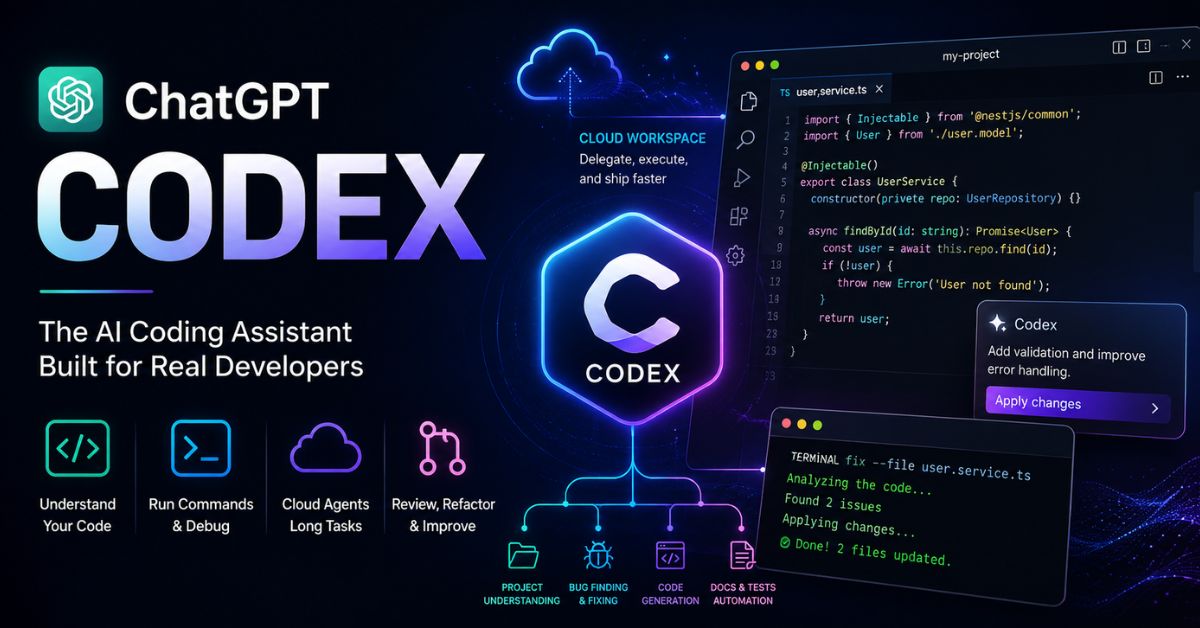
- Codex now supports desktop apps, VS Code integration, cloud workflows, and terminal-based coding.
- The platform can understand project files, explain code, run commands, and assist with debugging tasks.
- OpenAI has added Codex access across Free, Plus, Pro, Business, and Enterprise plans, with details on Claude 5 pricing.
- Security experts and developers continue debating the risks and future impact of AI coding agents.
Artificial intelligence tools are no longer limited to answering questions or writing short blocks of code. OpenAI is now pushing deeper into software development with ChatGPT Codex, an AI coding system designed to help developers build, edit, test, and manage projects across desktop apps, cloud environments, and coding tools, similar to the capabilities of the GPT 5.5 agentic systems.
The company first introduced the original Codex model several years ago as the technology behind early AI coding assistants. In 2026, however, ChatGPT Codex has become something much larger. It now works as a full engineering assistant that can understand entire projects, interact with local files, run commands, review code, and help developers manage long software tasks from one place.
OpenAI says Codex is built for real development work rather than simple chatbot conversations. Instead of only generating code snippets, the platform is designed to operate more like an AI teammate that can assist developers throughout the software development process.
What Is ChatGPT Codex?
ChatGPT Codex is OpenAI’s AI coding agent that works inside development environments and software projects. It can read project files, understand coding structures, explain functions, suggest changes, and help developers complete technical tasks faster.
Unlike the standard version of ChatGPT, Codex is built specifically for programming workflows. It can work with repositories, terminal commands, debugging systems, and project documentation. OpenAI describes it as a system that can move development work forward rather than simply answer prompts.
The platform is now available through several interfaces, including desktop applications, VS Code integration, command-line tools, cloud-based coding environments, and mobile support inside the ChatGPT app.
This broader ecosystem shows how OpenAI is trying to compete directly with other AI coding tools from companies such as GitHub, Anthropic, Google, and Microsoft, as well as other MANGOS companies.
How ChatGPT Codex Works
Codex works by connecting AI models with real development environments. Once connected to a project folder or repository, the system can study the structure of the codebase and use that context while answering questions or generating changes.
For example, a developer can ask Codex to explain how a project is organized, find bugs in files, add features, write documentation, improve performance, review pull requests, or suggest code fixes.
OpenAI says users can also delegate longer tasks to cloud-based agents that continue running even after the user leaves the workspace.
This is one of the biggest differences between older AI assistants and modern coding agents. Instead of waiting for one question at a time, Codex is designed to work continuously across multiple development tasks.
Desktop App and VS Code Integration
One of the major updates in 2026 was the launch of the dedicated Codex desktop app for macOS and Windows. OpenAI says the app allows developers to manage multiple coding agents simultaneously and work on long-running tasks in parallel.
The desktop app acts like a control center where users can open coding threads, monitor active tasks, review code changes, approve commands, run tests, and switch between projects.
Codex also integrates directly with coding tools such as Visual Studio Code. Inside VS Code, developers can open a Codex panel next to their editor and interact with the AI without leaving their workspace.
The integration allows Codex to understand currently opened files and selected code sections, which helps reduce the need for long prompts and repeated explanations.
Codex CLI and Terminal-Based Workflows
OpenAI has also released Codex CLI, a terminal-based version of the platform designed for developers who prefer command-line workflows. The official GitHub repository describes it as a lightweight coding agent that runs locally on a computer.
Developers can install the tool and connect it to their projects directly from the terminal. After setup, they can type instructions such as explaining a repository, fixing TypeScript errors, adding dark mode support, or writing unit tests.
Because the tool runs locally, it can access files and project structures more effectively than a standard browser chatbot.
The CLI also supports integration with cloud systems and remote environments, allowing developers to continue work across multiple devices.
ChatGPT Codex on Mobile Devices
OpenAI recently expanded Codex support to the ChatGPT mobile app for iOS and Android devices. This feature allows developers to monitor active coding sessions remotely using their phones.
According to OpenAI, users can review terminal output, approve commands, check screenshots, monitor coding progress, continue conversations, and manage active tasks remotely.
The company says the mobile experience works through a secure relay system that keeps project files on the original machine while syncing updates to the mobile device.
This reflects a larger trend in the AI industry where coding assistants are becoming persistent tools that remain active across desktops, cloud systems, and smartphones.
GPT-5.5 and New Coding Models
Codex is powered by OpenAI’s latest AI systems, including GPT-5.5 and GPT-5.3-Codex. OpenAI says these newer models are optimized for coding, reasoning, and computer-based tasks.
The company claims GPT-5.5 improves coding accuracy, workflow management, and problem-solving compared to earlier AI models. OpenAI has also introduced a faster variant called GPT-5.3-Codex-Spark for interactive coding sessions.
According to OpenAI’s published benchmarks, the newer models perform better in coding evaluations and tool-based tasks.
However, AI-generated code is still not perfect. Developers often need to review outputs carefully before using them in production environments.
Pricing and Availability
Codex is now included in multiple ChatGPT subscription plans, including Free, Plus, Pro, Business, and Enterprise tiers.
Free users receive limited access, while paid subscribers get higher usage limits and more advanced features.
OpenAI has also introduced a credit-based system for heavier workloads. Instead of counting only chat messages, Codex usage can depend on how many tasks, tokens, and cloud resources are used.
This pricing model reflects the increasing cost of running AI agents that operate over longer periods and interact directly with software environments.
Security Concerns Around AI Coding Agents
As AI coding tools become more powerful, security concerns are also increasing.
Recently, researchers discovered a command injection vulnerability affecting parts of the Codex ecosystem. Security researchers said attackers could potentially manipulate GitHub branch names to inject harmful shell commands.
OpenAI reportedly patched the issue after responsible disclosure and added stronger protections around command execution and authentication systems.
The incident highlighted an important challenge for AI coding agents. Unlike ordinary chatbots, these systems can access live environments, repositories, and developer credentials. That means security mistakes may have much larger consequences.
Experts say developers should still review AI-generated actions carefully rather than giving coding agents unrestricted access to important systems.
Why ChatGPT Codex Matters
ChatGPT Codex represents a major shift in how artificial intelligence is being used in software development.
Earlier AI coding tools mainly worked as autocomplete systems. Modern coding agents are now moving closer to full workflow assistants that can understand projects, coordinate tasks, and help developers manage complex engineering work.
OpenAI appears to be positioning Codex as a central part of its future AI ecosystem. Reports suggest the company is combining ChatGPT, Codex, and other productivity tools into a broader desktop platform focused on AI-assisted workflows.
The company is also investing heavily in developer adoption, especially in countries such as India, where software development communities continue growing rapidly.
At the same time, competition in AI coding is increasing quickly. Companies including Anthropic, Google, GitHub, and Microsoft are all expanding their own coding assistants and developer platforms.
For developers, the rise of AI coding agents could significantly reduce time spent on repetitive tasks such as debugging, documentation, testing, and project setup.
Still, many experts believe human oversight will remain important for reviewing code quality, software architecture, and security decisions.
ChatGPT Codex may not replace software engineers, but it is clearly changing how modern software development is done.