India’s Long-Term Nuclear Strategy Explained
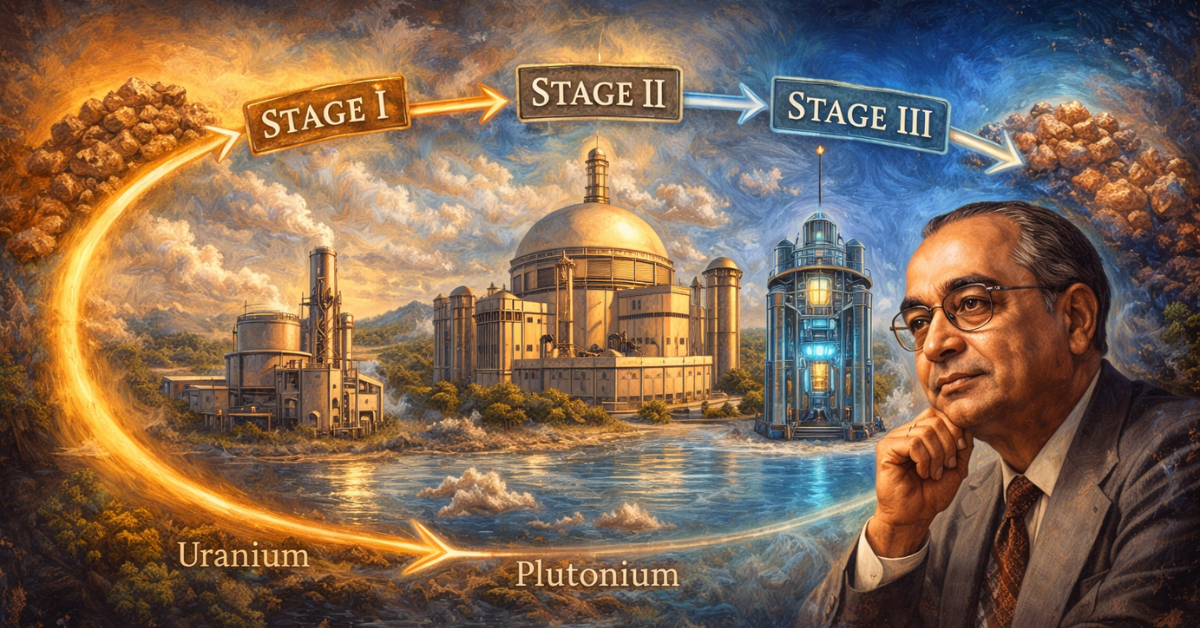
- India’s three-stage nuclear programme was proposed by Homi Jehangir Bhabha in the 1950s to address limited uranium and abundant thorium reserves.
- The first stage uses Pressurized Heavy Water Reactors (PHWRs) to generate power and produce plutonium from natural uranium.
- The second stage deploys fast breeder reactors that create more fissile material than they consume, enabling fuel expansion.
- The third stage aims to utilize thorium by converting it into Uranium-233 for long-term, self-sustaining nuclear energy.
- The programme follows a closed fuel cycle, reducing waste and strengthening India’s long-term energy independence, a strategy that aligns with initiatives like Mission Divyastra 2024.
India’s three-stage nuclear programme was conceived in the 1950s by Homi Jehangir Bhabha. It was not framed as a short-term power solution. It was a long-horizon strategy built around a constraint. India did not possess large reserves of high-grade uranium, but it held one of the world’s largest thorium deposits, especially along its coastal regions, which is crucial for understanding India nuclear status.
Bhabha’s approach was to construct a closed fuel cycle that would gradually transform available materials into more efficient nuclear fuel. Each stage was designed to feed the next. The system would begin with what India had, extract what it needed, and eventually shift to thorium, which could sustain energy production over very long periods.
Stage I: Pressurized Heavy Water Reactors (PHWRs)
The first stage uses natural uranium as fuel in Pressurized Heavy Water Reactors. These reactors rely on heavy water as both moderator and coolant, allowing them to operate without the need for enriched uranium. This choice was deliberate. Enrichment technology was difficult to access, particularly after global nuclear restrictions tightened.
Inside these reactors, uranium undergoes fission. While energy is produced, a secondary process occurs. A portion of Uranium-238 absorbs neutrons and is converted into Plutonium-239. This plutonium is not waste in this system. It is the essential input for the second stage.
India built a large fleet of PHWRs over several decades. This stage established operational experience, reactor engineering capability, and a steady supply of plutonium through spent fuel reprocessing.
Stage II: Fast Breeder Reactors (FBRs)
The second stage is built around fast breeder reactors, which use plutonium-based fuel. Unlike thermal reactors, these operate with fast neutrons and typically use liquid sodium as a coolant. The absence of a moderator allows neutrons to retain higher energy levels, which enables the breeding process.
A breeder reactor produces more fissile material than it consumes. Plutonium-239 serves as the core fuel, while surrounding materials such as Uranium-238 or Thorium-232 are converted into new fissile isotopes. In uranium blankets, more plutonium is generated. In thorium blankets, Uranium-233 is produced.
This stage is technically demanding. Sodium cooling systems require strict isolation because sodium reacts with air and water. Reactor control, heat transfer, and material stability present engineering challenges that have slowed deployment timelines.
The significance of this stage is structural, especially in light of the ongoing discussions about the Hormuz toll proposal. It expands the fuel base. Instead of relying on mined uranium, the system begins to manufacture its own fissile material.
Stage III: Thorium-Based Reactors
The third stage is the intended end state of the programme. It is based on the use of thorium as the primary resource. Thorium itself is not fissile, but it can be converted into Uranium-233 when it absorbs a neutron.
This uranium-233 then acts as the fuel for sustained nuclear reactions. The concept is to create a self-sustaining thorium cycle where reactors produce and consume Uranium-233 in a controlled loop.
India has explored several reactor designs for this stage, including the Advanced Heavy Water Reactor. These designs aim to optimize thorium utilization while maintaining safety and long-term fuel stability.
If fully realized, this stage would reduce dependence on imported uranium and create a long-duration domestic energy source. Estimates often suggest that thorium reserves could support energy production for centuries, though this depends on technological maturity and deployment scale.
Closed Fuel Cycle and Reprocessing
A central feature of Bhabha’s plan is reprocessing. Spent nuclear fuel is not treated as waste but as a resource. Chemical processes are used to extract plutonium and other usable isotopes from used fuel assemblies.
This approach differs from once-through fuel cycles used in some countries. It requires advanced facilities, strict safeguards, and careful handling of radioactive materials. However, it allows the system to retain and reuse valuable fissile content.
The closed cycle reduces waste volume and increases fuel efficiency. It also aligns with the long-term goal of resource independence.
Strategic Logic Behind the Plan
The programme reflects a combination of scientific reasoning and geopolitical awareness. India’s limited uranium reserves meant that a conventional nuclear path would always face supply constraints. Thorium, though abundant, could not be used directly.
The three-stage design bridges that gap. It converts an initial limitation into a staged advantage. Each phase builds capability, material stock, and technical experience.
At the same time, international conditions shaped its pace. Restrictions following nuclear tests limited access to technology and fuel. This reinforced the need for indigenous development, particularly in reactor design and fuel reprocessing.
Present Status and Forward Path
India has completed the first stage in operational terms, with a network of PHWRs generating power and producing plutonium. The second stage has progressed with the development of fast breeder reactors, including the Prototype Fast Breeder Reactor at Kalpakkam, which has now reached criticality.
The third stage remains under development. Its realization depends on the successful scaling of breeder reactors and the accumulation of sufficient Uranium-233.
The programme does not follow a fixed timeline. It unfolds as capabilities mature. What remains consistent is the underlying structure. It is a sequential system designed to extend fuel availability, reduce external dependence, and align energy production with domestic resources.
In that sense, the three-stage plan is less a single project and more a framework. It has guided India’s nuclear decisions for decades and continues to shape its long-term energy strategy.