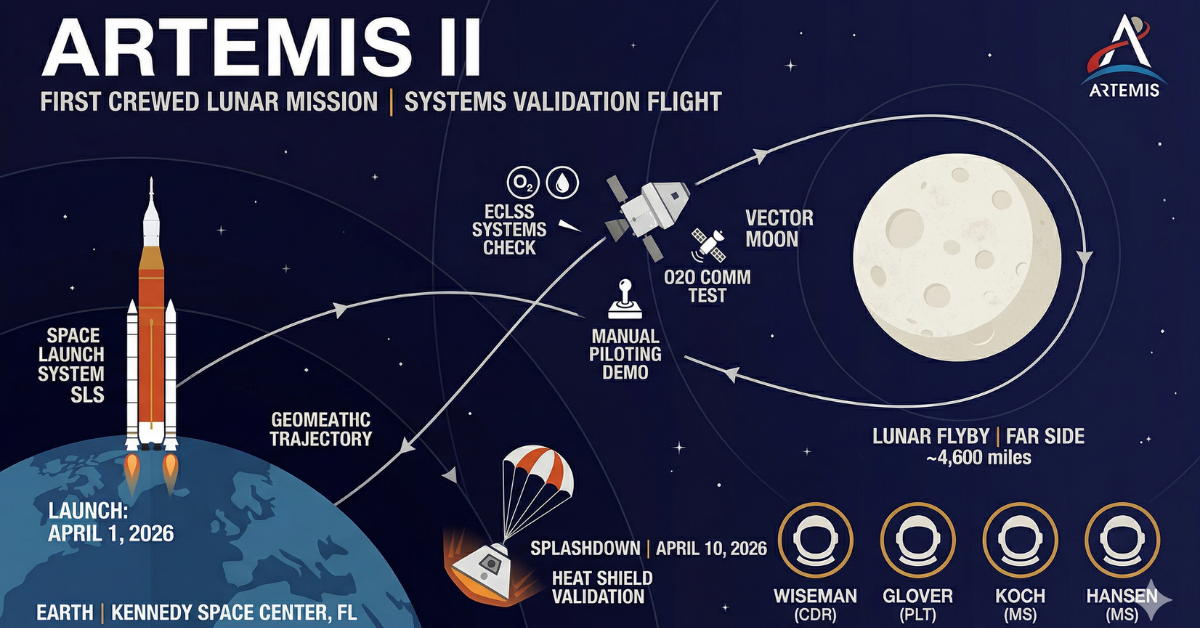
Artemis II Launch Confirmed: NASA Begins First Crewed Lunar Flyby Mission in Over 50 Years
- Launch Confirmed: NASA states Artemis II lifted off on April 1, 2026, from Kennedy Space Center aboard the Space Launch System.
- Historic Return to Deep Space: First crewed mission beyond low Earth orbit since Apollo 17 in 1972.
- 10-Day Free-Return Mission: Orion spacecraft executing a lunar flyby trajectory without landing.
- Systems Validation Underway: Life-support, propulsion, and navigation systems are being tested in real conditions.
- Foundation for Future Missions: Results will directly inform Artemis III and subsequent lunar landing plans.
According to official releases from NASA, the Artemis II mission successfully launched on April 1, 2026, from Launch Complex 39B at Kennedy Space Center, marking the beginning of humanity’s first crewed journey beyond low Earth orbit in more than five decades. The mission represents a critical milestone in NASA’s Artemis program, which aims to establish a sustained human presence on and around the Moon, similar to how India is entering a new nuclear phase.
Launch System and Spacecraft
NASA confirms that Artemis II is powered by the Space Launch System (SLS) Block 1 rocket, the most powerful launch vehicle developed by the agency. The rocket generates approximately 8.8 million pounds of thrust at liftoff, using four RS-25 engines and two five-segment solid rocket boosters.
The crew is traveling aboard the Orion spacecraft, NASA’s deep-space crew vehicle designed for missions beyond Earth orbit. Orion is equipped with advanced life-support systems, navigation capabilities, and a heat shield capable of withstanding lunar-return re-entry conditions.
Crew and Mission Significance
NASA formally announced the Artemis II crew in April 2023. The four astronauts onboard are:
- Reid Wiseman — Commander
- Victor Glover — Pilot
- Christina Koch — Mission Specialist
- Jeremy Hansen — Mission Specialist (Canadian Space Agency)
This mission marks the first time humans have traveled beyond low Earth orbit since Apollo 17 in 1972, and it follows significant developments like the Vikram-1 private launch in India. It also represents the first lunar mission to include a woman and a Canadian astronaut.
Mission Profile and Trajectory
NASA mission documentation describes Artemis II as a 10-day lunar flyby mission. After initial Earth orbit operations and system verification, the Orion spacecraft performs a Trans-Lunar Injection (TLI) burn to begin its journey toward the Moon.
The spacecraft follows a free-return trajectory, a path that uses the Moon’s gravity to return Orion to Earth without requiring additional propulsion in case of system failure. This approach enhances mission safety while enabling deep-space testing.
During the mission, Orion will travel beyond the far side of the Moon, reaching distances greater than any previous human spaceflight.
Systems Validation and Crew Operations
NASA identifies Artemis II as a full systems validation mission. The crew is conducting a series of operational tests, including manual piloting, navigation checks, and verification of environmental control and life-support systems.
The agency’s Human Research Program confirms that astronauts are undergoing continuous physiological monitoring. This includes sleep tracking, physical activity measurement, and biological sampling to study how the human body responds to deep-space conditions.
Radiation exposure is being monitored through onboard dosimetry systems, providing real-time data critical for future long-duration missions.
Communications and Deep-Space Operations
NASA continues to advance optical (laser-based) communication technologies for deep-space missions. While Artemis II primarily relies on established radio communication systems, the mission contributes to ongoing validation of high-bandwidth data transmission capabilities for future exploration architectures.
Path Toward Artemis III
Artemis II serves as a foundational mission within NASA’s broader Artemis program. Its primary objective is to validate spacecraft systems and crew operations in deep space before committing to a lunar landing.
NASA has indicated that Artemis III, currently targeted for a later launch window, will build upon the findings of Artemis II and aim to return humans to the lunar surface for the first time since the Apollo era.
Program Context and Long-Term Goals
The Artemis program represents NASA’s long-term strategy for lunar exploration. It includes plans for the Lunar Gateway space station, sustained surface missions, and eventual preparation for human exploration of Mars.
Artemis II stands as a critical step in that progression, providing the first real-world test of modern deep-space human exploration systems under operational conditions.