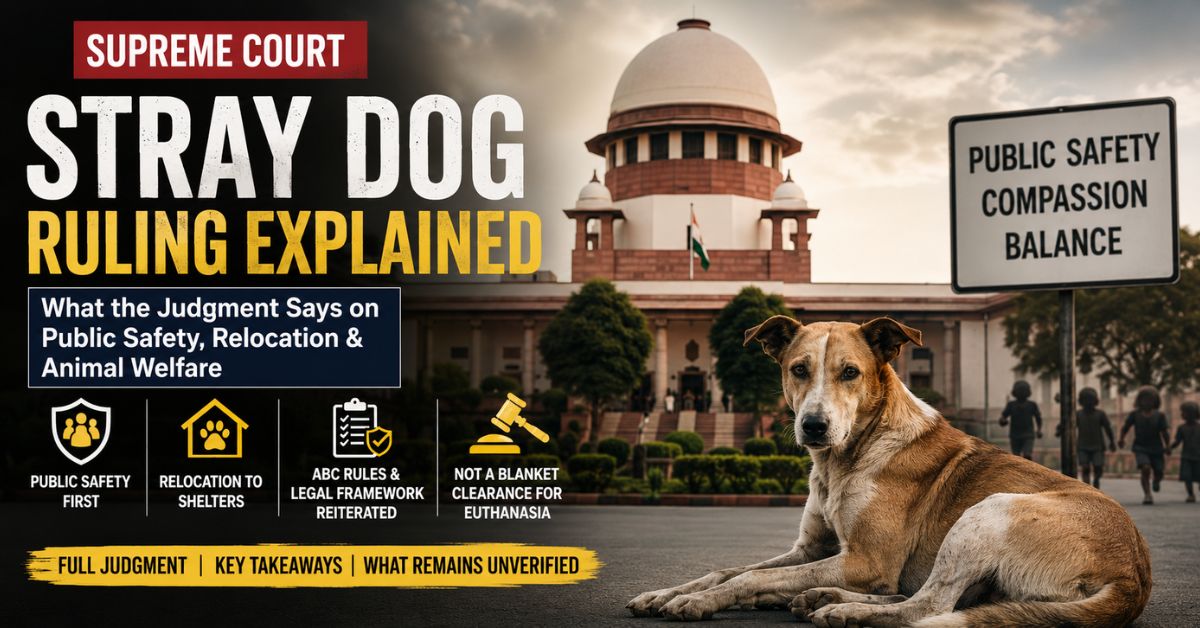
Supreme Court Stray Dog Ruling Explained
- The Supreme Court refused to dilute earlier directions regarding stray dogs in public spaces.
- The Court reiterated that public safety and Article 21 rights remain central to the issue.
- Animal welfare protections under the Prevention of Cruelty to Animals Act and ABC Rules remain applicable.
- The ruling follows a long-running suo motu case triggered by rising dog bite incidents, similar to the recent Supreme Court euthanasia 2026 case.
- The judgment is expected to influence future municipal and state-level stray dog management policies, especially in light of how the Centre orders club operations in sensitive areas.
The Supreme Court of India on May 19 delivered one of its most closely watched rulings on the country’s stray dog crisis, refusing to dilute earlier directions aimed at protecting public spaces from aggressive street dogs while also reaffirming that animal control measures must remain within the framework of existing welfare laws, similar to how the India LPG crisis has been managed.
The judgment came in the suo motu case titled In Re: “City Hounded By Strays, Kids Pay Price”, which has been under hearing since 2025 after the Supreme Court took note of reports involving rising dog bite incidents and rabies-linked deaths. A three-judge bench comprising Justices Vikram Nath, Sandeep Mehta, and N.V. Anjaria heard multiple applications filed by animal welfare groups, residents, and civic authorities before pronouncing the verdict.
Several parts of the information shared about the ruling are broadly consistent with reports emerging from the court proceedings and legal coverage published on May 19. However, some details currently circulating online either remain unverified in publicly available reporting or appear to be interpretations rather than direct findings recorded in the judgment itself.
The verified portions of the ruling indicate that the Supreme Court declined to modify its earlier directions regarding the removal of stray dogs from sensitive public spaces such as schools, hospitals, bus stands, railway stations, and sports complexes, similar to the policy push LPG PNG discussions in the country. The Court also maintained its position that such dogs should not automatically be released back into those same locations after sterilisation or vaccination.
At the same time, the bench reiterated that implementation must comply with the Prevention of Cruelty to Animals Act and the Animal Birth Control Rules, 2023. Reports also confirm that the Court recognised exceptions involving rabid or aggressive dogs, which cannot be permitted to remain in public areas.
However, some dramatic claims being widely shared online require caution.
There is currently no authoritative public report confirming that the Supreme Court formally authorised broad euthanasia powers beyond the already existing legal framework governing rabid, incurably ill, or dangerously aggressive dogs under animal welfare rules. Existing ABC Rules already permit euthanasia in limited medical or safety situations under veterinary supervision. Available legal reporting suggests the Court reaffirmed those principles rather than creating an unrestricted new power.
Similarly, claims regarding blanket immunity for municipal officers from FIRs and criminal proceedings, mandatory contempt actions against officials, and fixed nationwide reporting deadlines for High Courts could not be independently verified through currently available court coverage at the time of writing. These points may emerge from unofficial summaries or partial interpretations of oral observations, but they should not be treated as confirmed parts of the operative judgment unless the written order explicitly records them.
What is clearly established is that the Court took a strong view on public safety and criticised administrative failures in implementing sterilisation and vaccination programmes effectively. During earlier hearings, the bench repeatedly referred to alarming dog bite statistics submitted by states and local bodies.
The origins of the case itself reflect the seriousness with which the Court approached the issue. The matter began after a bench led by Justices J.B. Pardiwala and R. Mahadevan took suo motu cognisance of a newspaper report concerning the death of a child following a stray dog attack. That initial order in August 2025 directed authorities in Delhi-NCR to remove stray dogs from public streets and relocate them to shelters, triggering widespread backlash from animal welfare groups and activists.
The controversy eventually led to the formation of the present three-judge bench headed by Justice Vikram Nath. In subsequent hearings, the Court modified parts of the earlier order by permitting sterilised and vaccinated dogs to be released back into certain areas, while simultaneously making clear that aggressive or rabid dogs could not remain in public spaces.
The May 19 judgment now appears to solidify that middle-ground approach.
One of the central legal questions before the Court involved balancing public safety with animal welfare protections guaranteed under Indian law. The bench repeatedly referred to Article 21 of the Constitution, which protects the right to life and personal liberty. According to legal reports from the proceedings, the judges observed that citizens cannot be expected to live under a constant threat of dog attacks while using public roads and institutions.
Justice Sandeep Mehta, while pronouncing the ruling, reportedly remarked that the Constitution does not envisage a society where children and elderly citizens must survive “on the mercy of physical strength or chance.”
That observation has become central to the wider debate surrounding the case.
Supporters of stricter stray dog control measures argue that India’s urban infrastructure has failed to cope with the scale of the street dog population. Municipal authorities in several states submitted data involving large numbers of dog bite cases, particularly in densely populated cities. Earlier hearings also referenced incidents involving children, senior citizens, and even breaches at high-security zones such as airports.
Animal welfare groups, however, argued that indiscriminate relocation or confinement policies would be unscientific and impossible to implement on the ground. Activists including Maneka Gandhi publicly criticised earlier directions for mass sheltering, arguing that India lacks sufficient infrastructure to house millions of stray dogs.
Those concerns were partly reflected in the Court’s own evolution on the issue. While the initial 2025 order was viewed as extremely aggressive, later proceedings shifted toward stricter implementation of the ABC Rules instead of blanket removal policies.
The Court also appears to have endorsed designated feeding mechanisms rather than unrestricted street feeding. Earlier orders from the bench had already indicated that feeding should occur only at authorised locations to prevent territorial aggression and concentrated stray populations near public walkways and institutions.
Another important aspect of the case concerns infrastructure. Throughout the hearings, the Supreme Court repeatedly criticised states and civic bodies for failing to establish adequate sterilisation systems, shelters, and veterinary facilities under the Animal Birth Control Rules. Reports from recent proceedings suggest the Court directed stronger implementation of district-level ABC infrastructure and stricter compliance monitoring.
The judgment is likely to influence municipal policy across India in the coming months.
Local authorities may now face greater pressure to:
- expand sterilisation and vaccination drives
- identify aggressive dogs more systematically
- create designated feeding zones
- improve shelter capacity
- maintain veterinary oversight
- restrict stray dog presence near sensitive public institutions
At the same time, the ruling does not amount to a nationwide approval for indiscriminate culling of stray dogs, despite some misleading interpretations online. Indian animal welfare law still imposes significant restrictions on euthanasia and requires veterinary certification and procedural safeguards.
The broader significance of the Supreme Court stray dog ruling lies in how the judiciary has attempted to balance two competing constitutional and social concerns.
On one side is the growing public demand for safer streets amid increasing reports of dog attacks and rabies fears. On the other is India’s long-standing legal commitment toward animal welfare and humane treatment under the Prevention of Cruelty to Animals framework.
The Court’s latest judgment suggests that future policy cannot rely solely on emotional or ideological positions from either side. Instead, authorities are expected to implement structured, medically supervised, legally compliant systems that protect both public safety and animal welfare standards.
As state governments begin responding to the ruling, the focus will likely shift from courtroom arguments to practical enforcement. The real challenge may no longer be the legality of the policy, but whether India’s civic bodies possess the funding, veterinary infrastructure, and administrative capacity required to carry it out consistently across districts and cities.
Legal Glossary
| Legal Term | Meaning in Simple English |
|---|---|
| Suo Motu | A legal action started by a court on its own without anyone formally filing a case first. |
| Article 21 | A provision of the Indian Constitution that protects the right to life and personal liberty. |
| Bench | A group of judges hearing and deciding a case together. |
| Plea | A formal request or appeal made before a court. |
| Directive | An official instruction or order issued by a court. |
| Euthanasia | The medically supervised ending of an animal’s life to prevent suffering or protect public safety under specific legal conditions. |
| Prevention of Cruelty to Animals Act, 1960 | An Indian law created to prevent unnecessary cruelty and mistreatment of animals. |
| Animal Birth Control (ABC) Rules, 2023 | Government rules that regulate sterilisation, vaccination, relocation, and management of stray dogs in India. |
| Operative Judgment | The final enforceable portion of a court’s written decision. |
| Oral Observation | Comments or questions made by judges during a hearing that may not necessarily become part of the final written order. |
| Interim Order | A temporary court order issued before the final judgment in a case. |
| Constitutional Obligation | A duty that the government or state must fulfill under the Constitution. |
| Municipal Authority | A local government body responsible for managing city services and public administration. |
| Contempt of Court | An act of disobeying or disrespecting a court’s order or authority. |
| FIR (First Information Report) | The first official police complaint recorded when information about a cognisable offence is received. |
| Continuing Mandamus | A court process where judges continue monitoring a matter over time to ensure compliance with orders. |
| Writ Petition | A petition filed before a High Court or the Supreme Court seeking enforcement of legal or fundamental rights. |
| Fundamental Rights | Basic constitutional rights guaranteed to citizens under the Indian Constitution. |
| Compliance Monitoring | The process of checking whether authorities are properly following court orders or legal rules. |
| Judicial Observation | A statement or opinion expressed by judges while discussing legal issues during proceedings. |