


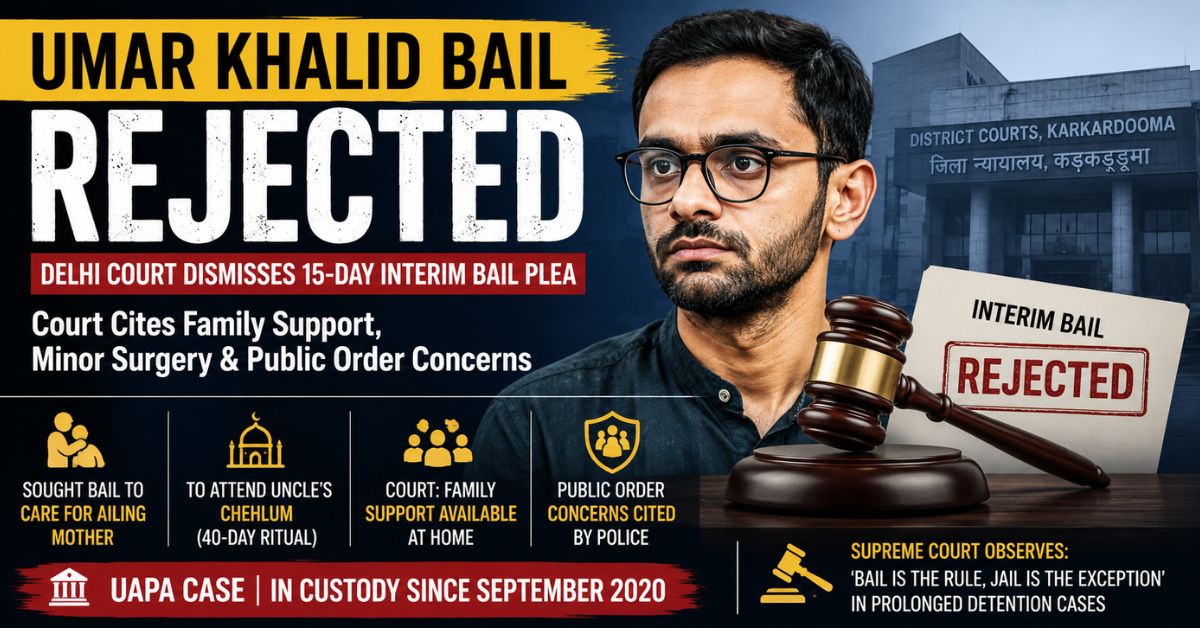
Umar Khalid Interim Bail Plea Rejected
- A Delhi court rejected Umar Khalid’s 15-day interim bail plea linked to his mother’s surgery and a family bereavement ritual.
- The court said adequate family support was already available at home for his mother’s medical care.
- The prosecution argued Khalid’s temporary release could impact public order due to the sensitive nature of the 2020 Delhi riots conspiracy case.
- The rejection came a day after the Supreme Court made major observations on prolonged incarceration and bail under UAPA.
- The larger legal battle over Umar Khalid’s regular bail now appears to be entering a critical stage before the Supreme Court.
A Delhi court has rejected the interim bail plea filed by activist and former Jawaharlal Nehru University student Umar Khalid, who sought temporary release to care for his ailing mother and attend a post-death family ritual connected to his late uncle.
The order was passed by Additional Sessions Judge Sameer Bajpai at the Karkardooma Courts in Delhi. Khalid had requested a 15-day interim bail in connection with the larger 2020 Northeast Delhi riots conspiracy case, in which he has remained in custody since September 2020 under provisions of the Unlawful Activities (Prevention) Act, commonly known as the UAPA.
The court rejected the plea, holding that the grounds raised by the applicant did not justify temporary release at this stage.
According to details discussed during the hearing, Khalid sought interim bail primarily on two grounds. The first involved his mother’s upcoming medical procedure, while the second related to attending the Chehlum, the traditional 40-day mourning ritual following the death of his uncle.
In its order, the court accepted the submissions made by the Delhi Police and prosecution opposing the plea.
The prosecution argued that Khalid’s mother already had sufficient family support available at home. The court noted that Khalid’s father and five sisters were present to assist before and after the medical procedure. The state also informed the court that the surgery scheduled for June 2 was not a major operation and would reportedly involve only local anesthesia.
Based on those submissions, the court concluded that Khalid’s physical presence was not indispensable for the medical care of his mother.
On the issue of attending the Chehlum ceremony, the judge observed that the relationship involved was not of such immediate proximity as to automatically require interim bail.
The order further stated that if the urgency of the relationship had been severe enough to justify emergency release, the applicant would likely have sought bail immediately following the uncle’s death rather than at the stage of the 40-day ritual.
The court also addressed arguments made by Khalid’s legal team regarding his conduct during previous temporary releases.
His counsel reportedly argued that neither Khalid nor his co-accused had violated any rules or conditions during earlier periods of temporary relief granted by courts. However, the judge stated that each interim bail request must be independently evaluated on its own facts and circumstances instead of relying on past conduct alone.
The prosecution additionally raised concerns linked to public order and administration.
Delhi Police opposed the 15-day release by arguing that Khalid’s release, even temporarily, could carry implications for public order because of the highly sensitive nature of the 2020 Delhi riots conspiracy case. The court ultimately accepted those objections while rejecting the plea.
The latest development has drawn wider legal attention because it came only one day after important observations made by the Supreme Court of India regarding the larger question of bail in the same conspiracy case.
A Supreme Court bench comprising Justices BV Nagarathna and Ujjal Bhuyan reportedly expressed serious reservations over earlier decisions denying regular bail to Umar Khalid and co-accused Sharjeel Imam.
During the hearing before the apex court, the bench discussed the issue of prolonged incarceration without trial in cases filed under the UAPA.
The judges referred to the landmark Supreme Court judgment in Union of India v. KA Najeeb, which has increasingly become central to bail jurisprudence in prolonged UAPA detention cases.
That judgment established that constitutional courts may grant bail in cases involving excessive delays in trial proceedings, even where stringent statutory restrictions exist under special laws like the UAPA.
According to reports from the Supreme Court proceedings, Justice Ujjal Bhuyan reiterated that constitutional protections under Articles 21 and 22 of the Indian Constitution continue to apply even in cases involving anti-terror legislation.
Article 21 guarantees the right to life and personal liberty, while Article 22 provides procedural safeguards relating to arrest and detention.
The bench reportedly observed that “bail is the rule and jail is the exception” in situations where prolonged incarceration occurs without meaningful trial progress.
Those remarks have become significant because Umar Khalid has now spent several years in custody while trial proceedings in the conspiracy case continue to move slowly.
The larger Delhi riots conspiracy case itself remains one of the most politically and legally sensitive criminal matters arising out of the February 2020 Northeast Delhi violence.
The violence left more than 50 people dead and hundreds injured across several parts of the national capital. Multiple FIRs and investigations were launched afterward, including a broader conspiracy case investigated by the Delhi Police Special Cell.
Authorities have alleged that several activists, students, and protest organisers were involved in a larger conspiracy connected to the riots. Many of the accused have denied those allegations and argued that the prosecutions are politically motivated.
Umar Khalid was arrested in September 2020 under provisions of the UAPA, a law that imposes stricter conditions for grant of bail compared to ordinary criminal statutes.
Under Section 43D(5) of the UAPA, courts are generally restricted from granting bail if accusations appear prima facie true based on the case material presented by the prosecution.
Because of that legal threshold, UAPA cases often involve extended pre-trial detention periods.
Over the last several years, Indian courts have increasingly faced constitutional questions regarding prolonged incarceration under anti-terror laws where trials remain incomplete for extended periods.
The Supreme Court’s observations in the present matter may therefore have implications beyond Umar Khalid’s own bail proceedings.
Legal experts have frequently pointed out that the KA Najeeb ruling has emerged as an important precedent in balancing national security legislation with constitutional liberty protections.
At the same time, courts have also continued to emphasise that allegations involving larger conspiracy, public disorder, or national security concerns require careful judicial scrutiny before relief is granted.
That constitutional balance remains at the centre of the ongoing legal battle surrounding the Delhi riots conspiracy case.
For now, Umar Khalid’s immediate request for temporary release has failed before the Delhi district court. However, the broader legal contest regarding his continued incarceration and regular bail remains active before the Supreme Court.
The contrast between the district court’s rejection of interim bail and the Supreme Court’s recent observations on prolonged detention has added renewed attention to the case.
As proceedings continue in the higher judiciary, the coming hearings may play an important role in shaping future judicial interpretation of bail, liberty, and prolonged incarceration under the UAPA framework in India.
Legal Glossary
| Legal Term | Meaning in Simple English |
|---|---|
| Interim Bail | Temporary bail granted by a court for a limited period due to special circumstances such as medical emergencies or family matters. |
| Regular Bail | Permanent or ongoing release from custody while a criminal case continues in court. |
| UAPA (Unlawful Activities Prevention Act) | India’s anti-terror law that deals with unlawful and terrorist activities and contains stricter bail provisions than ordinary criminal laws. |
| Additional Sessions Judge | A judge in a Sessions Court who hears serious criminal matters including cases involving major offences. |
| Karkardooma Courts | A district court complex in Delhi where several criminal and civil matters are heard. |
| Custody | The condition of being held in jail or under legal detention by authorities. |
| Prosecution | The side in a criminal case that represents the state and attempts to prove the accusations against the accused person. |
| Prima Facie | A legal term meaning there appears to be enough evidence at first view or on the face of the record. |
| Section 43D(5) of UAPA | A provision under the UAPA that makes it more difficult for accused persons to obtain bail if the court believes the allegations appear prima facie true. |
| Article 21 | A constitutional provision guaranteeing the right to life and personal liberty. |
| Article 22 | A constitutional provision that gives protections against unlawful arrest and detention. |
| Constitutional Liberty | The freedom and personal rights guaranteed to individuals under the Constitution. |
| Pre-Trial Detention | Keeping an accused person in jail before the trial is completed. |
| Bench | A group of judges hearing and deciding a case together. |
| Supreme Court | The highest court in India, whose decisions are binding on all lower courts. |
| Apex Court | Another term commonly used to describe the Supreme Court of India. |
| Bail Jurisprudence | The legal principles and court decisions that shape how bail matters are interpreted and decided. |
| Union of India v. KA Najeeb | A landmark Supreme Court judgment that held constitutional courts can grant bail in prolonged detention cases even under strict anti-terror laws. |
| Conspiracy Case | A criminal case involving allegations that multiple individuals planned or coordinated unlawful acts together. |
| Judicial Scrutiny | The careful examination of facts, evidence, and legal arguments by a court. |
| Accused | A person formally charged with committing a crime but not yet convicted by a court. |
| FIR (First Information Report) | The first official police complaint recorded when information about a cognisable offence is received. |
| Judicial Observation | Comments or remarks made by judges during hearings while discussing legal issues. |
| Merits of the Case | The actual facts, evidence, and legal strength of a case that a court examines before making a decision. |