


Key Highlights
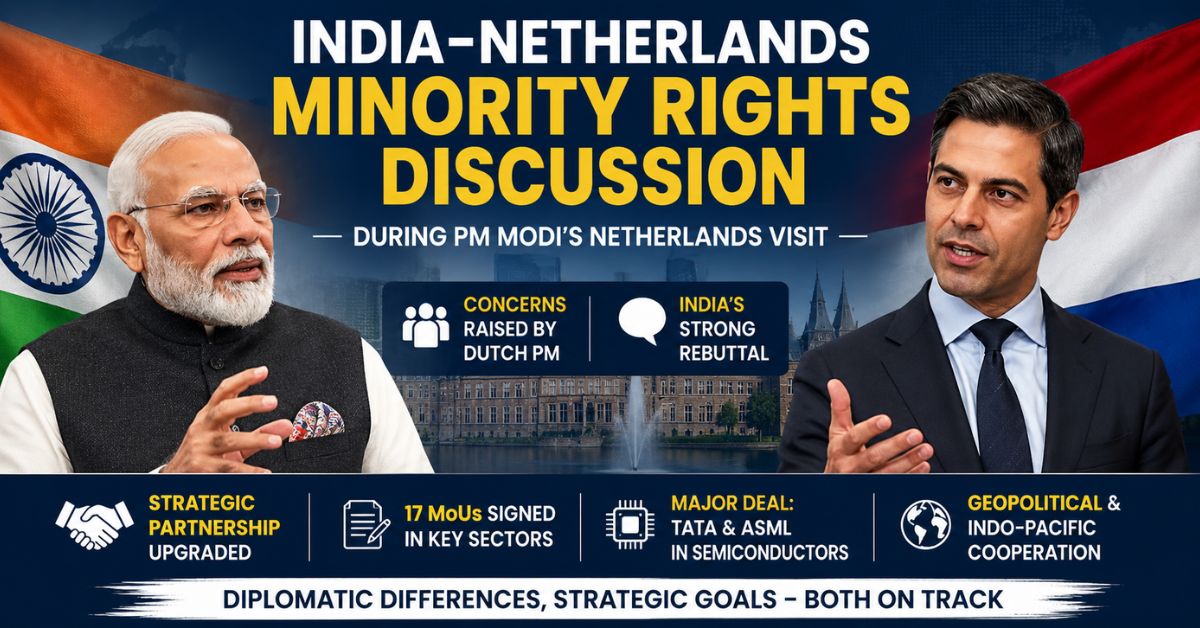
- PM Modi’s May 2026 visit to the Netherlands triggered a diplomatic exchange over minority rights and press freedom concerns.
- Dutch PM Rob Jetten reportedly raised concerns about the condition of minorities and democratic freedoms in India.
- India strongly rejected the criticism, calling it a misunderstanding of India’s democracy and civilizational history.
- Despite the disagreement, India and the Netherlands upgraded ties to a Strategic Partnership and signed 17 agreements.
- Semiconductors, green energy, mobility agreements, and Indo-Pacific cooperation emerged as major outcomes of the visit.
Prime Minister Narendra Modi’s visit to the Netherlands in May 2026 was expected to focus mainly on trade, semiconductors, green energy, water management, and India-Europe strategic cooperation. Instead, the trip also became the center of an international discussion on minority rights, democratic values, and press freedom in India.
The visit to The Hague ultimately achieved major diplomatic and economic outcomes. India and the Netherlands upgraded their bilateral relationship to a formal “Strategic Partnership,” adopted a five-year roadmap for cooperation, and signed 17 agreements across several sectors. However, the summit also produced an unusual public exchange after Dutch Prime Minister Rob Jetten reportedly raised concerns about minorities and media freedom in India before his official meeting with Prime Minister Narendra Modi.
The Indian government strongly rejected those concerns, calling them based on a “lack of understanding” of India’s democratic structure and civilizational history. The exchange quickly became one of the most discussed political aspects of the India-Netherlands summit and has now become a major topic in searches related to “India Netherlands minority rights discussion.”
What Triggered the India-Netherlands Minority Rights Discussion
The controversy emerged shortly before bilateral talks between the two leaders in The Hague. According to Dutch media reports referenced during the visit, Prime Minister Rob Jetten spoke about concerns in Europe regarding developments inside India under the current administration.
The reported comments focused on the condition of minority communities, especially Muslims and smaller religious groups. Jetten reportedly questioned whether India continues to maintain equal rights and inclusive democratic participation for all communities.
The issue became more visible after journalists questioned Indian officials about the absence of a joint press conference between the two leaders. During the media interaction, concerns about press freedom and minority rights were directly raised.
India responded immediately and firmly.
MEA Secretary (West) Sibi George rejected the criticism and argued that the concerns reflected an incomplete understanding of India’s democracy and social structure. According to India’s official response, the country remains a vibrant democracy where debate, criticism, and political participation happen at a massive scale.
India’s Response Focused on Democracy and Demographics
India’s rebuttal during the visit was notable because it combined political, historical, and demographic arguments.
Sibi George highlighted that India’s minority population has increased significantly since independence. He reportedly stated that minorities accounted for roughly 11 percent of the population in 1947 and now constitute more than 20 percent. According to the Indian side, this demographic growth demonstrates that minority communities continue to live and expand within a functioning democratic framework.
India also emphasized its long history of religious pluralism. Officials pointed out that India is the birthplace of four major religions: Hinduism, Buddhism, Jainism, and Sikhism. The government further argued that persecuted communities from different parts of the world historically found refuge in India, including Jewish and Zoroastrian communities.
Another notable part of the rebuttal involved India’s argument on media freedom. During the interaction, Sibi George reportedly referred to India’s 900 million smartphones as “weapons” of public participation. He argued that India’s digital environment allows millions of citizens to openly express views every day, creating what he described as a naturally “noisy democracy.”
The phrase gained significant attention because it attempted to redefine criticism and disorder as signs of democratic participation rather than democratic decline.
India and Netherlands Still Upgraded Ties Despite Public Differences
Despite the diplomatic friction, both countries moved ahead with major strategic agreements.
India and the Netherlands formally elevated ties to a “Strategic Partnership.” The move is considered important because it institutionalizes cooperation in critical sectors for the next five years under the newly adopted “Strategic Partnership Roadmap 2026–2030.”
The roadmap focuses heavily on:
- Semiconductor manufacturing
- Green hydrogen
- Clean energy
- Water management
- Maritime cooperation
- Digital technology
- Trade and investment
- Supply chain resilience
One of the biggest announcements during the visit involved Tata Electronics and Dutch semiconductor giant ASML.
The two companies signed an agreement connected to India’s semiconductor ambitions, particularly the planned semiconductor fabrication facility in Dholera, Gujarat. Prime Minister Modi described the partnership as an important milestone for India’s domestic semiconductor ecosystem.
The agreement drew international attention because ASML is among the world’s most critical semiconductor technology firms. The company’s lithography systems are central to advanced chip manufacturing worldwide.
Why Europe’s Human Rights Concerns Matter for India-EU Relations
The India-Netherlands minority rights discussion also matters because it reflects a broader European conversation regarding India’s democratic trajectory.
Several European political groups and rights organizations have increasingly raised concerns in recent years about:
- Press freedom
- Civil liberties
- Religious polarization
- Internet restrictions
- Political dissent
At the same time, Europe views India as an essential strategic partner because of:
- China-related geopolitical tensions
- Supply chain diversification
- Semiconductor cooperation
- Indo-Pacific security
- Energy transition partnerships
This creates a dual-track relationship. European governments often continue expanding economic and strategic ties with India while simultaneously raising concerns related to democracy and rights.
That balancing act was visible during the Netherlands visit itself.
Publicly, concerns were mentioned in media interactions. Officially, however, the final joint statement used more diplomatic language focused on “shared democratic values,” rule of law, and commitment to the UN Charter.
This difference between public political messaging and formal diplomatic language is common in modern international relations, especially between democratic partners with growing economic dependence on one another.
The Insiya Hemani Case Also Influenced Dutch Public Debate
Another important factor during the visit was the long-running Insiya Hemani case.
Insiya Hemani became a sensitive issue in the Netherlands after allegations that the child was abducted from the country and taken to India several years ago.
The case has remained emotionally charged in Dutch public discussions and is frequently associated with broader debates about legal cooperation, extradition, and judicial processes involving India.
Although the issue was not central to the official summit agenda, it reportedly shaped public and media sentiment surrounding Modi’s visit. In Dutch political discussions, the case often appears alongside debates about rule of law and human rights cooperation.
Other Major Outcomes of PM Modi’s Netherlands Visit
The minority rights debate received extensive media coverage, but several major outcomes from the visit were equally significant.
Return of Chola-Era Artifacts
The Netherlands returned ancient Indian artifacts, including nearly 1,000-year-old Chola-era bronze plates and cultural objects. Prime Minister Modi personally received them during the visit.
The move was viewed as a cultural and diplomatic goodwill gesture between the two countries.
Netherlands Joins Indo-Pacific Oceans Initiative
Prime Minister Rob Jetten also announced Dutch participation in India’s Indo-Pacific Oceans Initiative (IPOI), specifically in the “Capacity Building and Resource Sharing” pillar.
This step reflects increasing European engagement in Indo-Pacific strategic frameworks alongside India.
Migration and Mobility Agreement
India and the Netherlands signed agreements aimed at improving mobility for professionals, students, researchers, and skilled workers.
The Netherlands currently faces labor shortages in technology and engineering sectors, making Indian talent an important economic factor in bilateral relations.
Royal-Level Engagement
Prime Minister Modi also met Willem-Alexander and Máxima at the Royal Palace Huis ten Bosch.
The meeting reinforced the ceremonial and state-level importance attached to India-Netherlands relations despite the political disagreements that surfaced during the trip.
Why the India-Netherlands Minority Rights Discussion Matters Globally
The discussion matters beyond bilateral diplomacy because it reflects a larger global pattern.
India today is simultaneously:
- One of the world’s fastest-growing major economies
- A strategic partner for Western democracies
- A country facing increasing international scrutiny over democratic institutions
Western governments often attempt to balance strategic cooperation with public commitments to human rights and democratic values. India, meanwhile, has consistently maintained that internal social and political matters are sovereign issues that should not invite external commentary.
The Netherlands summit became an example of this wider diplomatic tension.
Even after public disagreement, neither country allowed the issue to derail strategic cooperation. Instead, both governments separated political differences from long-term economic and geopolitical priorities.
That approach is likely to continue in future India-EU engagements, especially as negotiations over trade, technology partnerships, and Indo-Pacific coordination deepen in the coming years.