


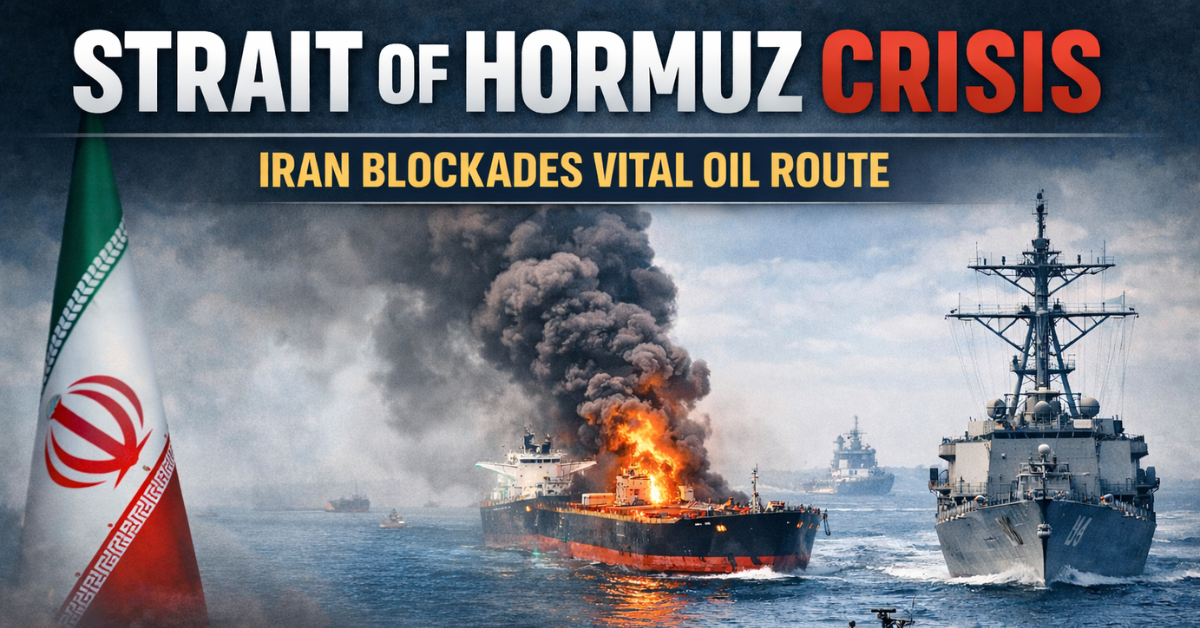
Strait of Hormuz Crisis: Key Points
- Iran’s new Supreme Leader Mojtaba Khamenei vowed on 12 March 2026 to maintain pressure on global shipping by keeping the Strait of Hormuz effectively closed.
- At least 13 commercial vessels have been attacked since late February amid the widening conflict involving Iran, the United States, and Israel.
- Three ships were struck on 11 March, including a Thai-flagged vessel that caught fire after being hit by projectiles, leaving three crew members missing.
- Nearly 500 oil tankers and cargo ships remain stranded across the Persian Gulf as insurers and shipping companies suspend transit through the strait.
- About 20 percent of global oil supply normally passes through the Strait of Hormuz, raising concerns of a global energy shock.
- Oil prices have surged above $100 per barrel as traders anticipate prolonged disruption to Gulf exports.
- India secured safe passage for a crude oil shipment bound for Mumbai after diplomatic engagement between External Affairs Minister S. Jaishankar and Iranian Foreign Minister Abbas Araghchi.
- Security analysts warn the crisis could escalate further if naval mines spread across the shipping lanes or if international naval forces attempt to reopen the strait by force.
The crisis in the Persian Gulf deepened on March 12, 2026, after Iran’s new Supreme Leader Mojtaba Khamenei declared that the blockade of the Strait of Hormuz would continue, framing the move as strategic pressure against the United States and Israel. In his first public address broadcast on Iranian state television since assuming leadership, Khamenei warned that Iran would use the strait as a geopolitical lever while promising retaliation for strikes that killed his father, Ayatollah Ali Khamenei.
The statement comes amid escalating maritime attacks and widespread disruption to one of the world’s most critical shipping lanes, through which roughly one-fifth of global oil supply normally passes. Analysts warn that the confrontation risks transforming the Strait of Hormuz into the most dangerous maritime corridor in the world.
Rising Attacks on Commercial Ships
Maritime authorities reported that three commercial vessels were struck by projectiles in or near the strait on March 11 alone. One of the ships, a Thai-flagged bulk carrier, caught fire after its engine room was hit, forcing the crew to abandon the vessel while rescue teams searched for three missing sailors.
Since late February, at least 13 ships have been damaged or targeted across the Persian Gulf and the Strait of Hormuz, with attacks involving missiles, drone boats, and suspected naval mines. Some incidents have occurred dozens of nautical miles away from the narrow passage, indicating that the conflict has begun spreading into the wider Gulf.
Insurance companies have declared the region a “high risk war zone,” and several global shipping lines have suspended operations in the area after repeated strikes on commercial vessels. Danish shipping giant Maersk and other carriers halted transit through the strait as companies began rerouting cargo around Africa despite the longer journey.
Shipping Gridlock in the Persian Gulf
The maritime crisis has created a severe traffic backlog across Gulf ports. Industry estimates suggest nearly 500 oil tankers are currently stranded or delayed, while around 20,000 seafarers remain aboard vessels unable to safely exit the Persian Gulf.
Traffic through the strait has collapsed sharply since the conflict began on February 28. Ship tracking data indicates that tanker movements initially fell by roughly 70 percent and then nearly halted entirely as the threat of missile strikes and sea mines increased.
Several countries have begun emergency diplomatic efforts to secure passage for their energy supplies. India, one of the largest importers of Gulf crude, recently secured safe passage for a crude shipment headed to Mumbai after discussions between External Affairs Minister S. Jaishankar and Iranian Foreign Minister Abbas Araghchi.
Global Energy Markets on Edge
The disruption has sent shockwaves through global energy markets. Brent crude oil prices surged past $100 per barrel as traders priced in the risk of a prolonged closure of the strait. Stock markets in several countries also fell sharply amid fears that the crisis could trigger a broader energy shock reminiscent of the oil crises of the 1970s.
The Strait of Hormuz is a narrow waterway only about 34 kilometers wide at its narrowest point but carries approximately 20 million barrels of oil per day. Much of this supply originates from Saudi Arabia, Iraq, the United Arab Emirates, and Qatar before heading to Asian markets including India, China, Japan, and South Korea.
Military Risks and Strategic Calculations
Iran’s Islamic Revolutionary Guard Corps has warned that vessels belonging to countries aligned with Washington could be targeted if they attempt to pass through the strait. Meanwhile, U.S. officials have acknowledged that naval forces are not yet prepared to provide full escort protection for tankers moving through the region, underscoring the risks facing commercial shipping.
Security analysts believe Iran is using a mix of asymmetric naval tactics to maintain pressure in the Gulf. These include sea mines, remote-controlled explosive boats, missile strikes, and drone attacks launched from coastal positions. Such methods allow Tehran to disrupt shipping without deploying large conventional naval forces.
Possible Next Phase of the Crisis
Experts warn that the situation could evolve in several directions. If Iran expands attacks on tankers or begins systematically mining the strait, international naval coalitions may attempt to reopen the corridor by force. That scenario would risk direct confrontation between Iranian forces and U.S. naval fleets stationed in the Gulf.
Another possibility is a partial reopening of the strait under selective conditions. Earlier signals from Iranian officials suggested that vessels from certain countries, particularly those not aligned with Western military operations, could be allowed to transit under strict monitoring.
For now, the strait remains technically open but effectively closed due to the security risks. With shipping insurers withdrawing coverage and carriers suspending voyages, the disruption has already become one of the largest threats to global energy supply in decades.