


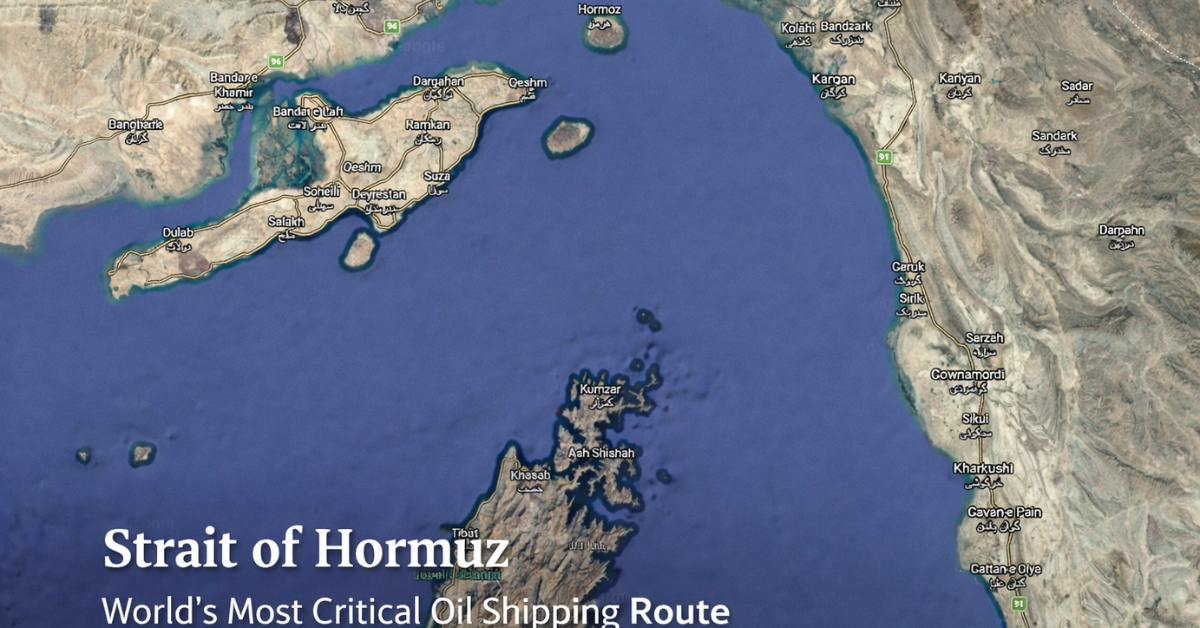
The Strait of Hormuz, a narrow channel between Iran and Oman, stands at the center of the global energy system. Though geographically small, the passage functions as the only maritime gateway linking the Persian Gulf to the open waters of the Gulf of Oman and the Arabian Sea, allowing oil and gas exports from the Gulf’s major producers to reach markets across Asia, Europe, and beyond.
Strait of Hormuz: Key Facts
- The Strait of Hormuz connects the Persian Gulf with the Gulf of Oman and the Arabian Sea.
- The passage lies between Iran in the north and Oman’s Musandam Peninsula in the south.
- At its narrowest point the strait measures roughly 33 kilometers wide.
- About 17 to 20 million barrels of oil pass through the strait every day.
- Nearly one fifth of global oil consumption depends on this corridor.
- Iran controls several strategic islands near the shipping lanes.
- Escalating tensions in March 2026 disrupted shipping after Iranian retaliation in the wider war.
| Event | Date | Key Development |
|---|---|---|
| Regional Airstrikes Begin | 28 Feb 2026 | United States and allied forces strike Iranian nuclear and military sites. |
| Iranian Leadership Crisis | 28 Feb – 1 Mar | Reports emerge that Supreme Leader Ayatollah Ali Khamenei was killed during the early strikes. |
| Threat to Close Strait | 2 – 4 Mar | Iranian officials warn that shipping through the Strait of Hormuz could be blocked. |
| Attacks on Shipping | 5 – 7 Mar | Commercial vessels report drone and missile threats near the strait. |
| Traffic Collapse | 8 – 10 Mar | Daily tanker movements fall sharply as shipping companies suspend routes. |
| Global Energy Shock | 10 Mar – Present | Oil prices surge as governments prepare emergency energy responses. |
A Narrow Passage with Global Reach
The Strait of Hormuz forms one of the most strategically important waterways on Earth. Located between Iran’s southern coastline and the mountainous Musandam Peninsula of Oman, the channel stretches for roughly 160 kilometers while narrowing sharply at several points. The tightest section measures about 33 kilometers across, forcing international shipping traffic into two controlled navigation lanes.
Despite its limited width, the strait remains deep enough for the largest oil tankers operating in the global energy trade. Maritime authorities organize ship movement through two narrow lanes separated by a safety buffer. Much of this regulated traffic passes through waters internationally recognized under Omani jurisdiction, even though Iran occupies the northern side of the channel.
Iran’s influence over the waterway extends beyond its coastline. Tehran controls several islands positioned near the shipping corridor, including Abu Musa and the Greater and Lesser Tunb islands. These positions allow Iranian naval forces to observe vessel movement and project military power across the narrow passage.
The World’s Most Important Energy Corridor
Energy analysts frequently describe the Strait of Hormuz as the most important oil chokepoint in the global economy. Each day an estimated 17 to 20 million barrels of crude oil pass through the corridor. This volume represents roughly one fifth of worldwide petroleum consumption and an even larger share of global seaborne oil trade.
Major exporters that depend on the passage include Saudi Arabia, Iraq, Kuwait, the United Arab Emirates, and Iran itself. Qatar also relies on the strait to ship large quantities of liquefied natural gas to markets across Asia and Europe. Because the Persian Gulf has no alternative maritime exit, almost all of these exports must move through the narrow channel before reaching international waters.
For major importers such as India, China, Japan, and South Korea, the stability of this route is central to national energy security. A disruption lasting even a few weeks can place immediate pressure on global oil prices and shipping insurance costs.
Escalation in the 2026 Iran War
The importance of the strait became evident again in early March 2026 as military conflict expanded across Iran and the wider Persian Gulf region. The crisis followed a series of coordinated airstrikes by United States and allied forces targeting Iranian nuclear and military infrastructure. The attacks triggered widespread retaliation and raised fears of a broader regional war.
Iranian authorities soon warned that continued strikes on Iranian territory could lead to a closure of the Strait of Hormuz. Officials from the Islamic Revolutionary Guard Corps stated that shipping could be halted if the country’s security or sovereignty came under sustained attack.
Within days of these warnings, commercial vessels operating near the corridor began reporting drone activity and missile threats. Several ships altered course while others delayed departure from Persian Gulf ports. Insurance premiums for tankers operating in the region rose sharply as shipping companies reassessed the risks of entering the strait.
Shipping Disruption and Market Shock
Under normal circumstances more than one hundred vessels transit the Strait of Hormuz each day, including large oil tankers carrying crude from Gulf export terminals. During the early days of the 2026 crisis, maritime tracking data showed a steep decline in traffic as shipping companies diverted vessels or suspended voyages.
The sudden disruption created immediate pressure in global energy markets. Oil prices climbed rapidly as traders anticipated potential shortages. Governments in major importing nations began discussing emergency energy measures, including the possible release of strategic petroleum reserves.
Energy producers inside the Persian Gulf also faced logistical challenges. Some countries attempted to redirect exports through pipelines connected to ports on the Red Sea, but those systems can handle only a limited portion of the region’s normal oil output.
A Waterway with a Long History of Conflict
The Strait of Hormuz has served as a commercial trade route for centuries. Historical accounts describe merchant vessels transporting goods from the Persian Gulf and the Arabian Sea toward markets in India, Central Asia, and the eastern Mediterranean. Even during earlier periods of empire, the narrow channel was recognized as a vital link between regional economies.
Modern tensions surrounding the strait intensified during the Iran–Iraq War of the 1980s, when both countries targeted oil tankers in what became known as the Tanker War. The attacks threatened global oil shipments and prompted the United States Navy to escort commercial vessels through the region.
Similar confrontations emerged again in 2011 and 2019, when Iranian authorities threatened to block the waterway during disputes with Western governments. Despite those tensions, the strait remained open to international shipping until the current conflict raised the possibility of an extended disruption.
A Strategic Pressure Point for the Global Economy
The events of 2026 have once again demonstrated how a narrow geographic corridor can influence the stability of the global economy. With a large share of the world’s oil and gas supply moving through a passage only a few dozen kilometers wide, the Strait of Hormuz remains one of the most sensitive strategic locations in international politics.
As military forces continue to gather across the Persian Gulf and diplomatic negotiations unfold, the future of the strait will play a decisive role in determining whether the current regional crisis remains contained or evolves into a wider disruption affecting global trade and energy supplies.